
Circuit Board Robot Arm
4.2Editor score
Wooden construction with circuits
Motorized and microcontroller-based
Suitable for ages eight and up
Robotic arm kits vary widely in controls, degrees of freedom, materials, and complexity; this expert guide compares 10 options for learners today.
Robotic arm kits turn mechanical movement, electronics, and programming into a hands-on project. A satisfying kit should match the builder’s experience, offer meaningful control options, and provide clear instructions without making the experience feel like a test. The best models also encourage experimentation after assembly.
We compared all ten kits by examining their stated degrees of freedom, construction materials, control systems, programming capabilities, intended age ranges, and supporting resources. The list covers simple wooden projects, hydraulic toys, app-controlled systems, Arduino platforms, tracked vehicles, and an advanced open-source AI arm.
Each review identifies the features that set one kit apart while noting practical limitations, such as required batteries, separate sensor modules, or a demanding build. Ratings and availability can change, and prices fluctuate, so readers should confirm current details and bundle contents before purchasing.
4.2Editor score

4.6Editor score
4.3Editor score
The following comparison covers the major differences among these robotic arm kits, including their movement systems, control methods, construction, and intended level of complexity.


The TEACH TECH Hydrobot Arm is a mechanical building kit that teaches how hydraulic pressure can produce controlled movement. It carries a 4.5 rating, and its most unusual strength is that it operates with water rather than batteries. Builders work with a six-axis arm that can rotate up to 270 degrees, offering a direct and visually intuitive way to explore mechanical engineering.
We may earn a commission when you buy through this link, at no additional cost to you.
Its controls operate the gripper through levers, allowing the user to open, close, and manipulate objects. The gripping section can also be replaced with suction components, which broadens the types of activities and challenges that can be attempted. Because the project is assembled rather than supplied ready to play, it also develops patience, analytical thinking, and familiarity with assembly sequences.
The trade-offs are clear: this is not a programmable electronics kit, so it will not satisfy someone seeking a coding platform. It is also intended for children 12 and older and should be supervised where appropriate. The water-powered mechanism must be handled carefully to prevent spills, and the build itself is expected to take multiple hours. Those constraints are reasonable for buyers specifically seeking a tactile hydraulic project.
Choose this kit for a learner who enjoys mechanical models, wants an electricity-free experience, or is curious about how pressure and levers coordinate movement. It is especially effective as a family build because adults and children can work through the detailed instructions together. Among the kits here, it stands apart for its hydraulic subject matter and unusually broad axis count rather than conventional motor-driven programming.
The water-based system makes cause and effect visible: changing pressure and lever position produces immediate mechanical movement. That physical feedback can help a young builder connect an abstract engineering principle with a working device.
The standard gripper supports basic manipulation, while the supplied suction components invite different experiments. Switching tools also demonstrates how the same arm can be adapted for different tasks.
We may earn a commission when you buy through this link, at no additional cost to you.
This Circuit Board Robot Arm is an approachable introduction to robotics for children, teens, and adults. Its 4.2 rating reflects a kit that combines wooden construction with motors, circuit boards, and a microcontroller. Rather than offering advanced artificial intelligence or elaborate action sequences, it focuses on the fundamentals of assembling a three-dimensional puzzle and seeing electronics produce movement.
We may earn a commission when you buy through this link, at no additional cost to you.
The included electronics teach how circuits can control mechanical components, making the project approachable for a first-time robotics builder. A wooden frame provides visible structural elements, while the assembly tutorial and accessory set help simplify the wiring process. No soldering is required, which lowers the barrier for younger users and for adults working with children.
The principal drawback is that six AA batteries are needed but not included. Users must also expect a more basic experience than app-programmable, multi-axis kits: the main educational value lies in assembly and basic operation rather than advanced coding or camera-based automation. The product listing nevertheless presents it as appropriate for ages eight through fourteen and up, with some flexibility for older beginners.
This is a strong first robotic arm for someone seeking an inexpensive, hands-on introduction to circuits and mechanics. It is well suited to a birthday gift, classroom activity, or weekend project, particularly when a family wants to explore STEM together. Buyers should buy batteries at the same time and verify that the current package contains all required motors, boards, and wires before beginning.
Motors, wires, and a microcontroller introduce the relationship between electrical signals and physical movement. The project makes core robotics concepts tangible without assuming advanced coding experience.
Wooden pieces provide a satisfying three-dimensional assembly challenge. The resulting structure gives users something displayable while reinforcing careful construction and troubleshooting habits.
We may earn a commission when you buy through this link, at no additional cost to you.
The VANLINNY 4DOF Robot Arm is a well-rounded educational robotics kit with a 4.6 rating. It combines a durable metal structure, four-axis movement, simple programming, and remote operation in a package aimed primarily at children eight to twelve and older teens. Its balance of hardware quality, accessible controls, and included accessories makes it the most versatile choice for many households.
We may earn a commission when you buy through this link, at no additional cost to you.
The arm can move through multiple angles, raise and lower its gripper, and simulate operational sound effects. Programming allows users to sequence actions, adding a coding element without making the system overwhelmingly complex. A remote control with a stated operating range of 30–50 meters adds a more playful and interactive dimension, particularly useful for demonstrations or obstacle-based activities.
The included battery, USB charging cable, tools, and remote reduce the chance that essential accessories will be missing on opening day. Metal construction is a meaningful advantage over wooden kits when durability matters. On the other hand, the relatively simple programming system will not satisfy an advanced developer seeking a full software development environment or sophisticated vision capabilities.
This kit works well for a child who is ready to progress beyond a basic wooden circuit project but does not yet need a full desktop robotics platform. It also suits parents seeking a gift that can be built, programmed, and demonstrated in several ways. For those priorities, its combination of metal construction, wireless control, and approachable programming makes it the strongest all-around recommendation in this roundup.
A metal frame gives the arm a more substantial feel and better resistance to wear than a basic wooden structure. It is well suited to repeated demonstrations after the initial assembly.
Simple action programming lets younger builders learn sequencing and control logic. The interface offers a meaningful bridge between a conventional remote-controlled toy and a more technical robotics platform.
We may earn a commission when you buy through this link, at no additional cost to you.
The 3-in-1 Technical Robotic Arm is a large, feature-rich construction kit with a 4.8 rating, the highest customer score among the products reviewed. It combines 975 ABS pieces, a tracked chassis, an articulated arm, three interchangeable attachments, a remote controller, and app control. The result is less like a simple desktop model and more like a configurable miniature engineering platform.
We may earn a commission when you buy through this link, at no additional cost to you.
The included gripper, bucket, and simulated drill bit let the user tackle different missions with the same core model. Four motors independently operate tracked driving, arm lifting, and attachment movement. App functions expand the experience through drag-and-drop programming, gyroscope steering, and custom path drawing, allowing users to explore sequencing, cause and effect, and spatial navigation.
Its size and piece count create a substantial build commitment. Some users may also find the app modes less compelling if they prefer direct manual control, and compatibility with the intended mobile device should be confirmed beforehand. The completed model measures approximately 15 by 7.9 by 12 inches, so buyers should also consider workspace and display space.
This is a strong choice for a teen or adult who wants a construction project with repeated configurations rather than a single-purpose arm. The three attachments, mobile base, and programming modes provide exceptional replay value. It may be too involved for a younger child working alone, but it can become a rewarding parent-child build, birthday project, or centerpiece for a home robotics club.
A gripper, bucket, and drill bit change the arm’s practical role without requiring a completely new robot. That modularity makes the platform feel more like a miniature construction vehicle.
Drag-and-drop sequences, gyroscope input, and drawn paths offer distinct ways to control movement. Each mode reinforces a different concept, from logical ordering to spatial awareness.
We may earn a commission when you buy through this link, at no additional cost to you.
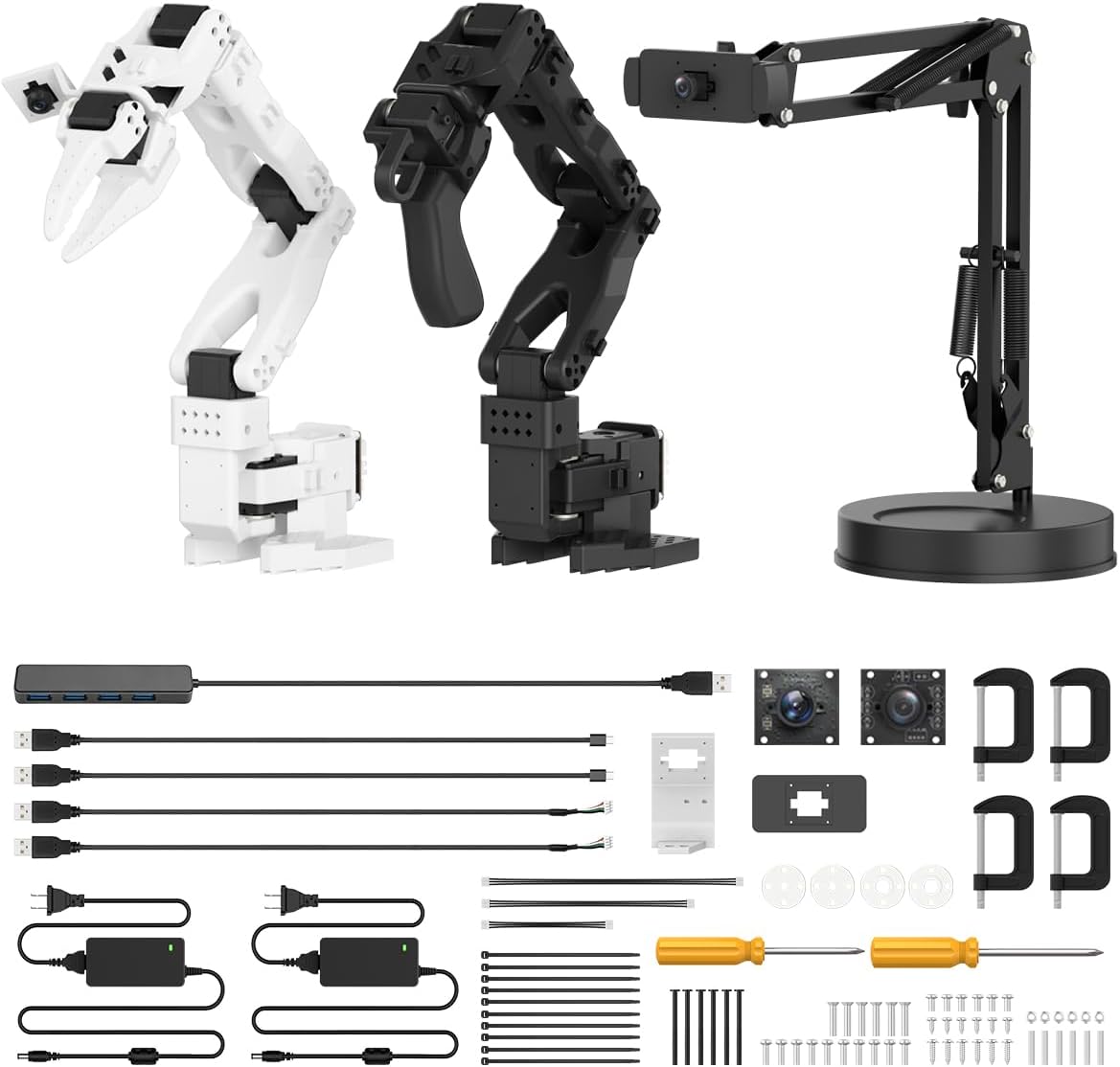
The Hiwonder SO-ARM101 is the most specialized robotic arm in this roundup. It is an assembled six-axis platform designed for embodied imitation learning and compatibility with the LeRobot open-source framework. Its 4.3 rating reflects a technically ambitious product aimed more directly at AI researchers, advanced hobbyists, and experienced robotics learners than at children seeking a simple toy.
We may earn a commission when you buy through this link, at no additional cost to you.
Twelve high-torque bus servo motors with magnetic feedback support smooth and stable movement while supplying useful position-related information. The dual-camera arrangement places one camera on the gripper and another externally, supporting both precise manipulation and broader awareness of the surrounding environment. Together, these features support experiments in collecting demonstrations and teaching movement behavior.
The Hiwonder BusLinker V3.0 debugging board adds servo scanning, real-time status monitoring, trajectory control, calibration, and PC-based debugging. That depth of instrumentation is a major advantage for technical users, but it also means the kit is not an effortless gift for a beginner. Software setup, calibration, and familiarity with open-source development workflows should be considered before buying.
Choose the SO-ARM101 when the goal is genuine AI experimentation rather than casual interactive play. It is well suited to researchers, university students, and serious makers who value the supplied 3D-printed part, assembled construction, and LeRobot compatibility. The investment is most compelling when the buyer already has a computer and some familiarity with robotics workflows.
The gripper-mounted and external cameras provide complementary views of the arm and its environment. This dual setup supports research workflows in which recorded human or guided movements become learning data.
Magnetic feedback servos improve the platform’s ability to report motion state accurately. The 12-motor arrangement also distributes the demands placed on individual joints during articulated movement.
We may earn a commission when you buy through this link, at no additional cost to you.
The Arduino miniArm is a five-axis educational robotic arm with a 4.6 rating and a clear focus on development. It runs on the Atmega328 platform, supports Arduino programming, and includes open-source programs, learning tutorials, and secondary-development examples. This makes it especially attractive to users who want to write or adapt code rather than simply operate a finished model.
We may earn a commission when you buy through this link, at no additional cost to you.
Its hardware includes a six-channel knob controller, Bluetooth module, high-precision digital servos, and several expansion ports. The listed sensor ecosystem includes an ESP32 camera module, accelerometer, touch sensor, and glowing ultrasonic sensor, enabling projects involving ranging, touch response, pose detection, and other inputs. App control and offline action editing add alternative ways to operate the arm.
The exact contents differ by package: the starter configuration excludes the glowing ultrasonic, touch, acceleration, and ESP32 camera modules, while the standard configuration includes those additions along with a Type-C cable and four-pin wire. Buyers should therefore choose the package according to the sensors they actually want rather than relying on a generic description of the arm.
This is a compelling option for a teen, student, or adult ready to move beyond a fixed educational exercise. It offers more genuine development potential than a basic toy, while remaining less specialized than an advanced imitation-learning system. It is best for Arduino users who want to experiment with sensors, modify sample programs, and gradually build a more capable project.
Open-source programs and secondary-development examples lower the barrier to modifying behavior. Learners can study the existing code, change movement logic, and connect the arm to additional inputs.
Expansion ports allow the arm to respond to touch, distance, orientation, and camera input. These additions can turn a basic movement platform into a more interactive and experimental system.
We may earn a commission when you buy through this link, at no additional cost to you.
LewanSoul’s LeArm is a six-degree-of-freedom desktop robot arm designed for grasping, transport, custom actions, and graphical programming. Its 4.2 rating fits a system that combines a capable physical platform with a broad selection of control methods. The kit is positioned for students, engineers, university courses, and committed robot enthusiasts.
We may earn a commission when you buy through this link, at no additional cost to you.
The arm uses six digital servos and metal brackets, with high-torque base servos and industrial-grade bearings contributing to stability. Three end-of-arm servos include anti-blocking protection and gear clutches intended to extend servo life. A mechanical claw supports hands-on manipulation experiments, while tutorials and programming software help users create repeatable actions.
Control can come through PC software, a mobile app, a mouse, or a wireless handle. That flexibility is useful during development because it allows a user to begin with direct commands and progress toward recorded action sequences. The downside is that having several interfaces can make setup less streamlined, and computer-based programming demands more attention than a simple remote-control kit.
Buyers who want a capable desktop arm without moving into camera-based artificial intelligence will find this model flexible and approachable. It suits a learner interested in bionic robotics, a classroom demonstration, or a maker who values both direct control and graphical programming. The mechanical claw and robust bracket design also make it more engaging than basic display models.
PC, app, mouse, and wireless-handle inputs support both casual operation and development. Users can choose the interface that best fits the current stage of their project.
Anti-blocking servos and geared clutches help the end mechanism resist stalls and reduce strain. That protection is particularly relevant when the arm encounters resistance while grasping.
We may earn a commission when you buy through this link, at no additional cost to you.
The Wooden Circuit Robot Arm is designed as a friendly introduction to real robotic movement for ages eight to twelve and older users. It carries a 4.2 rating and includes motors, a microcontroller, and circuit boards inside a natural wooden structure. Full 270-degree rotation and multi-axis control make it more mechanically expressive than a very basic craft kit.
We may earn a commission when you buy through this link, at no additional cost to you.
Step-by-step instructions and recognizable wooden parts provide a satisfying construction process. The finished arm can lift, steer, and rotate, allowing users to see how electronic commands become physical action. The build can also support family STEM nights, classroom rewards, and parent-child projects, where assembly and troubleshooting are as valuable as the final movement.
Wood is appealing and easier to handle than metal, but it may not tolerate the same punishment as an industrial-grade frame. The electronics deliver an introductory experience rather than sophisticated autonomous behavior, and buyers looking for advanced coding, sensors, or camera input should choose a more technical platform. The product is better understood as a well-rounded entry kit than an advanced developer system.
This model makes sense for younger builders, families introducing robotics, or anyone who prefers a warmer, craft-oriented appearance. It provides enough complexity to remain interesting while keeping the presentation approachable. Confirm the current package contents and battery requirements before ordering, and allow enough time to assemble it carefully rather than rushing the first movement test.
Wooden components make robotics feel more like a construction set than an opaque piece of electronics. Seeing the structure take shape can help younger builders understand how parts support one another.
The arm’s 270-degree rotation makes its working range easy to demonstrate. Combined with lifting and steering functions, it supports several basic manipulation challenges.
We may earn a commission when you buy through this link, at no additional cost to you.
The ACEBOTT 4-in-1 Smart Robot combines a five-degree-of-freedom programmable arm with a base robot car, tank-track expansion, and combined tank configuration. Its 4.1 rating reflects a kit that prioritizes modular construction, guided coding, and varied play. It is especially relevant to older children and teens who want to move from one fixed robot model to a configurable platform.
We may earn a commission when you buy through this link, at no additional cost to you.
The ESP32 controller supports Arduino and Scratch compatibility, while 16 story-based tutorials and HD assembly videos help users work through construction and coding. The robotic arm can grasp, lift, and place objects, and the rubber tracks are designed to handle grass, gravel, slopes, and carpet. This means the kit can function as an educational arm, an exploration vehicle, or a combined robot with more ambitious movement.
The modular approach adds complexity because a build may involve many more parts than a desktop arm. Beginners must also follow the ACEBOTT official website resource path for tutorials and assembly videos, making internet access helpful. A lower 4.1 rating than many alternatives suggests some variability in user experience, although the stated feature set is extensive for the intended age group.
Choose this kit for a teen who likes both coding and physical experimentation. It offers a stronger sense of real-world engineering than a stationary educational arm because the same components can become a car, a tracked robot, or a mobile manipulator. It is a strong fit for home learning, classroom demonstrations, and STEM programs where a versatile robot can support multiple lessons.
The base car, track expansion, arm, and combined configuration show how shared components can support different designs. That flexibility encourages builders to think about mechanical trade-offs rather than follow one fixed outcome.
Arduino and Scratch compatibility allow the robot to progress from block-style logic toward text-based programming. Sixteen guided tutorials provide a structured route through the larger system.
We may earn a commission when you buy through this link, at no additional cost to you.
The Hiwonder xArm1S is a full-metal, six-axis desktop robotic arm designed for grasping, transport, custom actions, and graphical programming. Its 4.0 rating makes it the lowest-rated product in this group, but the specification set remains substantial. It appeals most to established learners who want a polished physical arm with several programming and control paths.
We may earn a commission when you buy through this link, at no additional cost to you.
Six intelligent serial-bus servos report position, voltage, and temperature information, giving users more insight into the mechanism than basic servo systems provide. The listed gripping capacity reaches 500 grams, while aluminum alloy brackets, high-torque base servos, and industrial-grade bearings create a stable structure suited to repeated tabletop experiments.
The arm can be operated through a PC, phone app, mouse, wireless PS2 controller, or fingertip-oriented action controls. Offline manual editing and interface-based action editing support custom routines. This flexibility is a major strength for experimentation, although it can also make the system seem complicated to a person who has never used a desktop robot arm.
This is a worthwhile choice for students, engineering learners, and adults who want a durable desktop platform with meaningful control options. It is less suitable for a child seeking a simple one-button toy or a compact gift that can be assembled quickly. Buyers should consider the available desk space, assembly time, and computer or mobile compatibility before committing.
Position, voltage, and temperature feedback gives builders more information about the arm’s behavior. That visibility can help with troubleshooting and more precise control routines.
PC software, phone control, mouse operation, a wireless PS2 controller, and editable actions offer distinct interaction styles. The range supports both immediate manipulation and structured programming.
We may earn a commission when you buy through this link, at no additional cost to you.
The right robotic arm kit depends on the builder’s age, patience, preferred learning style, and desired control complexity. These factors help separate simple mechanical toys from programmable platforms built for serious experimentation.
Degrees of freedom indicate how many independent directions the arm can move. A three- or four-axis model is usually easier for beginners to understand, while five- and six-axis systems can reproduce more complex motions and reach around obstacles. The TEACH TECH Hydrobot Arm offers six axes with rotation up to 270 degrees, whereas several desktop kits use four or five degrees of freedom. Compare the movement range with the intended tasks rather than assuming a higher number is always better.
Choose fewer axes for straightforward lifting, rotating, and grasping. Choose five or six axes when reaching around objects, imitating human movement, or experimenting with more advanced manipulation matters.
A robotic arm that must be assembled can be educational, but the number of pieces and procedures affects who can realistically complete it. A wooden circuit arm may be manageable for an older child working with help, while a 975-piece tracked model or specialized six-axis platform is better suited to a patient teen or adult. Check whether the listing includes clear instructions, assembly videos, required tools, and a realistic estimate of the build.
Match the project to available time and assistance. Longer builds are more satisfying when they produce a model with meaningful post-assembly features rather than a static display.
Remote-only control is engaging for straightforward play, while app, PC, mouse, wireless-controller, and offline action controls support more experimentation. Scratch can make coding approachable, Arduino offers a direct path into text-based development, and an open-source AI framework supports research-oriented imitation learning. Check whether the app works with the buyer’s operating system and whether PC software or internet access is required for tutorials.
Select the least complex interface that supports the intended learning goal. A beginner can move up to advanced coding later, but an advanced platform may be frustrating without that foundation.
Wood offers a friendly appearance and straightforward assembly, metal provides rigidity and a more industrial feel, and ABS construction can support large modular models. The intended environment matters: a desktop arm is handled gently, while a tracked robot may encounter grass, carpet, gravel, and slopes. Review the stated material, gear protection, bearings, and anti-stall features to determine whether the design suits repeated use.
For light indoor projects, appearance and ease of assembly may matter most. For mobile or frequently handled robots, structural strength and motor protection deserve greater attention.
Power requirements can affect convenience and ongoing use. The TEACH TECH Hydrobot Arm uses water rather than batteries, while many electronic kits require AA batteries, a rechargeable battery, or a USB connection. Some packages include a charging cable, remote, tools, and sensor modules, while others require separate purchases. One listed kit specifically requires six AA batteries that are not included, so users should plan for that accessory immediately.
Verify the complete packing list rather than assuming every advertised feature is in the box. Included power equipment and tools can make a kit much easier to begin using.
Published age ranges are useful but not definitive. Children may need help with precise alignment, wiring, or software setup even when a kit is labeled for their age. Younger builders generally benefit from wooden pieces, a simple remote, and immediate visible movement. Teenagers may handle Arduino or Scratch projects, while adults can work with cameras, servo debugging, and imitation-learning frameworks.
Use the age label as a starting point and also consider the child’s tolerance for detailed instructions. An overly advanced model can be discouraging, while an overly simple kit may lose interest quickly.
A kit that accepts additional sensors can grow from a basic movement demonstration into an interactive project. Listed expansion options include touch, ultrasonic ranging, acceleration, camera, and Bluetooth capabilities. Modular robotic platforms can also change into a car, tank, tracked vehicle, or arm-equipped robot. Expansion is valuable when the buyer wants a system that remains engaging after the first successful build.
Check compatibility and package contents before planning a sensor project. An empty port does not guarantee that the required module, cable, or software support is included.
The tool at the end of the arm determines many of its practical uses. A basic claw supports picking and placing, suction cups can handle flatter objects, and a bucket or simulated drill creates role-specific missions. The 3-in-1 Technical Robotic Arm includes all three approaches, while the TEACH TECH kit offers a gripper and suction alternatives. Consider whether the goal is simple manipulation, classroom demonstrations, or repeated engineering scenarios.
Interchangeable tools usually create more long-term value than a single fixed attachment. They also help builders understand how mechanical design changes behavior.
Begin with a clear work area, lay out the components, and read the complete instructions before joining parts. Keep small pieces away from children and pets, and use a stable surface with enough room for the arm’s full range of motion. For electronic kits, install the specified batteries or connect the correct power source before testing the motors. If the kit includes multiple configurations, complete and test the basic build first before adding tracks, tools, or sensors.
Operate the arm with reasonable loads and avoid forcing a joint when it reaches a mechanical limit. Test each axis independently, then combine movements slowly to learn the control scheme. When programming, create short routines before adding complicated sequences, and save working examples so a faulty experiment does not erase a successful program. If a model uses an app, confirm compatibility before assembly and keep the mobile device charged during longer demonstrations.
Store powered robotic arms with joints supported and mechanisms free from unnecessary strain. Wipe wooden or metal surfaces with a dry cloth, keep water away from electronics, and remove batteries from kits that will not be used for an extended period. Check gears, screws, servo connections, and rubber tracks periodically. For kits with interchangeable tools or expansion sensors, store each component separately and reconnect them only when fully powered down.
The right age depends more on the controls and assembly difficulty than on the label alone. Younger children generally do well with wooden kits, simple remotes, and adult help, while teens can handle app-based programming, Arduino, and modular tracked builds. Advanced desktop and AI arms are best for students, adults, or researchers with computer and electronics experience.
Some include simple preset action programming, while others support graphical programming, Scratch, Arduino, or open-source AI frameworks. A kit with only a remote control can still teach mechanical and electrical concepts, but it will not provide the same coding experience as a programmable model. Check the stated control methods before choosing for a programming-focused goal.
Not necessarily. Six-axis arms can reach around obstacles and imitate a wider range of motions, but they are generally harder to assemble, calibrate, and program. A four- or five-axis model is often easier to master and still supports meaningful grasping and movement tasks. Beginners should prioritize clear instructions and manageable software.
That depends on the servos, structure, gripper, and intended load. The Hiwonder xArm1S is listed as able to grasp objects up to 500 grams, while many educational kits are designed for lighter items. Always follow the manufacturer’s limits and test with progressively heavier objects, because excess strain can stress the gears, servos, or gripper.
Wood can be perfectly durable for careful indoor projects and is often easier for young builders to handle. Metal is generally better for heavy use, repeated manipulation, and mobile applications, while large ABS kits can also withstand substantial handling. The right material depends on the environment and how roughly the model will be used.
Common omissions include AA batteries, screwdrivers, assembly materials, or optional sensor modules. One listed wooden circuit arm specifically requires six AA batteries that are not included, and the Arduino miniArm’s starter package excludes four listed sensors. Review the package contents carefully and compare the starter and standard configurations before buying.
Yes, but classroom use benefits from kits with clear instructions, reproducible programs, and enough robustness for multiple sessions. The ACEBOTT model offers guided tutorials, while the miniArm provides open-source examples and sensor expansion. Teachers should also check device compatibility, available work area, and whether a class will assemble one kit or share a completed model.
Most can be moved manually after assembly, but the depth of programming varies widely. Some have remote controls and preloaded actions, while programmable models require a sequence to be created before performing a repeatable task. The more advanced the software, the more likely it is that users will need a computer, compatible mobile device, and some setup guidance.
The best overall option for many families is the VANLINNY 4DOF Robot Arm because it combines a durable metal structure, four-axis movement, simple programming, wireless control, and included accessories. The Circuit Board Robot Arm is a budget-friendly introduction for a first electronics build, while the Hiwonder SO-ARM101 stands apart as the premium choice for AI experimentation, dual-camera vision, and open-source imitation learning.
Prioritize the learning objective before the number of features. Younger builders benefit from accessible instructions and immediate movement, teens may prefer Scratch, Arduino, or modular configurations, and advanced makers may want servo feedback, sensor ports, and AI frameworks. The most satisfying kit is not always the most advanced one; it is the one whose controls and build demands align with the user’s experience.
Before purchasing, confirm the current package contents, battery requirements, software compatibility, and available assembly space. Ratings and product details can evolve, and prices change frequently across retailers and over time. Checking the current listing and manufacturer resources ensures that the selected robotic arm kit delivers the intended experience without unexpected accessory needs.