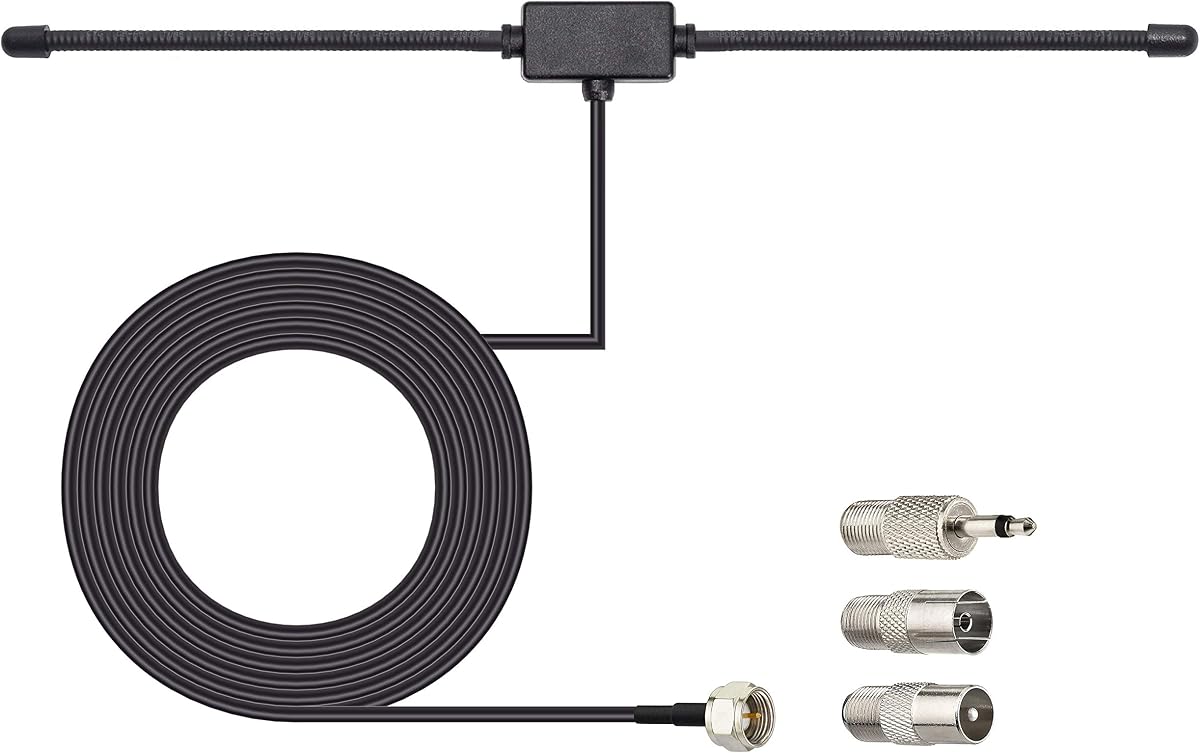
Bingfu Adhesive Dipole Antenna
4.1Editor score
Adhesive wall mounting
Ten-foot coaxial cable
Three connector adapters
Our FM Radio Antenna guide compares 10 indoor and vehicle antennas for connector fit, mounting, cable length, signal reception, and setup ease indoors.
An FM radio antenna can noticeably change reception, particularly when a receiver’s original antenna is missing, damaged, or poorly positioned. The right accessory depends on the receiver connection, available mounting space, cable length, and whether the antenna serves a home stereo, tabletop radio, home theater system, or vehicle.
We compared ten antennas supplied with different connector styles and mounting arrangements, including telescopic antennas, dipole antennas, magnetic-base models, adhesive models, and a concealed vehicle antenna. The list covers products designed for 75-ohm FM connections as well as a 300-ohm bare-wire option, with connector details included for easier comparison.
Each review explains the antenna’s strongest use case, installation considerations, and possible limitations. The top selections stand out for their practical mix of compatibility, placement flexibility, and straightforward setup. Product availability and prices can change, so check the current listing and connector requirements before purchasing.
4.1Editor score

4.2Editor score

4.4Editor score
The table below compares all ten antennas by connection type, mounting approach, reach, and intended application, making it easier to identify the model that matches your receiver and available space.


The Bingfu adhesive dipole antenna is a practical indoor upgrade for a receiver with weak or inconsistent FM reception. It carries a 4.1 rating and stands out for its ten-foot coaxial lead, adhesive wall mounting, and included adapters for several common connections. It is especially useful when an original antenna has been lost or when the receiver sits far from a window.
We may earn a commission when you buy through this link, at no additional cost to you.
Its greatest strength is placement freedom. The long cable allows the antenna to be moved away from the receiver, electronics, and other sources of interference without creating a complicated installation. The product is described as compatible with Yamaha, Sherwood, Pioneer, Panasonic, Onkyo, Sony, and Bose indoor radio systems, although buyers should still verify the socket on their own equipment.
There are some practical limitations. Adhesive mounting may be unsuitable for rented walls, textured surfaces, or locations that need to look pristine, and the ten-foot cable may be less useful in a compact room. As the product guidance notes, reception also depends on installation, location, terrain, weather, buildings, and nearby electronics, so no indoor antenna can guarantee the same result in every location.
This is a compelling choice for listeners who want more installation options than a compact telescopic antenna offers. It is also a sensible budget-oriented replacement for a missing receiver antenna. Buy it when you can place it high on a wall, near a window, or away from disruptive electronics, and confirm that the included adapters match the receiver before installation.
The ten-foot cable is the antenna’s defining advantage. It provides enough separation to move the receiving element away from a stereo chassis, power supply, television, or other electronics that may interfere with reception.
The package includes an F-type plug plus adapters for common TV-style and 3.5 mm connections. Matching the correct adapter before buying prevents the most common source of installation frustration.
We may earn a commission when you buy through this link, at no additional cost to you.
The magnetic-base FM antenna is an adaptable solution for home stereo receivers, home theater systems, indoor radios, and digital HD radio setups. It has a 4.2 rating and combines a retractable antenna with a five-meter, or sixteen-foot, coaxial cable. That combination makes it easy to seek a clearer signal without permanently altering the appearance of a room.
We may earn a commission when you buy through this link, at no additional cost to you.
The magnetic base is the key feature. It can sit on a metal shelf, cabinet, entertainment unit, or another suitable surface, allowing the antenna to be moved as reception conditions change. The retractable element adds another layer of adjustment, while the long cable makes the base placement less restrictive than it would be with a short attached antenna.
Its limitations are predictable. A magnetic base needs a stable metal surface, and the product may be less convenient where no such surface exists. Sixteen feet of cable can also create excess slack in a small room, although excess length can be loosely arranged rather than cut without checking the installation requirements.
This antenna is a strong all-around recommendation for someone who wants convenient access to placement adjustments. It suits a listener who can find a metal surface near a window or high shelf, while the retractable element helps fine-tune the position. For those seeking a simple indoor replacement with a generous cable, it offers an especially balanced package.
Because the antenna can be lifted and repositioned, the user can compare several locations quickly. A high metal surface away from the receiver is often the easiest starting point for indoor experimentation.
The telescoping element lets the user change height or orientation without replacing the entire antenna. Small adjustments can be useful near windows, walls, and electronic equipment.
We may earn a commission when you buy through this link, at no additional cost to you.
The Superbat telescopic antenna kit offers a compact replacement solution for FM and DAB-capable equipment. It has a 4.0 rating and uses a 75-ohm FM dipole design with a type-F male connector. Its folding form is useful for receivers with a nearby FM socket, while the extended antenna can stretch away from the device to improve reception.
We may earn a commission when you buy through this link, at no additional cost to you.
The kit includes an F-female-to-PAL-male adapter, an F-female-to-PAL-female adapter, and an F-female-to-3.5 mm connector. It is listed for use with FM radio, DAB, and AV receivers, including several Sangean, Tivoli Audio, Harman Kardon, Sony, Yamaha, Denon, Teac, Pioneer, Panasonic, Onkyo, Marantz, and Sansui models.
Compared with a long dipole or magnetic model, this antenna has less reach and offers fewer possibilities for moving the receiving element around a room. Its strength is instead portability and simplicity. The included length is approximately 13.5 centimeters before extension and up to 51 centimeters after extension, with steel and brass construction.
Choose this kit when you need a compact replacement, travel between locations, or want to try extending the antenna directly away from a receiver. It is less suitable when reception requires a substantial separation between the antenna and the chassis. Confirming the receiver socket and selecting the proper adapter remains essential.
The folding antenna stores neatly without requiring a permanent mounting point. This makes it suitable for a tabletop radio or a receiver where visual clutter and unused cable would be inconvenient.
With three included adapters and a standard type-F connection, the kit covers several legacy and modern indoor radio arrangements. The extensive compatibility list should still be treated as guidance rather than a substitute for checking your exact model.
We may earn a commission when you buy through this link, at no additional cost to you.
The Ancable telescopic FM antenna provides an extended, metal-bodied option for indoor receivers. It holds a 4.1 rating and is built from brass copper with ten extension sections. The type-F male connector and three included adapters make it relevant to a broad selection of tabletop radios, stereo receivers, and DAB equipment.
We may earn a commission when you buy through this link, at no additional cost to you.
Its main appeal is straightforward installation. Instead of running a long wire across a room, the user screws or plugs the antenna into the receiver and extends it as far as practical. The listing specifically calls out compatibility with Bose Wave, Bose 321, Sangean, Cambridge Audio One, Pure Evoke, Tivoli Audio, Denon, Roberts, Sony, Marantz, Yamaha, Hitachi, Yamaha, JVC, Sherwood, Pioneer, Panasonic, Onkyo, and Sony equipment.
A telescoping antenna cannot offer the placement freedom of a ten- or sixteen-foot cable. If interference originates directly around the receiver, or if the best signal arrives from another part of the room, the user may need to move the entire stereo instead. The model is also built around a 75-ohm F-type male connection, so users with unusual bare-wire terminals should verify compatibility.
This antenna is best for a straightforward replacement that does not require permanent mounting. It suits listeners of tabletop radios and compact stereo systems who want a sturdier, more visible element than a short indoor antenna. Its ten sections provide useful reach, while the adapters broaden the range of devices it can serve.
The ten-section construction provides meaningful antenna length without a trailing cable. That makes it a tidy option for receivers positioned close to a wall or sitting on a crowded entertainment unit.
Brass copper is used for the telescopic body, providing a more substantial alternative to a loose wire antenna. The product also includes a twelve-month warranty for added buyer reassurance.
We may earn a commission when you buy through this link, at no additional cost to you.
The Bingfu magnetic telescopic antenna is the most highly rated option in this guide, carrying a 4.4 rating. It combines a strong magnetic base, a telescopic antenna, and a ten-foot coaxial extension, giving it more placement flexibility than a compact fixed antenna while avoiding the need for permanent wall mounting.
We may earn a commission when you buy through this link, at no additional cost to you.
The package includes an F-type male plug and adapters for a 3.5 mm audio connection plus TV female and male socket connections. It is intended for indoor radio tuners, AV receivers, home theater receivers, Bluetooth-equipped stereo systems, power systems, speaker selectors, and music systems. Pioneer, Onkyo, Yamaha, Marantz, and Sherwood receivers are specifically named.
The main requirement is a suitable metal surface. The included guidance recommends placing the antenna vertically on metal, which can provide a stable, elevated position. However, the listing’s claims should not be interpreted as a guarantee of reception: interference, nearby electronics, building materials, weather, and station transmitter distance can still affect the final result.
This is an excellent general-purpose antenna for someone who values easy repositioning and a longer reach. It works particularly well when a receiver has access to a nearby metal shelf or cabinet that can be moved. The telescopic element permits additional fine-tuning, while the magnetic base makes repeated placement changes fast and uncomplicated.
The 4.4 rating reflects a favorable balance of features. It combines the reach of a cable antenna with the convenience of a movable mounting base and the precision of a telescoping element.
The F-type plug and three supplied adapters cover several likely home-audio connections. Checking the receiver socket first helps avoid a purchase that cannot be connected without another accessory.
We may earn a commission when you buy through this link, at no additional cost to you.
The black version of the Bingfu magnetic telescopic antenna offers the same broad feature set as the standard model, including a magnetic base, a ten-foot coaxial extension, a type-F connector, and three adapters. Its 3.9 rating places it below the leading products in the list, but its physical design remains appropriate for many home audio systems.
We may earn a commission when you buy through this link, at no additional cost to you.
Its black appearance may be the deciding feature for a receiver in a living room, office, or home theater where visible wiring and hardware should blend into dark furniture. The magnetic mounting approach allows the antenna to be moved without adhesive, while the extension cable provides room to place the base away from the receiver.
The same constraints apply to most magnetic antennas. A metal surface must be available, and the product’s recommended vertical placement may not always be convenient. The lower rating also warrants closer attention to recent customer feedback rather than assuming that its specifications will produce the desired reception in every environment.
This model is most appropriate for buyers who value a discreet appearance and flexible mounting more than a compact footprint. It works with the same broad range of indoor stereo and tuner connections highlighted for the standard version. Verify the included adapter against the receiver socket, then test several locations before settling on a permanent position.
The black finish is intended to blend into entertainment furniture and electronic equipment. It is a practical distinction for rooms where the antenna and cable will remain visible.
The ten-foot lead gives the magnetic base room to move, while the included adapters broaden compatibility. Together, they reduce dependence on the receiver’s exact position.
We may earn a commission when you buy through this link, at no additional cost to you.
The FM coax and AM loop set is designed for home stereo receivers that need both FM and AM antennas. It has a 4.1 rating and combines a 75-ohm FM coaxial antenna with a separate AM loop antenna. The FM side uses a type-F male plug and a 4.9-foot, or 150-centimeter, cable.
We may earn a commission when you buy through this link, at no additional cost to you.
The AM component has a two-pin bare-wire connection and a fold-out base. That combination makes the package more useful than an FM-only replacement for listeners who still rely on AM broadcasts. Both pieces are portable and are positioned for use around homes, garages, basements, attics, and offices.
The primary limitation is the relatively short FM lead. Four-point-nine feet is sufficient for nearby placement but does not provide the freedom to move the antenna to a distant wall or window. Users should also confirm that their stereo has a suitable FM antenna terminal and can accept the AM loop’s two-pin connection.
Choose this set when your receiver has both FM and AM inputs and you prefer a coordinated two-antenna package. It is less suited to someone with a 300-ohm bare-wire FM socket or a need to separate the FM antenna from the receiver by several meters. Its strength is simple, balanced coverage of both broadcast bands.
A dedicated FM coax and a dedicated AM loop avoid asking one antenna design to handle both services. That can make the package more practical for a dual-band home receiver.
The short lead and compact loop make the set easy to carry between a home, office, garage, or attic. Its practical strength is simple flexibility rather than long-distance positioning.
We may earn a commission when you buy through this link, at no additional cost to you.
The hidden windshield antenna is the only vehicle-focused model in this roundup. It has a 4.0 rating and offers AM and FM reception in a small, slim body designed to blend into a vehicle. An adhesive mounting label lets the installer position the antenna where it is less visible and can be adjusted if reception improves elsewhere.
We may earn a commission when you buy through this link, at no additional cost to you.
Its dimensions are listed as 4.53 by 0.85 by 0.22 inches, while the supplied cable measures ten feet. The listing identifies cars, trucks, motorcycles, street rods, show cars, hot rods, classic vehicles, boats, campers, and golf carts as possible applications, giving it wider relevance than a conventional car-only antenna.
Because the product information does not describe a universal plug format, compatibility should be verified before ordering. The concealed style may also be less effective if the chosen location is enclosed by heavy metal or surrounded by electronics. A placement that preserves radio signals will matter more than the most visually hidden position.
This antenna is ideal for a vehicle owner who wants a low-profile installation and can route the cable to the radio. It is not the right choice for a home receiver unless the connection and electrical requirements are explicitly compatible. Use the adhesive label to compare a few locations, keeping the antenna clear of obstructions and moving metal components.
The narrow body is made to blend into a windshield or nearby interior surface. This helps preserve the appearance of classic cars, show vehicles, motorcycles, and daily drivers.
The adhesive mounting label allows the antenna to be repositioned without a permanent complex installation. Testing in more than one location is the practical way to find a stronger signal.
We may earn a commission when you buy through this link, at no additional cost to you.
The Bingfu 300-ohm dipole antenna offers a straightforward wired alternative for receivers that use a two-pin bare-wire FM terminal. It has a 4.5 rating, making it the second-highest-rated product in the guide, and is presented as a replacement antenna for indoor radio, AV receivers, home theater systems, stereo receivers, and HDTV tuners.
We may earn a commission when you buy through this link, at no additional cost to you.
The antenna uses a T-shaped, 300-ohm dipole design with a 1.6-meter cable. Each dipole lead is approximately 75 centimeters, giving the user some room to spread the wires apart and orient them away from the receiver. It is listed as compatible with Yamaha, Pioneer, Panasonic, Onkyo, Sony, Sherwood, and other home stereo receivers.
Connector type is the decisive issue. This antenna will not directly fit a standard F-type socket, so it is most appropriate for equipment with the matching two-pin terminal. The product explicitly advises checking the receiver’s FM socket before ordering. Bare-wire connections also need to be attached securely and routed so they are not strained or pinched.
For a compatible receiver, this is a simple and highly rated solution with no magnetic base or adhesive pad to manage. Its lightweight dipole can be positioned near a window, on an upper shelf, or across the back of a system. It is a particularly attractive option when a long cable and a straightforward two-wire connection are preferable to a fixed telescopic antenna.
This product fills a specific compatibility gap that F-type and coaxial antennas cannot. A two-pin dipole is useful when replacing a legacy or bare-wire indoor radio connection.
The approximately 75-centimeter leads can be spread apart and directed away from the receiver. That physical separation is often more valuable than simply adding a larger decorative antenna.
We may earn a commission when you buy through this link, at no additional cost to you.
The Superbat magnetic-base FM antenna is a portable replacement for indoor stereo radios, tabletop systems, home theater receivers, and tuner-equipped components. Its 3.7 rating is the lowest among the ten products, but its practical design remains clear: a magnetic base, a ten-foot extension cable, and an F-type plug with three adapters.
We may earn a commission when you buy through this link, at no additional cost to you.
The magnetic base allows the antenna to be set up quickly on a metallic surface and moved between rooms or locations. A ten-foot cable provides enough reach to separate the antenna from the receiver, while the adapter bundle covers 3.5 mm and TV-style connections. The product is listed for Yamaha, Pioneer, Onkyo, Marantz, Sherwood, and Bose Wave systems, among others.
The listing provides less detail about the antenna element and construction than some competing products, so buyers should consider customer feedback and the return policy carefully. Like every magnetic model, it requires a suitable surface and can be affected by the surrounding electrical environment. It should not be assumed to overcome severe interference or weak transmitter coverage by itself.
This antenna makes the most sense for a listener who prioritizes portability and simple repositioning over a telescopic element or permanent mounting. It can also be useful as a temporary secondary antenna. Confirm the connector, use the most appropriate adapter, and test the antenna vertically on a metal surface before settling on a position.
The magnetic base and extension cable make the antenna easy to carry and deploy. It is useful for a tabletop stereo that moves between a home, office, garage, or other indoor area.
The included 3.5 mm and TV-style adapters cover several common receiver terminals. A visual comparison with the socket is still important because connector names alone can be misleading.
We may earn a commission when you buy through this link, at no additional cost to you.
The most useful FM radio antenna is one that matches the receiver, supports practical placement, and suits the listening environment. Connection type, impedance, mounting method, and cable reach deserve careful attention before purchase.
Begin by inspecting the antenna socket on the back of the receiver or radio. Some equipment uses a 75-ohm F-type female connection, while older or tabletop units may use two bare pins, a 3.5 mm jack, or another arrangement. A 75-ohm coaxial antenna, a 300-ohm dipole, and a bare-wire antenna are not interchangeable without the correct adapter or matching interface. Read the connector description carefully and compare its shape, pin count, and impedance with the socket on your equipment before ordering.
Most importantly, verify the socket on your exact model rather than relying only on a brand name.
The 75-ohm options in this guide are designed primarily around coaxial FM connections and are generally the most straightforward choice for modern or replacement home-radio connections. A 300-ohm dipole is useful when the receiver expects a two-pin bare-wire connection. Impedance is not just a technical detail; the antenna and receiver should be matched to avoid signal loss or an unsuitable installation. Pay attention to the included adapter types as well as the advertised impedance.
Choose 75 ohms for F-type FM connections and 300 ohms for a matching two-pin dipole input.
A longer cable can improve practical placement because the antenna can be moved away from the receiver chassis and nearby electronics. The products in this guide range from a short four-point-nine-foot coax lead to sixteen feet. More length is not automatically better, however. Excess cable can be untidy, may create unwanted loops if handled poorly, and cannot overcome weak station coverage. Choose a length that lets you reach a window, upper wall, or suitable metal surface without excessive slack.
Pick the shortest cable that provides enough room to position the antenna effectively.
Magnetic bases are easy to reposition and require a metal surface. Adhesive mounts can reach a wall or window area but may be less attractive or difficult to remove. Telescopic antennas need little extra space and are often convenient for tabletop receivers, although they cannot be moved as far from the equipment. A bare-wire dipole is flexible but demands a secure two-pin connection. Choose the mounting method that suits your room, decor, and willingness to reposition the antenna.
Prioritize the mount you can actually position well, not merely the one with the strongest specifications.
Antenna placement often matters more than small differences between antenna models. Start high, near a window, and away from televisions, computer equipment, power adapters, dimmer switches, and other electronics that may create noise. For a magnetic antenna, place it vertically on a metal surface as recommended by the manufacturer. If reception is noisy, move the antenna incrementally and rescan or reset the receiver. Avoid assumptions that any indoor antenna will overcome severe interference.
Test several locations and keep the receiving element away from electronics.
Home users may prefer a dipole or magnetic model that can be separated from the receiver, while compact radio owners often favor a telescopic replacement. A vehicle installation calls for a low-profile body, an adhesive mounting method, and a long routed lead. A dual-band stereo owner may prefer the included AM loop, whereas an FM-only listener does not need to carry that extra component. The most valuable product is the one designed around the device and location in which it will actually be used.
Match mounting, band support, and reach to the device’s real listening location.
Adapters can make an otherwise compatible antenna useful across several receivers, but only if the correct one is included. Look for a type-F plug or the proper two-pin interface, then check whether a 3.5 mm or TV-style adapter is supplied. Also consider whether the package includes enough cable, a magnetic base, an adhesive pad, or an AM loop. A complete package reduces the chance of needing another cable or adapter after delivery.
Inventory the antenna, connectors, adapters, cable, and mounting hardware before installation.
A warranty provides some reassurance, but it should complement rather than replace careful compatibility checks. Ratings and customer reviews can reveal practical issues such as difficult adapters, inconsistent magnetic strength, or a connector that does not fit a particular receiver. Look for comments about the same device or connection type you plan to use. Also consider the seller’s return policy, since an antenna that is physically unable to connect may be of little use despite a strong feature list.
Use ratings, detailed feedback, and warranty terms to confirm compatibility before buying.
Start by identifying the receiver’s antenna input and comparing it with the antenna connector or included adapters. With the receiver switched off, connect the correct fitting firmly but without forcing it. For a magnetic-base model, place the base upright on a stable metal surface. For an adhesive model, attach the mounting pad to a clean, dry area and allow the adhesive to settle before repositioning the antenna.
Next, extend or position the antenna as far from the receiver and electronic equipment as practical. A window, upper wall, or elevated metal surface can provide a better starting point than a location beside the stereo chassis. Power-cycle the receiver after connecting the antenna, then scan the FM band. Compare stations, listen for background noise, and move the antenna in small increments to find the clearest overall position rather than optimizing for only one station.
For routine care, avoid sharply bending a telescopic element or pulling on a coax connector. Keep adhesive-mounted antennas away from moisture and heat, and do not route a vehicle cable where it can interfere with pedals, sharp edges, or hot components. Periodically inspect the connection and mounting point. If reception changes, check the fitting first, then move the antenna and repeat the receiver scan.
Look at the socket or terminals labeled for FM or antenna on the back of the receiver. A round threaded F-type connection generally accepts a 75-ohm coax antenna, while two pins or bare leads may require a 300-ohm dipole. Some compact radios use a 3.5 mm jack or an adapter. The model number and receiver manual can confirm the expected connection and impedance.
No. A better antenna can reduce noise and improve reception when the original signal, cable, or placement is the limiting factor. It cannot reliably overcome a very weak transmitter signal, major building interference, or severe electronic noise in the area. Placement, station coverage, and the receiver’s tuner all affect the final listening experience.
Begin near a window or high on a wall, ideally as far as practical from the receiver, television, computers, dimmer switches, and power supplies. Magnetic antennas should stand vertically on a stable metal surface. Test several locations because the best position can differ by station and by the layout of the room.
Magnetic bases are usually easier to move and test, but they require a metal surface. Adhesive antennas can be placed on walls or near windows without that requirement, although the adhesive may be permanent and the mounting surface must be suitable. The better choice depends on your room, available surfaces, and how much repositioning you expect to do.
Only if the receiver includes the correct interface or you use a suitable matching adapter. Plugging a 75-ohm F-type antenna into a two-pin 300-ohm socket is not mechanically or electrically compatible. Check both the connector format and the advertised impedance before purchasing, especially with older or specialized radio equipment.
Power-cycling the receiver can help it recognize a newly connected antenna and clear internal states. After resetting, scan the FM band again and compare results at different antenna positions. A scan performed only before moving the antenna may not reflect the improved placement.
The FM coax and AM loop set provides separate elements for the two bands. Most of the other antennas in this guide are designed specifically for FM. If your receiver supports AM and you want both bands, look for a package that explicitly includes an appropriate AM loop or antenna terminal.
Choose an interior location where the antenna can receive a signal without being blocked by metal, then attach it using the supplied adhesive label. Route the cable carefully toward the radio and avoid sharp edges, moving pedals, heat sources, and dashboard components that could obstruct controls. Compare reception at several positions before settling on the final mounting point.
The Bingfu adhesive dipole is the most practical budget-oriented indoor choice because it offers a ten-foot lead, adhesive mounting, and several adapters. The magnetic-base antenna with a retractable element and sixteen-foot cable stands out for flexible home theater placement, while the highly rated Bingfu magnetic telescopic model combines a stable base, an extendable element, and a generous cable.
For other needs, the Superbat telescopic kit suits a compact replacement, the Ancable model provides a longer rigid element, and the FM coax plus AM loop set covers dual-band receivers. The 300-ohm dipole is ideal for a two-pin connection, whereas the concealed antenna is intended for vehicles. Prioritize exact connector compatibility, usable placement, and a mounting method suited to the room or dashboard.
Product details, ratings, and prices can change, so review the current listing before buying. Confirm the receiver model, compare the socket, check the supplied adapters, and consider the seller’s return terms. With those checks completed, the right antenna can provide a more dependable FM signal and make better use of the receiver’s tuner.