
Flashfish 100W Solar Panel
4.4Editor score
100W nominal solar capacity
USB-C PD up to 65W
USB-A QC3.0 up to 18W
Four integrated kickstands
Our solar charger for fishing electronics guide compares 10 models for charging phones, GPS units, cameras, power banks, and batteries safely in outdoor
Keeping navigation, communications, and safety devices powered is essential for a productive day on the water. A solar charger for fishing electronics should combine usable charging performance, weather resistance, portability, and compatibility with the devices anglers actually carry.
We compared all ten products by examining their solar capacity, output ports, charging protocols, physical dimensions, outdoor durability, and intended applications. The guide includes direct USB charging panels for phones and GPS units as well as maintainers designed to preserve 12-volt batteries in boats, trailers, and other vehicles.
Each pick highlights a different balance of portability, output, and specialized battery-maintenance features. Solar performance remains dependent on sunlight, panel placement, and device conditions, while prices and product details can change, so readers should verify current specifications before purchasing.
4.4Editor score

4.5Editor score

4.2Editor score
The comparison covers portable panels for directly charging angling electronics and solar maintainers for 12-volt batteries. Output ratings, connection types, weather resistance, and deployment methods help distinguish which product fits a particular boat, tackle setup, or off-grid trip.


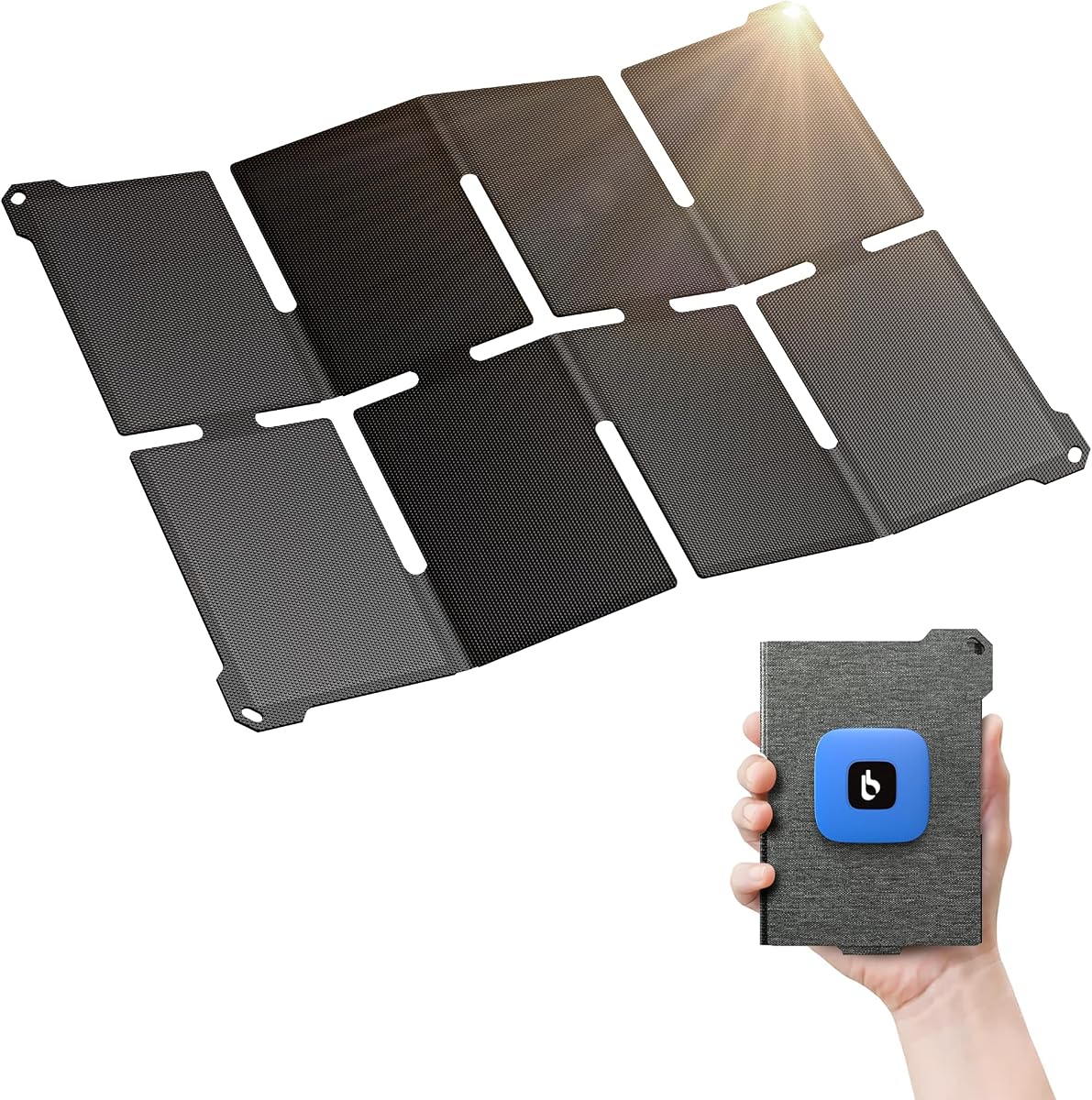

The GEYOTO 45W Solar Panel Charger earns a 4.5 rating and stands out as the most balanced option for anglers who need more capability than a small emergency panel without carrying a large power station. Its three outputs, high stated conversion efficiency, and strong environmental rating make it suitable for phones, tablets, power banks, cameras, and other compatible USB devices.
We may earn a commission when you buy through this link, at no additional cost to you.
The panel uses monocrystalline cells with conversion stated at up to 26 percent. Its most useful charging path is the 25W Power Delivery USB-C port, while the second USB-C connection and USB-A port allow several smaller devices to operate at once. The manufacturer also supplies a USB-C extension cable, which is helpful when a device needs to remain shaded while the panel sits in direct sunlight.
Portability remains reasonable for a fishing trip. The folded package measures 8.44 by 12.52 by 1.26 inches and weighs 1.65 pounds, making it similar in bulk to a tablet. Although not as small as the 25W BigBlue or 15W display model, the extra output capacity gives it a broader role: it can charge a phone, maintain a power bank, or support multiple devices during a long day outdoors.
The IP68 rating adds confidence around spray, dust, and changing weather, although the charging ports themselves must remain dry. This is the most versatile direct-charging choice in the group for anglers carrying several electronics. It is especially suitable for someone who wants one panel to handle a phone, GPS unit, action camera, and battery pack rather than buying separate solar accessories.
Two USB-C ports and one USB-A port reduce the need to unplug and reconnect equipment throughout the day. The 25W USB-C PD path is particularly useful for compatible phones and tablets, while the other connections accommodate smaller accessories and power banks.
The folding format, included pouch, carabiners, and IP68 panel construction make the charger easy to organize and carry. Anglers should still protect the connection ports from standing water and return the unit to dry storage after severe weather.
We may earn a commission when you buy through this link, at no additional cost to you.
The SOLUPUP 30W Portable Foldable Solar Charger has a 4.4 rating and offers a practical middle ground between lightweight phone panels and larger equipment chargers. It supports phones, power banks, tablets, and other compatible USB devices through one USB-A and one USB-C output.
We may earn a commission when you buy through this link, at no additional cost to you.
Both ports provide a maximum combined output of 15W according to the listed 5V/3A specification. Its monocrystalline cells have a stated conversion efficiency above 23 percent, while an integrated smart chip identifies connected devices and includes protection against overcurrent, overvoltage, and short circuits. Automatic reconnection is a useful feature when passing clouds temporarily interrupt solar input.
The panel weighs 2.4 pounds and folds to a stated 10.63 inches in length. That is less pocket-friendly than the 25W BigBlue or 15W display option, although the adjustable stand and included carabiners simplify placement at a campsite or on a tackle bag. Its IPX5 rating also makes it more appropriate for exposed outdoor use than an unprotected panel, provided it is not submerged.
This is a sensible choice for anglers who want one or two essential devices supported without the bulk of a 40W or 100W setup. It works especially well as a portable power source for a GPS unit or phone when paired with a power bank. The lower 15W maximum output means it is better viewed as an efficient daily top-up charger than a solution for power-hungry devices.
The auto-optimization function reconnects the charging process when sunlight returns after an interruption. That makes the panel practical on a bright day with passing clouds, where output naturally rises and falls throughout the day.
The folding construction and integrated adjustable stand make setup uncomplicated. Clip the panel to a pack while moving or orient it toward the sun when it is safe to leave in place on a dry surface.
We may earn a commission when you buy through this link, at no additional cost to you.
The Flashfish 100W Foldable Solar Panel carries a 4.4 rating and is the premium option for anglers with a larger power budget. It is especially relevant to people who travel by boat or RV, carry cameras and tablets, or want to collect solar energy for a compatible power station rather than depend only on direct device charging.
We may earn a commission when you buy through this link, at no additional cost to you.
Its output selection is the strongest in this roundup. The USB-C port supports Power Delivery up to 65 watts, the USB-A port supports QC3.0 up to 18 watts, and a DC 5521 connection provides an 18-volt path. This allows two USB-powered devices to charge simultaneously and gives the user more options than conventional small USB panels.
The monocrystalline cells are stated to convert 22 to 23 percent of solar energy, and four integrated kickstands provide a stable setup on compatible ground surfaces. A TPE handle aids transport, while the foldable format reduces the space required when the panel is not in use. Multiple DC connector sizes are included for a broader range of compatible equipment.
This panel is best suited to anglers who want serious solar collection capacity and will dedicate a clear, sunlit position to it. It is less attractive for someone who must carry every item in a small daypack or power only a phone. For a multi-device or RV-based setup, however, its output range and flexible connections make it the most capable premium choice here.
USB-C PD, USB-A QC3.0, and DC 18V connections support modern USB equipment as well as compatible higher-wattage devices. This wider range reduces the need to carry separate solar cables for different systems.
Four kickstands help the larger surface remain oriented toward the sun. Because the panel cannot overcome poor placement, it needs an open location with no shadows from trees, boat cabins, or tackle boxes.
We may earn a commission when you buy through this link, at no additional cost to you.
The POWOXI 7.5W 12V Solar Battery Charger is a compact maintenance solution rather than a portable phone charger. Its 4.4 rating reflects a simple, specialized design for supporting compatible 12-volt lead-acid, lithium-ion, LiFePO4, and related batteries used in cars, boats, motorcycles, tractors, and other equipment.
We may earn a commission when you buy through this link, at no additional cost to you.
Installation can be handled in two ways: the panel may plug into a vehicle's cigar-lighter socket or connect to the battery using the supplied alligator clips. A built-in controller, blocking diode structure, and internal protection system are designed to help prevent overcharging, overvoltage, and short circuits while maintaining the battery.
The panel uses a rigid ABS-and-PC frame around high-transparency glass rather than a flexible sheet. That construction resists bending and reduces the concern associated with an aluminum frame contacting painted surfaces. Red and green indicator lights communicate whether sunlight is being received and whether the panel is connected for charging.
The main limitation is purpose: this product does not offer USB ports for a phone, GPS unit, or camera. It is appropriate when the priority is keeping a boat or vehicle battery maintained between outings. It should not be chosen as the primary source of power for portable fishing electronics.
The cigar-socket connection offers a quick way to install the maintainer without attaching clips directly to a battery. Clip connection is useful when the charging location is more convenient than the vehicle outlet.
The internal protection system and blocking diode help manage the charging process. This makes the unit more appropriate as a maintainer than as a high-output charger for deeply depleted batteries.
We may earn a commission when you buy through this link, at no additional cost to you.
The FlexSolar 40W Foldable Solar Panel Charger has a 4.4 rating and combines three useful output options with a relatively low stated weight of 1.76 pounds. USB-A, USB-C, and 19-volt DC connections give it more versatility than most portable panels in this group.
We may earn a commission when you buy through this link, at no additional cost to you.
The USB-A port supports QC3.0 up to 18 watts and the USB-C port supports PD2.0 up to 18 watts, allowing two compatible devices to charge at the same time. A smart IC detects connected devices and optimizes output, while protections cover overcurrent, overheating, and short circuits. The DC connection can deliver up to 40 watts to a compatible small power station.
The stated conversion efficiency is 24 percent, and the panel uses an ETFE laminate coating intended to resist abrasion, rain, and dust. Its IP67 construction supports use in wet outdoor settings, although the manufacturer explicitly notes that the junction box is not fully waterproof. It should be stored indoors during heavy rain and never submerged beyond the stated limitation.
The 40-watt rating and folding dimensions of 8 by 11.1 by 1.8 inches make this a strong middleweight choice. It is useful for anglers carrying a phone, tablet, GPS unit, or small power station, but partial shade can reduce performance significantly. Positioning the panel at roughly a 45-degree angle in unobstructed sunlight is the best approach.
USB-C, USB-A, and 19V DC outputs cover both everyday devices and compatible small power stations. Smart load distribution is still important, with single-port use recommended when maximum efficiency is the priority.
The 24 percent stated cell efficiency is attractive, but placement remains decisive. A partially covered panel can lose a large portion of its potential output, so unobstructed sunlight is more important than simply orienting the unit toward a bright horizon.
We may earn a commission when you buy through this link, at no additional cost to you.
The SOLPERK Solar Panel Kit earns a 4.5 rating and is designed primarily to maintain 12-volt rechargeable batteries in boats, trailers, cars, RVs, motorcycles, tractors, and other applications. Its 20-watt panel uses monocrystalline A-grade cells with a stated cell efficiency of 21 to 30 percent.
We may earn a commission when you buy through this link, at no additional cost to you.
The included 10A MPPT controller uses a three-stage charging design intended to reduce overcharging, overvoltage, and short-circuit risks. Indicator lights provide charging status, and the manufacturer states that the controller draws no power from the battery. Compatible battery types include LiFePO4, lithium-ion, AGM, SLA, GEL, EFB, and maintenance-free lead-acid batteries.
Unlike a folding portable panel, this kit is meant to stay mounted. A fully adjustable bracket lets the user refine the sun-facing angle, and pre-drilled holes simplify attachment. The low-iron tempered glass and corrosion-resistant aluminum frame are designed to withstand sun, wind, hail, dust, and other outdoor conditions over an extended service life.
For a boater who wants reliable battery maintenance without repeatedly positioning a portable panel, this kit is a strong match. It is less useful for directly charging a phone or GPS unit because it does not provide direct USB outputs. Its advantage lies in dedicated MPPT control and a flexible mounting system.
The 360-degree adjustable mount allows seasonal and daily changes in angle. This flexibility is particularly useful on a boat or trailer, where a fixed position may not receive consistent sunlight throughout the day.
The panel, MPPT controller, alligator clip, O-ring, and mounting hardware provide the essential pieces for a permanent installation. Plug-and-play connections simplify attachment and removal.
We may earn a commission when you buy through this link, at no additional cost to you.
The BigBlue 28W High-Efficiency Solar Panel Charger has a 4.3 rating and remains a practical direct-charging option for anglers who need a phone, GPS unit, flashlight, camera, or power bank replenished during outdoor travel. Its three USB connections allow multiple compatible small devices to charge simultaneously.
We may earn a commission when you buy through this link, at no additional cost to you.
The panel has a stated conversion efficiency of 25.4 percent and uses N-type cells with no front-side metal lines. Its dual USB-C ports and one USB-A port each support up to 5V/3A, with a collective maximum of 5V/4.8A. An intelligent safety system is included, but actual output changes with sunlight, angle, temperature, and device requirements.
The folded unit measures 11 by 6 by 1.4 inches and weighs 1.5 pounds, making it easy to place in a backpack or emergency kit. It does not contain an internal battery, so it must operate in direct sunlight. The manufacturer specifically advises keeping connected phones and tablets in the shade because heat can trigger thermal protection and reduce charging speed.
The IP44 rating protects the panel surface against moderate exposure, but the USB junction box is not waterproof. It is therefore best kept away from heavy rain and standing water. For direct charging of portable fishing electronics, this offers a strong efficiency-to-size balance, although it cannot provide enough output for laptops or larger power stations.
The three-port arrangement allows a phone, GPS unit, and power bank to operate together when conditions support it. Output remains tied to the panel's received sunlight, so full simultaneous performance should not be expected under weak light.
Placing the panel in sun while leaving the connected device shaded helps avoid overheating. This arrangement can preserve charging speed and is a sensible practice on hot, open-water days.
We may earn a commission when you buy through this link, at no additional cost to you.
The BigBlue Ultra-Light Portable 25W Solar Panel Charger has a 4.2 rating and is built around portability. At 0.84 pounds, it is the lightest direct-charging panel listed, making it attractive for anglers who carry their electronics in a small sling, shore bag, or compact tackle backpack.
We may earn a commission when you buy through this link, at no additional cost to you.
The charging connections consist of one USB-A port rated at 5V/2.4A and one USB-C port rated at 5V/3A. Smart charging technology is intended to optimize power delivery and provide protection for connected devices. Because the panel operates without internal storage, it requires direct sunlight and cannot charge after sunset.
Its N-type solar cells are described as having up to 25.4 percent conversion efficiency and use no metal lines on the front surface. The construction combines ETFE coating, UV-resistant EVA, and a baseplate intended to resist hidden cracks. Its IP68 rating provides stronger water and dust resistance than many competing portable panels.
The folded dimensions of 4.65 by 6.42 by 1.38 inches make this an excellent travel backup for a phone, power bank, camera, or GPS unit. It cannot replace a larger panel for tablets, laptops, or power stations, and its two-port design limits concurrent device use. Within that narrower role, it provides an excellent weight-to-output ratio.
The 0.84-pound listed weight reduces the burden of carrying backup power. Included carabiners and an elastic strap make it easy to attach the folded panel to a backpack, tent, or other gear.
The ETFE and EVA layers are designed to resist scratches, UV exposure, and outdoor wear. These materials support the IP68 rating and make the panel better suited to splashes and changing conditions than an uncovered basic panel.
We may earn a commission when you buy through this link, at no additional cost to you.
The SUNER POWER Waterproof 12W 12V Solar Battery Charger is a dedicated maintainer with a 4.4 rating. Its built-in UltraSmart MPPT controller is stated to provide tracking efficiency up to 99 percent and peak conversion efficiency up to 98 percent, making it a capable choice for maintaining compatible batteries around a boat, trailer, RV, or vehicle.
We may earn a commission when you buy through this link, at no additional cost to you.
A three-stage charging algorithm moves through bulk, absorption, and float stages. The unit stops charging when the battery is full and resumes after discharge, reducing the need for manual maintenance. Listed protections cover overcharge, over-discharge, overvoltage, overcurrent, overload, short circuit, reverse polarity, and excessive temperature.
Compatibility extends to flooded, gel, AGM, SLA, maintenance-free lead-acid, and LiFePO4 batteries. The enclosure includes pre-designed mounting holes, and suction cups are included for quick installation. Grade A+ solar cells, tempered glass, and a corrosion-resistant frame are designed for extended outdoor exposure.
This product serves a different purpose from portable USB panels: it preserves vehicle or marine battery health rather than powering a phone. It is most valuable for anglers who leave electronics or navigation equipment connected to a 12-volt system and want the starting battery maintained while the boat or trailer is idle.
The staged charging sequence adapts the panel's behavior as the battery reaches different levels. Automatic shutdown and restart make it suitable for long-term maintenance without constant supervision.
Support for several lead-acid and lithium battery types makes the maintainer useful across marine, automotive, RV, and utility equipment. Users should still verify their battery type and wiring requirements before installation.
We may earn a commission when you buy through this link, at no additional cost to you.
The 15W Portable Small Solar Panel Charger has a 4.2 rating and represents the most compact and economical option in this comparison. It is designed for anglers who need a lightweight emergency top-up for a phone, GPS receiver, camera, flashlight, or small power bank rather than sustained charging for several devices.
We may earn a commission when you buy through this link, at no additional cost to you.
Its most distinctive feature is the built-in digital display, which shows power, voltage, and current. That information helps anglers determine whether the panel is receiving strong sunlight and lets them adjust its angle. The monocrystalline cells have a stated conversion efficiency of 23.5 percent, and the ETFE-coated surface is designed to resist scratches, heat, and outdoor wear.
USB-C and USB-A outputs provide flexibility for different devices, while intelligent protection is listed against overcharging, overheating, and short circuits. The panel folds and weighs only 0.82 pounds, allowing it to fit in a small pocket or backpack without adding much bulk. Two carabiners are included for attachment.
Because output is modest and no internal battery is provided, it works best for emergency readiness and slow daytime replenishment. It cannot charge a laptop or large power station, and performance may be inconsistent in overcast weather. Even so, the display and low weight make it a distinctive budget option for basic fishing electronics.
The digital readout is more useful than a simple status light because it reveals power, voltage, and current. Anglers can reposition the panel when readings indicate weak sunlight rather than guessing whether the device is receiving adequate input.
At 0.82 pounds, the panel is easy to keep in a pocket, tackle bag, or emergency kit. It offers a practical backup for small electronics when unexpected downtime makes conventional charging unavailable.
We may earn a commission when you buy through this link, at no additional cost to you.
The right choice depends on whether the primary need is charging handheld devices, collecting energy for a power station, or maintaining a 12-volt battery. Capacity, connector compatibility, weather protection, pack weight, and realistic charging conditions should be evaluated together.
A solar charger for fishing electronics falls into two broad functional groups. Portable USB panels directly charge phones, GPS units, cameras, tablets, and power banks when exposed to sunlight, while fixed solar maintainers connect to 12-volt batteries in boats, trailers, vehicles, and outdoor equipment. Choosing the wrong category would leave the intended device without the connection it actually needs.
Select a direct panel when your priority is powering gear carried on the water. Choose a maintainer when the goal is preventing a vehicle, trolling motor, or auxiliary battery from losing its charge during storage.
Solar panel wattage indicates nominal collection capacity, but the usable result at the USB port depends on conversion efficiency, sunlight, panel angle, temperature, wiring, and device draw. A 15W to 30W folding panel is generally more appropriate for phones, GPS units, lights, and power-bank top-ups, while a 40W to 100W panel offers greater flexibility for tablets, cameras, or compatible power stations.
Match the panel to the electronics rather than relying on wattage alone. The most important point is whether the device and connection protocol are supported by the available ports.
USB-C and USB-A are the most common connections for portable angling electronics, but their supported charging protocols matter. Look for Power Delivery, QC3.0, or a stated voltage and current when using a phone, tablet, GPS receiver, or power bank. A USB-A connection does not guarantee fast charging, and compatibility can vary with the cable and device.
For larger systems, check whether the panel includes a DC output and whether the connector diameter matches the battery, power station, or adapter. Avoid proprietary cables unless the necessary connection is explicitly included.
Fishing gear already occupies space, so a solar charger must be easy to carry without interfering with rods, tackle, and safety equipment. Panels in the 0.8- to 1.8-pound range are convenient for backpacks and sling bags, while larger fixed mounts and high-capacity folding panels may be better suited to a dedicated compartment, boat, or RV.
Folding dimensions and included carabiners also matter. A compact charger can remain accessible during travel, whereas a larger panel is more efficient when it can be placed in a stable, sunlit location.
Fishing exposes electronics to spray, humidity, dust, and sudden rain, so panel durability is a major consideration. An IP44, IP67, or IP68 rating indicates increasing levels of protection, but ratings may apply only to the solar surface and not the junction box, ports, or controller. Fixed marine kits benefit from weather-resistant glass, corrosion-resistant frames, and sealed connections.
Treat every charging connection as vulnerable unless the manufacturer explicitly states otherwise. Keep ports dry, avoid submerging the panel, and store the unit indoors during heavy rain or severe conditions.
Stated conversion efficiency shows how effectively a panel converts received sunlight, but it cannot compensate for shade or an unfavorable angle. A highly efficient panel positioned behind a boat cabin or beneath trees may produce less than a larger panel in direct sunlight. Clean surfaces and orient the unit toward the sun with as little obstruction as possible.
For panels with an adjustable stand, experiment with the angle during the day. For products with a digital display, use the power, voltage, and current readings to identify the strongest position.
A dedicated MPPT controller can improve solar collection and manage battery charging more effectively than a basic maintainer. For a 12-volt installation, look for staged charging, automatic full-charge shutdown, and protections against overcharging, reverse polarity, short circuits, overcurrent, and excessive temperature. These features are especially valuable for unattended maintenance.
Also verify the supported battery chemistries. A controller suitable for AGM or flooded lead-acid batteries may need confirmation before use with LiFePO4 or other lithium systems.
A complete package can make setup easier at an unfamiliar launch or campsite. Look for an extension cable, carabiners, a storage pouch, adjustable stand, mounting hardware, and appropriate battery leads. These accessories affect convenience rather than core solar performance, but they reduce the chance of arriving without a practical way to position or carry the charger.
Keep spare cables organized with the panel and confirm that any included connection reaches the intended device. Dry storage helps protect electronic junction boxes and prevents corrosion or debris from accumulating on the surface.
Before deployment, identify the devices or battery being charged, inspect the cables and connectors, and confirm that the voltage and charging protocol are compatible. Unfold or mount the panel where it can receive direct sunlight without shadows. Avoid placing it on hot metal or against surfaces that can be damaged by prolonged exposure, and keep any electronic junction box and connection ports dry.
For direct device charging, connect the cable before positioning the panel if practical, then move the phone, GPS unit, or other device into the shade. Heat can cause thermal protection to slow charging or stop it temporarily. If the display shows weak output, clean the panel, remove any obstruction, and adjust its angle. A panel without internal storage cannot deliver stored energy after dark, so use a compatible power bank when continuous overnight power is needed.
For a 12-volt maintainer, switch off the connected equipment when required by its manufacturer, attach the correct leads according to polarity, and install the controller and panel where they remain dry. Check the indicator lights periodically and inspect the wiring for abrasion, corrosion, or loose connections. After the trip, disconnect the battery if the instructions recommend it, wipe away salt and moisture, and store the charger in a dry, ventilated place.
It can, provided the fish finder accepts the available USB or DC connection and the panel receives strong direct sunlight. Many portable panels can sustain smaller navigation and GPS electronics more effectively than tablets or high-power displays. Because output fluctuates, charging a compatible power bank during the day and powering the unit from that bank later is often more dependable.
Most of the portable panels in this guide operate directly and do not contain an internal battery. They generate usable output only while receiving sufficient sunlight. Products described as solar battery maintainers are also intended to manage a separate 12-volt battery rather than store energy in the panel itself. Use a power bank or compatible battery system if power is needed after sunset.
No. A higher wattage provides more nominal collection capacity, but it also tends to be larger and heavier. A smaller panel may be a better match when the goal is to charge a phone, GPS unit, or flashlight during daylight. Choose a higher-capacity model when carrying several devices, supporting a power station, or having a secure sunny location for deployment.
They can still produce output in cloud cover, but charging speed will usually be lower than in direct sunlight. The extent of the reduction depends on cloud density, panel placement, and the device's power requirements. A panel display can help indicate weak conditions, while a power bank provides useful energy storage for later use.
Only with a panel that has enough compatible ports and sufficient available output. Three-port models are convenient for simultaneous charging, while two-port panels are still useful for a phone and a small GPS receiver. For stable results, use quality cables and keep the connected devices shaded so heat does not trigger protective shutdowns.
A dedicated 12-volt solar maintainer with an MPPT controller is the more suitable choice. Products such as the SOLPERK and SUNER POWER models are designed for staged charging, automatic maintenance, and broad battery compatibility. Portable USB panels are better for handheld electronics and generally are not direct substitutes for a purpose-built battery maintainer.
That depends on the product's complete construction. Some panels have IP67 or IP68 ratings, while the junction box or USB ports may have a lower protection level. Consult the specific instructions and keep exposed connections dry whenever possible. After salt spray or heavy rain, wipe the unit and let it dry fully before storing it.
The solar panel should receive direct sunlight, but the electronic device should usually remain shaded. Leaving a phone or tablet exposed to strong sun can raise its temperature and activate thermal protection, reducing charging speed. Positioning the panel independently allows it to collect maximum sunlight while the device remains cooler.
The GEYOTO 45W panel is the most balanced overall choice because it combines strong direct-charging capability, three ports, good portability, and IP68 protection. The Flashfish 100W model is the premium option for anglers needing more output and multiple connection types, while the 15W smart display panel offers an inexpensive and unusually lightweight backup for basic devices.
Prioritize the job your electronics actually require. Use a folding USB panel for phones, GPS units, cameras, and power banks; select a larger panel when several devices or a compatible power station must be supported. For boats and vehicles, choose a 12-volt maintainer with a suitable controller, verified battery compatibility, and secure weather-resistant mounting.
Before buying, check the current port layout, output protocols, dimensions, weather limitations, and included accessories. Product specifications, availability, and prices can change, so confirm the latest listing details and compare the charger with the exact devices and battery systems you intend to use.