
Zoom F3 Professional Field Recorder
4.6Editor score
32-bit float capture
Dual locking XLR inputs
Flexible standalone USB workflows
This guide compares the best audio field recorders for film, covering inputs, timecode, portability, monitoring, recording formats, and sync.
Audio field recorders for film give filmmakers a dependable way to capture dialogue, ambience, effects, and isolated tracks with more control than a camera-mounted microphone. The right model balances input flexibility, sound quality, synchronization, monitoring, storage, and portability for the environments and teams in which it will be used.
The recorders in this guide were compared using the supplied product specifications, emphasizing channel count, connector options, 32-bit float support, timecode features, displays, recording media, power options, and USB workflows. The list includes professional multi-input units, compact XLR recorders, stereo handheld models, and a wearable lavalier recorder.
Each selection highlights the use case it serves most effectively, whether that is budget-conscious documentary work, production sound, synchronized location recording, music-and-film versatility, or discreet on-camera audio. Product ratings and specifications reflect the supplied listings, while prices and availability can change over time.
4.6Editor score

4.7Editor score

4.6Editor score
This side-by-side comparison covers the principal filmmaking considerations: input count, audio format, timecode, storage, monitoring, and portable operation. It reveals which recorders suit small crews, larger production-sound rigs, synchronized multi-device shoots, and discreet wearable workflows.




The Zoom F3 is a compact professional field recorder with a 4.6 rating, designed for filmmakers and musicians who need reliable capture without a large multi-channel rig. Its defining combination is two locking XLR inputs, 32-bit float recording, and ultra-low-noise preamps, all in a format suited to run-and-gun work and demanding field conditions.
We may earn a commission when you buy through this link, at no additional cost to you.
The most important strength is the reduced need to manage gain during changing scenes. With 32-bit float recording, the recorder is presented as capable of capturing quiet dialogue and sudden peaks without stopping to adjust levels. Locking XLR connections also suit a recorder mounted away from the operator or incorporated into a larger production rig, where accidental cable movement would be inconvenient.
Its limitations are practical rather than fundamental. Two inputs are enough for a compact dialogue or isolated-sound workflow but do not match the six- or eight-input capability of the Zoom F6 and F8n Pro. The supplied information also does not identify dedicated timecode I/O for the F3, making the larger Zoom models more compelling when frame-accurate synchronization is a central requirement.
Choose the F3 when you want professional XLR capture, low-noise amplification, and the safety margin of float recording without carrying a larger multi-input recorder. It is especially attractive for independent films, documentary interviews, field sound, and production teams that need an uncomplicated professional backup unit.
The combination of 32-bit float recording and ultra-low-noise preamps gives filmmakers greater tolerance for unexpected level changes. That makes the F3 useful when dialogue, movement, and environmental sound may vary between takes.
Dual locking XLR inputs are valuable in field rigs where cables may be handled, mounted at a distance, or connected to unusual microphone positions. Secure connections reduce avoidable interruptions during a take.
We may earn a commission when you buy through this link, at no additional cost to you.
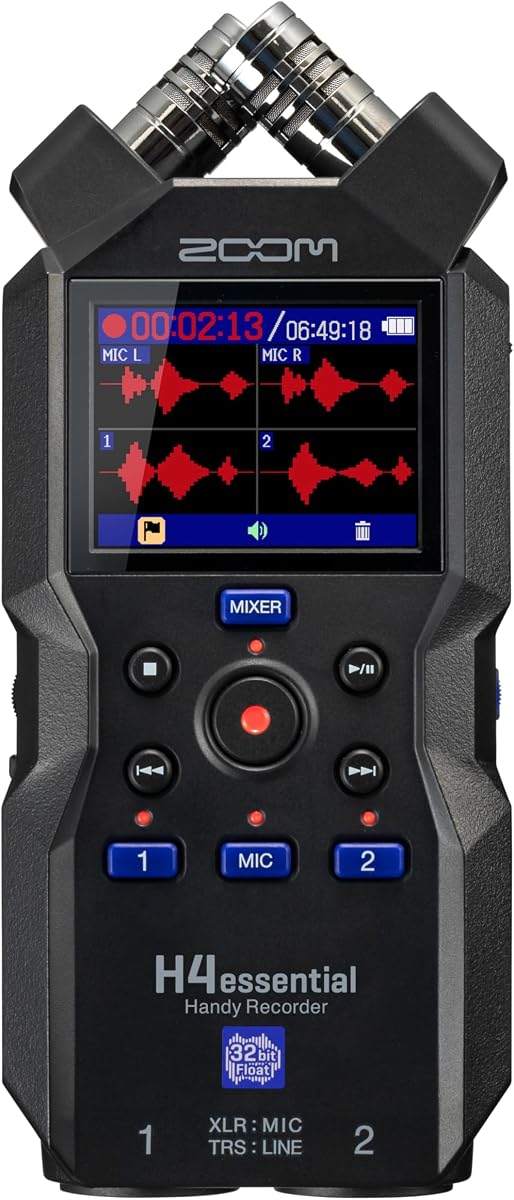
The Zoom H4 Essential is a versatile four-track handheld with a 4.4 rating, aimed at musicians, podcasters, and filmmakers who want flexible recording without a dedicated production-sound configuration. It can record with its built-in stereo microphones, accept external microphones or instruments, and connect to a mixer or soundboard through two XLR/TRS inputs.
We may earn a commission when you buy through this link, at no additional cost to you.
The format is particularly useful when a project moves between different kinds of sound. A filmmaker might capture a room tone pair with the built-in microphones and add a lavalier or boom microphone through an XLR input. The four-track format allows more simultaneous detail than a basic two-channel handheld, while the available USB-C workflow supports recording or streaming to a phone, tablet, or computer and backup to an SD card.
The trade-off is that the H4 Essential is not the strongest choice for a large isolated-sound team. It has two XLR/TRS inputs rather than the six XLR inputs of the F6 or the eight-input architecture of the F8n Pro. Timecode is also not identified in the supplied specifications, so it is less directly suited to elaborate multi-camera synchronization than those professional models.
The H4 Essential makes sense for creators who need one recorder for interviews, video narration, podcasts, music, and ambient recordings. It is particularly attractive when a project is still developing and the number or type of sources may change from one recording session to the next.
Built-in stereo microphones and two external inputs let the H4 Essential handle ambience, dialogue, instruments, and line-level sources. This makes it a practical all-rounder for mixed production roles.
USB-C recording and streaming, together with direct SD-card backup, provides flexibility for connected editing, live digital workflows, and the safeguarding of an independent local copy.
We may earn a commission when you buy through this link, at no additional cost to you.
The Zoom F6 is a professional field recorder with a 4.7 rating that strikes an effective balance between channel capacity, portability, and synchronization. It provides six XLR inputs, can record up to 14 tracks, and includes timecode input and output for frame-accurate sync with video in filmmaking and broadcast workflows.
We may earn a commission when you buy through this link, at no additional cost to you.
Six XLR inputs make the F6 appropriate for a production-sound mixer or a filmmaker recording a larger number of isolated sources. The up-to-14-track capability adds room for flexibility, while 32-bit float recording with dual AD converters is designed to capture a wide dynamic range without clipping. Rugged construction, a portable format, multiple power options, headphone monitoring, and line input support strengthen its location suitability.
The F6 requires a more considered setup than a compact stereo recorder. Filmmakers must plan tracks, gain, and timecode configuration, and the larger professional models may be preferable when eight inputs or redundant card recording are required. Even so, the F6 supports both standalone recording and operation as a USB audio interface, so it can move between isolated capture and a connected production setup.
This is the most broadly balanced choice for a serious film crew that needs multiple XLR sources and reliable timecode without automatically choosing the most complex recorder. It works especially well for narrative production, documentary interviews, commercial shoots, and location recording where a mixer and several microphones need a dependable central recorder.
Timecode input and output keep separate audio and video recordings aligned for post-production. For multi-camera or multi-device shoots, this dedicated synchronization capability is a major advantage over simpler recorders.
Six XLR inputs and up to 14 tracks support a professional isolated-sound mix while preserving a portable form. The F6 fills the space between compact dual-input units and larger eight-input systems.
We may earn a commission when you buy through this link, at no additional cost to you.
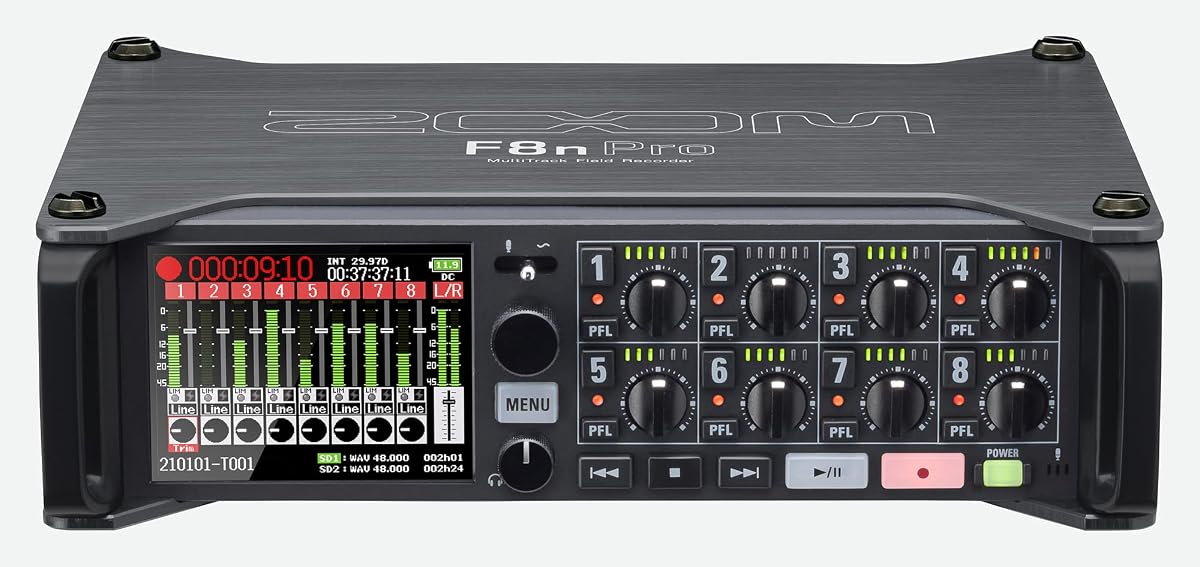
The Zoom F8n Pro is the premium selection in this guide, combining eight channels, ten-track recording, 32-bit float capture, dual AD converters, and a 4.6 rating. It is built for professional film and field audio, particularly productions that need more microphones, stronger recording redundancy, and precise synchronization.
We may earn a commission when you buy through this link, at no additional cost to you.
The 75dB gain range and -127dBu equivalent input noise specification support low-level dialogue as well as dynamic action sources. Its 0.2ppm TCXO provides the listed timecode accuracy, while dual SD card slots can record redundantly and accept cards up to 1TB each. Three outputs support camera feeds, headphones, and external devices, adding flexibility across a larger production setup.
The trade-off is complexity and scale. A solo filmmaker recording one or two sources may not benefit from eight inputs or redundant card workflows, and the full feature set can demand more setup discipline. The F6 may therefore be more efficient for many established crews. Even so, the F8n Pro can operate as an eight-input, four-output USB audio interface at 32-bit float and 96kHz while recording to an SD card, preserving a serious production workflow.
Choose the F8n Pro for demanding narrative films, large documentary crews, commercial production, or any shoot where redundant capture, exact timecode, and multichannel flexibility justify a high-end field recorder. It is the strongest option here for maximum production input capacity and recording resilience.
Two SD card slots allow redundant recording, providing a useful safeguard when a full production depends on a small number of location recorders. Each slot supports media up to 1TB according to the supplied specifications.
The 0.2ppm TCXO and dedicated timecode workflow suit productions using multiple cameras or independent audio devices. Accurate alignment reduces the manual burden of matching separate recordings during editing.
We may earn a commission when you buy through this link, at no additional cost to you.
The Zoom H1 XLR is a compact two-channel recorder with a 4.5 rating for filmmakers, musicians, and podcasters who want more flexibility than a built-in-microphone recorder. Its two XLR/TRS combo inputs accept microphones, instruments, and other compatible sources, while the supplied specifications confirm 32-bit, 96kHz recording.
We may earn a commission when you buy through this link, at no additional cost to you.
The OLED waveform display is its most user-facing advantage. Seeing levels visually makes it easier to identify clipping, check a source, and preserve a clean recording without relying only on audio cues. A 3.5mm stereo input and headphone output broaden the connections available for monitoring and external devices, while SDXC support up to 1TB provides substantial session capacity.
Two XLR/TRS inputs are enough for a compact documentary kit, a narrator and performer setup, or a small two-microphone arrangement, but not for a full production-sound crew. No dedicated timecode is identified in the supplied data, and the H1 XLR does not offer the multichannel expansion of the F6 or F8n Pro.
The H1 XLR is a good middle ground for filmmakers who want professional external-microphone connections and visual level monitoring in a small unit. It is especially suitable for interviews, narration, small narrative scenes, podcasts, and creators who want a straightforward two-channel recorder rather than a mixer-scale setup.
The OLED waveform display gives immediate visual feedback on signal level. It helps creators confirm that microphones are delivering usable audio while monitoring a source in a changing environment.
Two XLR/TRS combo inputs bring professional microphone and instrument connections into a small format. The additional 3.5mm input and headphone output make it easier to incorporate line sources and monitor independently.
We may earn a commission when you buy through this link, at no additional cost to you.
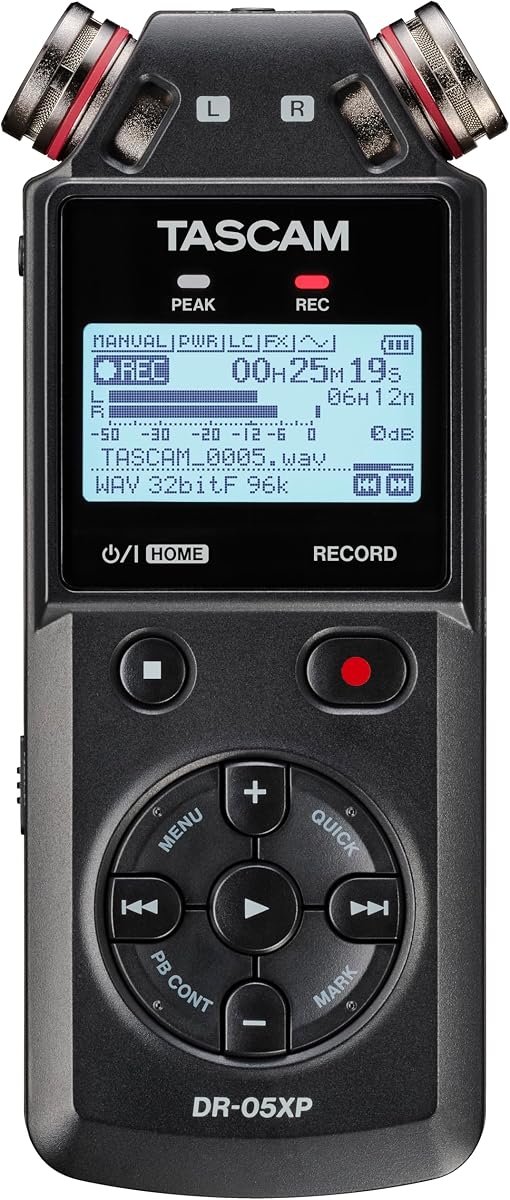
The TASCAM DR-05XP is a portable stereo field recorder with a 4.2 rating, designed for music, sound, voice, video, and podcasting. Its built-in omnidirectional condenser microphones make it a ready-to-record option when carrying separate microphones and a large field rig would be unnecessary.
We may earn a commission when you buy through this link, at no additional cost to you.
Recording modes include 32-bit float, 24-bit, and 16-bit, with sample-rate options of 96kHz, 48kHz, and 44.1kHz, along with MP3. The microphones handle sources up to 125dB SPL, making the unit relevant to loud locations, and the two-in, two-out USB-C audio interface allows direct computer recording.
The main limitation is input type. The DR-05XP is centered on its built-in stereo microphones rather than professional XLR connections, so it cannot serve as the central isolated-sound recorder for a multi-microphone film crew. It also does not list timecode support. For a filmmaker, it is most useful as a dedicated ambience, room-tone, reference, or backup recorder rather than the main dialogue recorder.
Choose the DR-05XP for mobile documentary work, sound gathering, narration references, and creators who value portability and immediate operation. It can also be useful as a compact stereo backup during a larger shoot, capturing environmental information while a dedicated mixer handles isolated dialogue.
Built-in microphones remove the need to connect and position a separate stereo pair for routine ambience recording. This makes the DR-05XP convenient for walk-and-talk scouts, room tones, and sound-effect gathering.
Multiple bit depths, sample rates, and MP3 support accommodate different post-production needs. The 32-bit float mode can reduce the pressure of reacting to sudden level changes during a location session.
We may earn a commission when you buy through this link, at no additional cost to you.
The Zoom H5 is a modular four-track handheld with a 4.7 rating, combining interchangeable input capsules with two XLR/TRS combo inputs. Its detachable X/Y capsule, shock-mounted microphones, reduced handling noise, and four-track simultaneous recording make it a well-regarded option for filmmakers and musicians who want flexibility in a portable body.
We may earn a commission when you buy through this link, at no additional cost to you.
The capsule system is especially useful because the microphone configuration can change with the assignment. A filmmaker can use the included X/Y pair for stereo ambience or location sound and add microphones through the combo inputs for dialogue or additional isolated sources. Each input offers selectable phantom power and a -20dB pad, adding practical control for different source types.
The supplied data lists SD and SDHC recording support up to 32GB, which is a meaningful constraint compared with the much larger capacities highlighted for newer recorders. The H5 also has only two physical XLR/TRS connections, so the four-track capability comes from its multi-source design rather than a large professional input count. Dedicated timecode is not listed.
The H5 remains attractive for crews that value a proven, portable, modular system and do not need high-capacity media or extensive synchronization. It is well suited to small films, interviews, music documentation, field sound, and production work where the included capsule and two external inputs are enough for the planned microphone arrangement.
Interchangeable capsules let a user adapt the recorder to different assignments without treating the built-in microphone arrangement as fixed. The included X/Y configuration is intended to resist handling noise with its shock-mounted design.
Four-track simultaneous recording supports a flexible mix of stereo and external sources. Phantom power and pads on the XLR/TRS inputs help accommodate microphones and hotter line-level signals.
We may earn a commission when you buy through this link, at no additional cost to you.
The TASCAM DR-10L Pro is a discreet wearable recorder with a 4.4 rating, built around an included TM-10L clip-on lavalier microphone. It is designed for personal audio capture in busy settings, including wedding receptions, and offers a practical alternative to routing every isolated source through a central production-sound mixer.
We may earn a commission when you buy through this link, at no additional cost to you.
Its 32-bit float recording captures a wide range from a whisper to a scream, while the included microphone is matched to the recorder for clear personal audio. Firmware Version 2.0 adds LTC Jam Sync for multi-device synchronization, and support for Atomos Wireless Timecode is available through the separately sold AK-BT1 adapter. The product is not compatible with the AK-BT2 adapter according to the supplied information.
The DR-10L Pro is specialized rather than a general-purpose mixer. It does not offer the multiple XLR inputs or broad track count of the professional Zoom recorders, and its included lavalier makes it most relevant to solo presenters, interview subjects, or discreet secondary audio. The CONNECT App can control up to five simultaneous recordings, reducing the inconvenience of managing several wearable units.
Choose the DR-10L Pro when a production needs clean, isolated personal audio without asking every subject to remain close to a sound mixer. It is particularly well suited to event videography, interviews, wedding films, and multi-camera content where each participant can wear a self-contained recorder.
The included lavalier and wearable recorder format allow a subject to carry a dedicated audio source. This can preserve speech more effectively than a distant camera microphone in a crowded or reverberant setting.
LTC Jam Sync and Atomos Wireless Timecode support extend synchronization to multi-device workflows. Controlling up to five units from the CONNECT App also makes coordinated wearable recording easier to manage.
We may earn a commission when you buy through this link, at no additional cost to you.
The Zoom H1 Essential is a compact stereo recorder with a 4.0 rating, designed for musicians, podcasters, and content creators. It is positioned for situations where improved audio is needed without the complexity of external XLR microphones or a multichannel field-recording rig.
We may earn a commission when you buy through this link, at no additional cost to you.
Built-in stereo microphones make it suitable for videos, tutorials, voiceovers, behind-the-scenes clips, interviews, music sessions, and real-world ambience. The supplied listing specifically highlights natural stereo sound for conversations and detailed recording for songs, rehearsals, and acoustic performances, expanding its usefulness beyond a single creator format.
USB-C connectivity lets the recorder function as a microphone for livestreams, remote meetings, video calls, voiceovers, podcasts, and desktop or mobile recording. Its limitations are equally clear: professional XLR inputs, multitrack production, and dedicated timecode are not identified in the supplied specifications. It should not be confused with a production-sound mixer for a full film crew.
The H1 Essential is best for filmmakers creating supplementary ambience, social clips, behind-the-scenes material, or simple narration, and for creators who want a dedicated recorder separate from a phone or camera. It is also useful for a small team that values simple operation and immediate stereo capture over professional input expansion.
A dedicated stereo recorder can give creators a cleaner and more controlled source than relying on a camera or phone microphone. The format is simple to place near a speaker, performance, or environmental sound.
USB-C operation supports both local capture and connected microphone use. That versatility makes the H1 Essential useful across production, streaming, communication, and educational tasks without requiring a separate interface.
We may earn a commission when you buy through this link, at no additional cost to you.
The Zoom F2 is a small wearable lavalier recorder with a 4.0 rating, intended for weddings, filmmaking, journalism, videography, podcasting, and content creation. It includes the LMF-2 omnidirectional lavalier microphone with a screw-lock connector, windscreen, and lapel clip, creating a complete personal recording setup.
We may earn a commission when you buy through this link, at no additional cost to you.
Its 32-bit float recording captures at 44.1kHz or 48kHz without a stated need to adjust gain, reducing the chance of clipping when a subject's voice changes unexpectedly. The screw-lock connection is useful for a wearable device that may be handled or moved, and the REC Hold switch helps prevent an accidental stop during a critical recording.
The F2 is highly specialized. It does not provide the multiple XLR inputs, track counts, or timecode controls of the professional Zoom F6 and F8n Pro. Instead, it focuses on one clean personal track in a highly portable form. The supplied data also does not identify USB audio-interface capability, making it less versatile as a general computer recording device.
Choose the F2 when discreet personal audio is more important than mixer-scale routing. Its stated operation of up to 15 hours on two AAA batteries, support for microSD, microSDHC, and microSDXC cards up to 512GB, and +/-0.5ppm internal clock make it well suited to long events, interviews, and extended location sessions.
The compact body, included lavalier, and lapel clip let a subject carry a dedicated recorder without holding a separate microphone system. The screw-lock connector helps keep the microphone connection secure.
Up to 15 hours of stated battery operation supports weddings and extended events. The REC Hold control provides a simple safeguard against stopping a take accidentally, while high-capacity card support provides ample room for the session.
We may earn a commission when you buy through this link, at no additional cost to you.
The right audio field recorder depends on the number of isolated sources, synchronization method, recording medium, crew size, and physical demands of the shoot. These factors determine whether a compact personal recorder is sufficient or a multichannel professional body is necessary.
Begin by counting the microphones that must be recorded independently, not merely the number of people visible in a scene. A two-input recorder can handle a compact pair of sources, while a six- or eight-input model supports a mixer, boom operator, wireless receivers, and several isolated sound sources. XLR/TRS combo inputs are particularly useful because they can accept microphones or line-level equipment through one connection.
Thirty-two-bit float recording is valuable on location because it offers greater tolerance for sudden peaks and unexpected changes in source level. It can reduce the need to stop and reset gain between quiet dialogue and louder action. This does not remove the need to monitor levels, arrange microphones thoughtfully, or protect equipment from extreme conditions, but it adds a useful safety margin to a demanding shoot.
Timecode is essential when separate video and audio devices are recorded independently and must be aligned later. Dedicated timecode input and output gives a crew a common reference, while a precise internal clock can improve small synchronization errors. Wearable recorders with Jam Sync or wireless timecode support can fit into a larger multi-device workflow. If all audio and video originate in one camera and require only basic alignment, fewer inputs and no timecode may be acceptable.
Record media should be matched to the sample rate, bit depth, channel count, and length of the shoot. Larger capacities support high-resolution multichannel files and long production days, while dual SD slots can provide redundant recording on critical shoots. A smaller unit with limited card support may still be suitable for interviews or short sessions, but filmmakers should verify capacity before a long documentary or multi-day narrative production.
Headphone monitoring is important for hearing noise handling, cable placement, room reflections, and the quality of a source before the performance ends. A waveform display offers an additional visual check of level and can make it easier to notice distortion or an inactive channel. Built-in microphones are convenient for ambience, while professional dialogue and isolated sound generally benefit from external capsule or XLR microphones.
A recorder must be easy to carry, mount, operate, and power for the length of the day. Compact wearable models work well for personal audio and events, while larger professional bodies suit mounted mixer workflows. Compare stated battery duration, available power options, and connector security. Locking XLR sockets, screw-lock lavalier connectors, and protective routing can matter more than small size differences during a long location day.
Some recorders operate as standalone units, as USB audio interfaces, or in both modes. A standalone workflow is important for location sound because a computer failure or cable disconnection should not stop capture. USB operation adds value when a director, editor, or musician wants to record directly to a computer or stream a source. Simultaneous local and computer recording can create useful flexibility, though storage planning remains necessary.
Track count determines how many sources can be captured independently, while sample rate and bit depth influence file size and post-production detail. Common choices include 44.1kHz, 48kHz, and 96kHz, with 24-bit and 32-bit float options on many current models. Match the recorder to the final delivery format and available storage rather than assuming the largest number is always necessary. A focused two-source recording rarely requires a ten-track professional configuration.
Before recording, format compatible storage, confirm the intended sample rate and file type, install fresh batteries, and test every microphone, cable, adapter, and mounting point. Create a short reference recording, check headphone levels, inspect each channel, and verify that timecode is transmitting and receiving where it is used. A disciplined pre-shoot check prevents avoidable interruptions and silent tracks.
During filming, mount the recorder where it will not obstruct the crew or expose it to unnecessary impact. Route cables with strain relief, protect connector openings from dust and moisture, and use a windscreen appropriate to the location. Monitor continuously, watch levels, and record room tone or clean sound when useful. Avoid speaking near an open recorder and do not reposition microphones without checking the result through headphones.
After the session, save files to a second location, label each take clearly, and preserve the original media format for backup. Clean the recorder gently, remove batteries during long storage, keep microphones dry, and inspect mounts and cables for strain. Back up project files, check synchronization before dismantling a multi-device setup, and document which recorder, timecode, channels, and microphones were used on each setup.
No. Timecode is most valuable when a production records audio and video on separate devices that must be synchronized precisely in post-production. A single-camera shoot with camera-generated audio or a simple backup recorder may not need dedicated timecode. Multi-camera crews, independent location recorders, and wearable units distributed across a set should strongly consider clock or timecode synchronization.
XLR inputs are commonly used for professional microphones and balanced connections, while 3.5mm TRS inputs serve many microphones, headphones, line sources, and consumer equipment. Combo inputs accept both connector types, making them flexible for mixed source inventories. Always confirm that an external source matches the expected level and connector arrangement before recording.
32-bit float recording adds tolerance for unexpected level changes and reduces clipping risk, but it does not make every recording decision automatic. You still need appropriate microphones, sensible placement, monitoring, storage, and an understanding of how the source is behaving. It is best treated as additional safety margin rather than a substitute for good production practice.
It is enough when the project requires ambience, room tone, narration, performance audio, or a single simple source. Dialogue-heavy productions often benefit from isolated boom, lavalier, and wireless tracks, which require multiple inputs or separate recorders. A compact unit can also serve as a valuable ambience or backup recorder alongside a professional mixer.
A wearable recorder can provide an excellent personal track because it places the microphone close to the speaker and remains independent from the camera. It can also give each participant a clean isolated source in a busy environment. Filmmakers should still monitor for clothing rub, placement movement, wind exposure, and potential interference from radio equipment.
Required capacity depends on sample rate, bit depth, channel count, and recording duration. Multichannel high-resolution files can consume storage rapidly, especially on a long shoot with several redundant devices. Use compatible high-capacity media, carry a second set of cards where practical, and confirm the recorder's supported formats and maximum capacity before departure.
Several models in the guide support USB operation, including the Zoom F3, H4 Essential, F6, F8n Pro, TASCAM DR-05XP, and Zoom H1 Essential. Specific input and output counts, resolutions, and whether local card recording can continue simultaneously vary by model. Check the supplied workflow details and operating requirements for the intended computer setup.
Use a suitable mounting solution, relieve cable strain, protect the recorder from impact and moisture, and keep connectors clean. A windscreen helps control wind-induced noise, but it does not replace careful microphone placement. After the shoot, remove batteries for extended storage, inspect cables and mounts, and keep recordings backed up in more than one location.
The Zoom F3 stands out as a focused professional choice with two locking XLR inputs, clean preamps, and 32-bit float capture, while the Zoom F6 offers the strongest balance of six inputs, timecode, and portable multichannel recording. The Zoom F8n Pro is the premium option for crews that need eight inputs, 0.2ppm timecode accuracy, and redundant dual-card recording.
The right choice depends on the structure of the shoot. Use a compact two-input or wearable recorder for isolated personal tracks, a stereo handheld for ambience and supplementary sound, and a six- or eight-input professional body when a mixer or multiple isolated sources require centralized control. Prioritize input count, synchronization, storage, monitoring, and field reliability over features that the production will never use.
Finally, confirm the exact specifications, compatible accessories, media requirements, and current product details before purchasing. Ratings and features can change as models are updated, and prices and availability fluctuate, so comparing current listings can help ensure the selected recorder still fits the intended workflow and budget.