
UGREEN 3.5mm to RCA Cable
4.7Editor score
Gold-plated stereo connectors
Flexible PVC cable jacket
Tangle-resistant design
A 3.5mm to RCA cable provides a straightforward way to connect headphones, phones, tablets, laptops, and portable media players to stereo receivers, amplifiers, speakers, televisions, and other equipment with red and white RCA inputs. A quality cable should offer a secure fit, dependable shielding, flexible construction, and clear stereo transmission.
The products in this guide were compared using the information supplied for each cable, including connector design, cable length, conductor materials, shielding, bend rating, intended equipment compatibility, and practical installation considerations. The list covers standard shielded models, reinforced braided options, angled connectors, and premium constructions for more demanding audio systems.
Each pick reveals a different reason to choose a particular 3.5mm to RCA cable, from flexible everyday connections to compact audiophile setups and longer runs around a room. Ratings and product details reflect the supplied listings, while prices and availability can change, so confirm the current listing and full specifications before purchasing.
4.7Editor score

4.7Editor score
4.5Editor score
As an Amazon Associate we earn from qualifying purchases.
The comparison covers ten cables with different lengths, connector arrangements, shielding methods, and intended applications, helping readers identify the right option for portable audio, home theaters, stereo systems, or more specialized listening setups.




The UGREEN 3.5mm to RCA Cable combines a 4.7 rating with a practical 6.6-foot length and a straightforward 3.5mm male-to-two-RCA male layout. Its gold-plated connectors, copper conductors, and flexible PVC jacket make it a convincing all-purpose cable for connecting a mobile device or laptop to a receiver, amplifier, speaker, or other stereo equipment.
We may earn a commission when you buy through this link, at no additional cost to you.
The strongest feature is its combination of physical design and channel identification. The slim 3.5mm connector is designed to fit a device securely even when a protective case is attached, while red and white markings help users place the right and left channels correctly. The supplied information also describes resistance to radio-frequency and electromagnetic interference, and a 10,000-plus bend lifespan.
The main limitation is that the cable does not use a braided exterior, so it may be less visually consistent with premium furniture or equipment than a heavily woven model. It also has no ferrite bead or arrow to identify preferred signal direction. These omissions matter more in specialized installations than in a straightforward phone-to-stereo or laptop-to-speaker arrangement.
This is an easy recommendation for most buyers because it covers common household and studio connections without introducing complicated directional requirements. Choose it when you want a moderate-length, clearly labeled, durable cable with a slim 3.5mm plug and broad compatibility. It is particularly useful for everyday listening where simplicity and a secure fit matter more than specialized signal conditioning.
The slim 3.5mm plug and 6.6-foot length suit phones, tablets, laptops, MP3 players, CD players, amplifiers, and receivers. It also provides enough reach to move a portable source comfortably around a nearby shelf or entertainment unit without creating a long unmanaged run.
Red and white RCA markings remove much of the guesswork from installation. The 3.5mm side carries the combined stereo output, while the two RCA plugs separate right and left channels for the amplifier or receiver.
We may earn a commission when you buy through this link, at no additional cost to you.
The JSAUX RCA to 3.5mm Cable earns a 4.7 rating through a balanced package of shielding, flexible construction, and straightforward installation. Its 6.6-foot length is long enough for most nearby equipment, and the two-RCA male end connects to conventional stereo inputs while the 3.5mm side serves as the portable source connector.
We may earn a commission when you buy through this link, at no additional cost to you.
Dual shielding, gold-plated connectors, and an oxygen copper wire core are the main technical attractions. The exterior uses double-braided nylon, which should handle repeated movement and storage more gracefully than a basic exposed jacket. The stated 10,000-plus bend lifespan reinforces the cable's positioning as a durable daily-use option, while the listed anti-tangle construction helps it remain manageable.
JSAUX describes the cable as bi-directional, meaning it can carry signal from an RCA output to a 3.5mm input or from a 3.5mm output to RCA inputs. One side must still function as an output and the other as an input; the cable cannot make incompatible equipment directions work simultaneously. It also lacks the extra conditioning seen in specialized premium constructions.
This is the most versatile conventional choice in the roundup for readers who want a braided cable without moving to a specialized audiophile design. It suits smartphones, tablets, computers, media players, televisions, car systems, amplifiers, and stereo receivers. Select it for a tidy installation, dependable everyday handling, and a generous but still manageable length.
Dual shielding and an oxygen copper core are intended to preserve a stable stereo signal while reducing the effects of EMI and RFI. The gold-plated connector finish adds corrosion resistance and supports consistent contact through repeated use.
The double-braided nylon exterior resists tangling and fraying better than many conventional jackets. It is a useful choice for a visible setup near a receiver, speaker, or media console where cable management affects both appearance and longevity.
We may earn a commission when you buy through this link, at no additional cost to you.
The FosPower 3.5mm to RCA Cable provides a useful 10-foot run and a 4.7 rating, making it a practical option for equipment that is not directly beside the source. It uses a 3.5mm male plug, two male RCA plugs, copper-braided and aluminum-foil shielding, and a polyethylene foam dielectric intended to minimize signal loss.
We may earn a commission when you buy through this link, at no additional cost to you.
Its beveled step-down design is the defining practical feature. The reduced connector profile is intended to allow the plug to seat fully even when a phone or tablet remains in its case. On the opposite end, 24K gold-plated connectors are designed to resist corrosion and tarnish, supporting reliable connections over repeated plugging and unplugging.
The tradeoff is that a 10-foot cable can be excessive for a small desk or bedside setup. It is also not described as braided, so it may not offer the same premium appearance or abrasion resistance as nylon-jacketed alternatives. Nevertheless, the shielding arrangement and stable signal claims make it a solid middle ground for moderate-length runs.
Choose this cable when the source and stereo system are separated by several feet, or when you want extra slack for arranging a home entertainment setup. Its step-down connector is especially helpful for mobile users who keep a protective case installed. It is less compelling for a compact installation, but it offers a versatile combination of reach, shielding, and connector protection.
Ten feet provides enough distance to connect a laptop, portable player, or phone to a stereo component across a desk, console, or nearby shelving unit while leaving room for cable management.
The beveled step-down plug can make a meaningful difference when a device case surrounds the headphone socket. It is designed to reduce the chance that the bulky case prevents a full connection.
We may earn a commission when you buy through this link, at no additional cost to you.
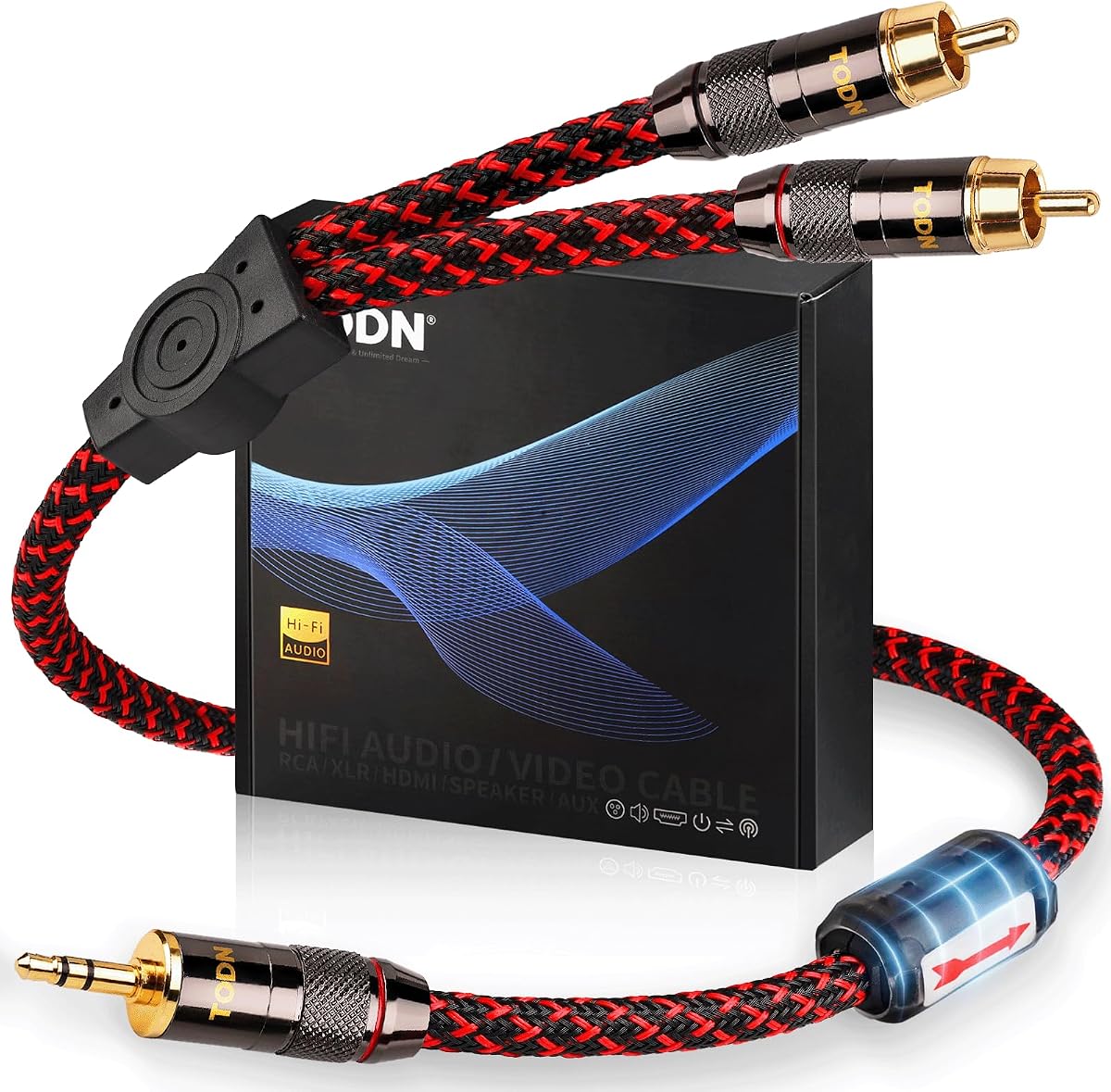
The TODN 3ft RCA to 3.5mm Cable is the most specialized premium option in this guide, carrying a 4.5 rating and emphasizing signal integrity. Its four-core 99.99% oxygen-free copper construction, tinned copper braided shielding, ferrite bead, and built-in PCB splitter target users who want more control than a conventional auxiliary lead provides.
We may earn a commission when you buy through this link, at no additional cost to you.
The ferrite bead is positioned about 15 centimeters from the 3.5mm output end, and an arrow identifies the intended direction of signal flow. The internal PCB is intended to divide the stereo output more precisely into left and right channels, while matching seven-millimeter cable diameters on both the main and split sections help limit crosstalk. A 24K gold-plated pure copper plug supports corrosion resistance and conductivity.
This design does carry a meaningful responsibility. The arrow must be respected because reversed installation may create a signal-level mismatch and, according to the supplied information, could damage equipment. Its three-foot length also makes it less suitable for widely separated components. The more elaborate construction is best appreciated in a considered desktop or near-field setup rather than a casual temporary connection.
This is the pick for listeners who care about interference control, channel separation, and a clearly defined installation process. It is appropriate for connecting a phone, laptop, MP3 player, or gaming device to a home theater receiver or car audio system where the components sit close together. Buyers prioritizing easy installation over advanced signal conditioning should look toward a simpler option.
A four-core conductor increases the available conductor surface area compared with a two-core layout. Combined with 99.99% oxygen-free copper, the construction is intended to support lower resistance, stronger bass, and better high-frequency detail.
The ferrite bead and tinned copper braid target EMI, RFI, and crosstalk, while the arrow prevents the user from installing the cable against the intended signal direction. The result is a more specialized design than a standard Y cable.
We may earn a commission when you buy through this link, at no additional cost to you.
The Amazon Basics 3.5mm Stereo Aux to 2 RCA Audio Cable Adapter is a four-foot adapter with a 4.7 rating and an uncomplicated approach. The package includes one 3.5mm male connector and two male RCA connectors, making its format immediately understandable for connecting a portable source to stereo equipment.
We may earn a commission when you buy through this link, at no additional cost to you.
Dual shielding and polished metal connectors form the core of its construction, while the 3.5mm plug receives a corrosion-resistant gold-plated finish. The stated goal is clear audio with minimal signal loss. Its compatibility covers the standard left and right inputs found on common speakers, stereo receivers, amplifiers, smartphones, tablets, and MP3 players.
This is not the most specialized model in the list. Its four-foot length is appropriate for equipment placed close together but can be limiting across a larger room or entertainment console. The construction also does not emphasize a braided exterior or a directional ferrite bead. Those omissions are logical for a standard adapter designed to provide a direct route between common ports.
Amazon Basics is a sensible selection for readers who want a recognizable, conventional adapter without extra installation features. It works well for a phone or tablet beside a pair of powered speakers, a laptop connected to a compact stereo, or a straightforward legacy system upgrade. Choose it for simplicity, standard compatibility, and a cable length that suits a nearby setup.
The cable does not require ferrite beads, directional arrows, or other specialized setup procedures. One end connects to a 3.5mm output, and the other separates the signal into right and left RCA inputs.
The gold-plated 3.5mm connector is designed to resist corrosion, while dual shielding helps maintain a clean signal. Polished metal RCA connectors add a straightforward, durable interface for permanent or repeated connections.
We may earn a commission when you buy through this link, at no additional cost to you.
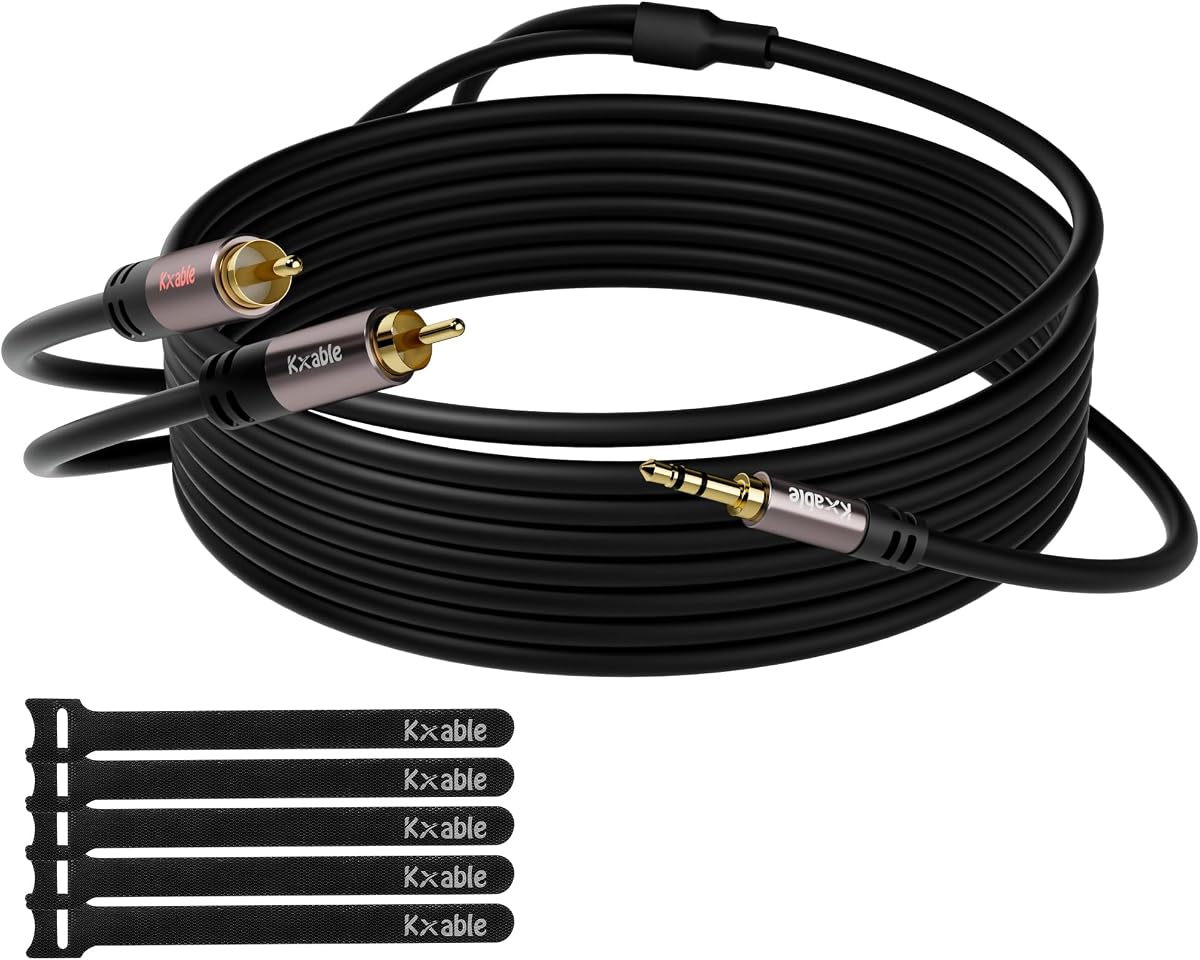
The 15FT 3.5mm to RCA Cable is built for installations where the source and stereo system are far apart. Its 4.7 rating reflects a generally strong feature set that includes a double-shielded cable, an oxygen-free copper core, 24K gold-plated plugs, and sturdy aluminum connector shells.
We may earn a commission when you buy through this link, at no additional cost to you.
The 15-foot span offers considerable placement freedom. It can reach across a room, connect equipment on different shelving units, or run behind an entertainment center without requiring an extension. The step-down ladder design and high-elastic PVC jacket are intended to make the long cable more manageable and flexible than a stiff alternative.
Durability is emphasized through testing of more than 10,000 bends without reported damage or performance change. That figure supports routine handling, although a long cable remains more exposed to pulling and tangling than a short one. The included five cable ties help control excess length, and the gold-plated plugs and aluminum shells are designed to resist oxidation and corrosion.
Choose this cable when reach is the primary requirement. It is appropriate for a phone or tablet feeding a distant speaker system, a laptop connected to an entertainment center, or an outdoor, home, or office arrangement. For a compact desk, a three- or four-foot lead will usually be easier to manage and less likely to create excess slack.
Fifteen feet allows one cable to cross a room or connect components on separate pieces of furniture. That removes the need for an intermediate extension and helps preserve a straightforward installation.
A high-elastic PVC jacket supports easier handling, while the supplied ties help bundle unused length. The result is more practical for long runs than an unmanaged length of stiff cable.
We may earn a commission when you buy through this link, at no additional cost to you.
The CableCreation 3.5mm to RCA Cable stands apart with a 10-foot length, soft cotton-braided exterior, and a right-angle 3.5mm connector. It carries a 4.7 rating and is especially useful where clearance is limited, such as a device positioned against a wall or inside a road case.
We may earn a commission when you buy through this link, at no additional cost to you.
The 90-degree connector reduces how far the cable projects from the source device. It can also relieve strain on the connection by avoiding a sharp pull directly against the 3.5mm socket. Gold-plated connectors and oxygen-free copper support conductivity, while the slim connector is designed to fit a broad range of 3.5mm audio jacks.
Users should confirm that a right-angle plug physically fits their equipment before purchasing. Some recessed or unusually shaped sockets may not provide enough clearance. The cable is also bi-directional, which means it can transmit from RCA output to 3.5mm input or from 3.5mm output to RCA input, but it cannot operate in two output directions simultaneously.
This is an excellent choice for tight installations where a straight plug would protrude awkwardly. It suits compatible phones, tablets, laptops, media players, televisions, car systems, amplifiers, speakers, and receivers. The ten-foot length gives more routing freedom than a short adapter while remaining practical for most entertainment setups.
The right-angle profile keeps the cable closer to the device than a conventional straight plug. That can make it easier to connect equipment positioned against furniture, a wall, or the rear of a case.
The soft cotton braid is designed to remain flexible and neat over time. It suits installations where the cable will be visible and handled regularly without sacrificing useful length.
We may earn a commission when you buy through this link, at no additional cost to you.
The Audiophile HiFi RCA to 3.5mm Audio Cable is a compact 3.28-foot option built around 4N oxygen-free copper conductors, multi-layer shielding, and thick gold plating. Its 4.5 rating reflects a design aimed at balanced response and detailed stereo sound across bass, midrange, and high frequencies.
We may earn a commission when you buy through this link, at no additional cost to you.
The internal shielding combines a high-density tinned copper braid with double-layer PVC shielding and ferrite cores. This layered approach is intended to reduce EMI, RFI, signal loss, and distortion. The connectors use pure copper cores with five-micron gold plating, exceeding the standard plating thickness cited in the product information to support corrosion resistance and reliable insertion.
Its main limitation is length. At just over three feet, it is best suited to equipment arranged immediately beside one another. A premium build cannot solve the need for distance, so this cable is less practical when the source and receiver sit several feet apart. The specialized shielding and connector treatment may also exceed what a basic listening arrangement requires.
Choose it for a close-range desktop or near-field audio setup where compactness, layered protection, and refined connector construction are priorities. It can connect a speaker, home stereo system, or television with a 3.5mm output to RCA inputs. It is a compelling compact cable, but buyers should measure their setup and confirm that the short cable will reach.
Tinned copper braid, double-layer PVC shielding, and ferrite cores work together to reduce electromagnetic and radio-frequency interference. The multi-shielding design is especially relevant near computers, power adapters, and other electronics.
Five-micron gold plating provides a thicker corrosion-resistant layer than the product description's standard comparison. Pure copper connector cores support smooth insertion and stable electrical contact over repeated use.
We may earn a commission when you buy through this link, at no additional cost to you.
The SKW Audiophile 3.5mm to Dual RCA Y Cable uses a 3.2-foot length and a 4.6 rating to deliver a notably robust build. Its 22AWG copper core, seven-millimeter diameter, dual-layer shielding, nylon-braided exterior, and 24K gold-plated connectors make it appealing for both home audio and professional equipment connections.
We may earn a commission when you buy through this link, at no additional cost to you.
The relatively substantial 22AWG construction is designed to resist premature wire fatigue, while the high-purity copper core and extra shielding support clear audio transmission. The high-gloss copper housings provide a polished appearance, and the gold-plated connectors are intended to resist corrosion. Together, these details suggest a cable intended to tolerate regular handling and repeated connections.
The one-meter length is the principal compromise. It works well for a portable player, laptop, DJ device, or instrument-oriented setup close to an amplifier, but it may be insufficient for components on separate stands or furniture. The cable also relies on conventional channel separation rather than a PCB splitter or directional ferrite bead.
Choose this cable when equipment will be connected and disconnected frequently or when a substantial, braided cable is preferred for a near-field setup. It is compatible with subwoofers, DJ equipment, MP3 and CD players, laptops, tablets, and amplifiers or receivers with red and white RCA inputs. For a balanced desktop installation, it offers a strong combination of gauge, shielding, and connector durability.
A 22AWG copper core and seven-millimeter profile give the cable a more substantial feel than many lightweight alternatives. The nylon braid and extra shielding are designed to withstand years of daily use without fraying.
The 3.2-foot length is convenient for equipment arranged closely on a desk, DJ workstation, or media shelf. It is especially useful for portable sources and professional devices that frequently need to be disconnected.
We may earn a commission when you buy through this link, at no additional cost to you.
The Premium AUX to 2RCA Audio Cable combines a 3.2-foot length with a 4.7 rating and a 75-ohm constant-impedance design. High-purity copper conductors, double-layer shielding, 24K gold-plated connectors, and a reinforced copper shell give it a premium specification set for compact stereo installations.
We may earn a commission when you buy through this link, at no additional cost to you.
Constant impedance is the distinguishing technical detail. The listed 75-ohm design is intended to support consistent high-quality signal transmission and preserve detail across the audio signal path. Shielding adds protection against interference, while the cotton-braided cover is presented as a durable and visually tidy exterior for equipment exposed to regular handling.
The product information states that the cable passed a rigorous bend test exceeding 15,000 cycles. That is a strong stated durability figure, although it does not replace careful installation. The one-meter length remains best for devices and stereo components positioned close together, and the premium features offer less practical value if the cable must cross a large room.
Choose it for a close-range setup involving an amplifier, speaker, smartphone, tablet, laptop, turntable, or another device with a 3.5mm output. It is well suited to buyers who value controlled impedance, layered shielding, and a braided appearance. Verify that the source provides an audio output and the destination accepts the appropriate right and left RCA inputs.
The stated 75-ohm constant impedance is intended to promote consistent signal transmission. This specification is relevant when the cable connects sensitive source equipment to a conventional stereo input in a close, considered setup.
The cotton-braided cover combines a neat appearance with resistance to everyday wear. The listed bend testing supports confidence in routine handling, provided the cable is installed without sharp bends or pulling force.
We may earn a commission when you buy through this link, at no additional cost to you.
The right 3.5mm to RCA cable depends on connector compatibility, cable length, signal direction, shielding, construction, and where the equipment will be installed. These factors matter more than decorative specifications when choosing a dependable stereo lead.
Most 3.5mm to RCA cables use a 3.5mm male plug at the source and two male RCA plugs at the destination. The 3.5mm end carries a combined stereo output, while the red and white RCA ends separate the right and left channels. Check that the portable device has a 3.5mm audio output and that the receiver, amplifier, speaker, television, or car unit has two RCA audio inputs. Some cables can work in either direction, but one end must always be an output and the other an input.
Length should reflect the actual distance between devices, with a little extra for routing and service loops. A four-foot cable is common for equipment on the same desk, while six- to ten-foot options work for nearby shelves and entertainment units. A 15-foot cable offers more freedom across a room but can introduce excess slack. Buyers should avoid choosing a very short premium cable when components sit on separate stands unless the setup is deliberately compact.
Shielding helps protect a low-level analog audio signal from electromagnetic and radio-frequency interference. Dual shielding, foil, braided shielding, ferrite beads, and multi-layer constructions all serve this general purpose, though they are not automatically required in every room. The need is greater near computers, power transformers, poorly shielded adapters, and long cable runs. A basic shielded cable is usually sufficient for short connections, while a heavily conditioned or multi-shielded model makes more sense in a dedicated audio setup.
The 3.5mm plug must physically fit the source socket without being stopped by a device case. A slim or step-down connector can make a meaningful difference for phones and tablets in bulky protective cases. A right-angle plug is useful behind furniture or in road cases because it reduces protrusion and relieves strain. Standard straight plugs are more universally compatible and often preferable where clearance is plentiful. Gold plating helps resist corrosion, but connector geometry matters just as much as finish.
A flexible jacket is easier to route around furniture and less likely to develop a sharp stress point. Braided nylon or cotton exteriors improve handling and can resist abrasion, while PVC jackets remain a practical and economical option. The stated bend rating provides a useful durability reference, though ratings from different manufacturers are not directly comparable. A well-made cable should bend smoothly, retain its shape reasonably well, and use connectors that remain secure after repeated insertion and removal.
Some premium cables add a ferrite bead, PCB-based Y splitter, multi-layer shielding, controlled impedance, or four-core conductors. These features can be useful in audio-focused environments, specialized equipment, or installations where the source and receiver are close enough to benefit from precise channel separation. They are not essential for every use, and directional models require careful installation. Standard shielded cables remain more forgiving and usually easier to use as a temporary or universal connection.
The listed compatibility of these cables covers common 3.5mm sources, including phones, tablets, laptops, MP3 players, and CD players, along with RCA-equipped amplifiers, receivers, speakers, televisions, and car audio. Do not assume that an older device with a 3.5mm jack can output stereo to a modern receiver. Likewise, a turntable may require a separate phono preamplifier and a line-level output before this type of connection is appropriate.
Look for recognizable red and white channel markings, a secure 3.5mm fit, and a Y splitter that cleanly separates left and right. These details reduce installation errors and help maintain a stable connection. For permanent installations, route the cable away from power cords and tightly bind excess length. For portable use, a braided jacket and compact connector arrangement make storage and repeated connection more convenient.
Begin by identifying the audio output on the 3.5mm source and the right and left RCA inputs on the destination. Connect the 3.5mm plug fully into the source, then match the red RCA plug to the right channel and the white RCA plug to the left channel. On directional models, follow the arrow near the ferrite bead. Turn the source volume down before making the connection, and raise it only after confirming that the stereo path is active.
For the best physical result, route the cable along furniture or behind equipment rather than across a walking path. Avoid placing it beside high-power electrical cables for long distances, and do not create tight bends at either connector. When excess length is unavoidable, coil the cable loosely and secure it with a reusable tie. Do not wrap a cable too tightly around itself, as prolonged compression can damage the jacket or internal conductors.
Disconnect the cable by gripping the plug rather than pulling the cable. At each connection, inspect the 3.5mm tip and RCA contacts for dust, debris, bent pins, or corrosion. Keep the cable away from moisture, direct heat, and pets that may chew the jacket. If interference appears, check the channel connections first, move the cable away from power sources, and reseat both ends before assuming the cable itself is faulty.
A 3.5mm to RCA cable connects a 3.5mm stereo audio output to right and left RCA inputs. Common source devices include phones, tablets, laptops, MP3 players, and CD players. Typical destinations include amplifiers, stereo receivers, powered speakers, televisions, and car audio systems that have matching red and white RCA inputs.
Yes, the standard version carries a combined stereo signal from the 3.5mm plug and separates it into left and right channels at the two RCA plugs. The red lead normally represents the right channel, while the white lead represents the left. A mono cable or one with a different connector arrangement may not work with the same equipment.
Only when the turntable provides a suitable line-level output. Many turntables output a low-level phono signal that must first pass through a phono preamplifier. Connecting that signal directly to a standard AUX input can produce quiet or distorted sound. Check the turntable documentation and the receiver's input requirements before making the connection.
It depends on the shape and depth of the device's audio socket. A right-angle plug is useful in tight spaces, but some recessed ports or large protective cases may not leave enough clearance. Measure the available space and compare it with the product images before purchasing, particularly when the device will remain in its case.
Length can make interference and signal loss more relevant, especially when a cable runs near power equipment or across a large room. A well-constructed cable with effective shielding should perform well for normal home and studio distances. Rather than worrying about every inch, prioritize suitable shielding, secure connectors, and a route that avoids electrical noise.
Yes. Lowering the volume before inserting or removing the 3.5mm plug reduces the chance of a loud pop or sudden burst of audio. It is also good practice to power down or mute equipment when making significant connection changes, particularly in a home theater or car audio installation.
A directional cable is designed for one signal path, such as a 3.5mm output feeding RCA inputs. An arrow or other marking identifies the intended direction. Reversing a directional model may create a signal-level mismatch and, with some specialized cables, could damage connected equipment. Follow the manufacturer's orientation instructions.
First, make sure the red and white RCA plugs are connected to the correct channels and are fully seated. Next, keep the cable away from power cords, transformers, and poorly shielded adapters. A cable with effective shielding can help, but it cannot compensate for incompatible equipment or a very noisy electrical environment. Test with a short, known-good connection if the problem continues.
The UGREEN cable is the strongest all-around value, with a practical 6.6-foot length, a case-friendly slim connector, and a 4.7 rating. The JSAUX model is the well-rounded choice for readers who want a double-braided exterior, dual shielding, and versatile bi-directional use. For a close-range premium system, the TODN cable stands out with four-core oxygen-free copper, integrated PCB splitting, and dedicated interference conditioning.
Most buyers should begin with compatibility, required length, and connector fit rather than paying for features they will not benefit from. A standard shielded cable is sufficient for nearby devices, while a braided construction, right-angle plug, or longer run becomes valuable as the installation becomes less conventional. Premium shielding, controlled impedance, and directional components are most relevant to dedicated audio equipment and carefully arranged setups.
Ratings, product details, and availability can change over time, and current prices may vary between sellers. Review the latest listing, confirm the exact connector arrangement, and check the dimensions and intended signal direction before buying. Those checks will help ensure that the selected cable integrates cleanly with the source, receiver, speakers, and surrounding setup.