
EBL Universal Smart Battery Charger
4.5Editor score
Supports multiple battery sizes
Built-in discharge function
LCD charging-status display
Discover the best NIMH smart charger for AA, AAA, hobby packs, and mixed batteries, with expert comparisons of features, safety, and capacity.
A NIMH smart charger should do more than refill ordinary AA and AAA cells. It should recognize battery conditions, manage charging safely, provide useful status information, and accommodate the rechargeable batteries found in flashlights, remotes, cameras, toys, and other everyday equipment.
We compared all ten chargers by examining supported battery formats, independent charging behavior, display or indicator options, protection features, connector coverage, and intended use. The list includes compact four-bay units, high-capacity multi-bay chargers, hobby-pack models, and advanced chargers with diagnostic functions.
Each review explains where the charger stands out, where its compatibility limits matter, and whom it is likely to suit. Product ratings and configurations may change over time, and current prices, availability, and included accessories should always be checked on the linked listing before buying.
4.5Editor score

4.8Editor score
4.2Editor score
This side-by-side comparison highlights supported battery formats, capacity, status displays, safety systems, and specialized functions, helping distinguish everyday AA/AAA chargers from hobby-pack and diagnostic models.


The EBL LCD 4-Bay Charger is a straightforward, compact option for households that need dependable charging for AA and AAA rechargeable cells. Its 4.6 rating reflects a generally favorable balance of clear status reporting, broad mains compatibility, and individual slot control. The defining feature is the separate LCD display for each of the four bays, allowing users to see progress without interpreting a shared row of lights.
We may earn a commission when you buy through this link, at no additional cost to you.
Each occupied bay operates independently, so one, two, three, or four cells can be charged without requiring a particular pairing arrangement. The screen identifies charging, completion, and error states, including an error message when a cell is installed incorrectly or may be defective. An advanced microcontroller and negative-delta-voltage cutoff method support the transition to trickle charging, while overheat, overcurrent, and short-circuit protection add layers of control.
The charger accepts both NiMH and NiCD rechargeable batteries and operates from 100–240V AC at 50/60Hz, making it suitable for use in many regions. Its main limitation is format flexibility: it does not accommodate C, D, or 9V cells, hobby packs, or the diagnostic features available on larger models. It also lacks a discharge function, so it is less useful for users who want to measure capacity or condition.
This EBL is a strong choice for people who value understandable displays more than extensive battery analysis. It is particularly helpful when a household regularly mixes different AA and AAA batteries and wants to know which one is still charging. For users who only need ordinary rechargeable cells and a clear four-slot setup, it offers a focused alternative to larger and more complex chargers.
A dedicated display for every bay removes the guesswork associated with shared status lights. You can charge a single cell without filling unused spaces, then track completion and possible errors one battery at a time.
Detection for defective cells, incorrect installation, short circuits, overheating, and overcurrent makes the charger more than a basic power block. The negative-delta-voltage approach also supports a controlled trickle stage after charging.
We may earn a commission when you buy through this link, at no additional cost to you.
The BONAI 16-Bay Charger is built for households, schools, offices, and hobbyists who routinely need more than four cells ready at once. Its 4.5 rating reflects a well-established design that emphasizes slot count, independent control, and simple red-and-green status lights. The standard American AC plug and attached cord make it straightforward to place wherever charging is needed.
We may earn a commission when you buy through this link, at no additional cost to you.
Every bay can operate independently, and users can charge a single battery, a partial group, or a full set. AA and AAA NiMH cells may be mixed without having to fill neighboring positions. Empty slots initially show green to confirm that power reaches each port, occupied charging ports turn red, and completed ports return to green. A flashing red indication alerts the user to a defective battery.
The charger supports 110–240V input and supplies a 1.4V DC output with a stated current range of 250–500mA. As more cells are added, the overall charging time increases. It does not support alkaline or lithium cells, and the batteries are not included. Safety features cover overcharging, overvoltage, overcurrent, overheating, short circuits, and reverse polarity.
This model is best for buyers who have a large collection of AA and AAA NiMH batteries and value capacity over a screen or discharge analysis. Some warmth during use is normal, so the charger should remain uncovered in a ventilated location. For the right battery mix, its sixteen independent bays can consolidate an entire collection into one organized charging station.
Large collections no longer need to be rotated through several small chargers. Sixteen independently controlled positions allow occupied slots to charge together without wasting capacity on empty spaces.
The red charging, green completed, and flashing defective-battery indications are easy to interpret at a glance. This is useful in offices or homes where users may not want to navigate a complicated touch interface.
We may earn a commission when you buy through this link, at no additional cost to you.
The Tenergy 8.4V–9.6V Smart Charger serves a specific but important role: recharging seven-cell and eight-cell NiMH battery packs used in airsoft equipment, RC cars, and RC airplanes. Its 4.7 rating places it among the strongest options in this roundup, while its compact design and uncomplicated LEDs make it approachable for hobby users.
We may earn a commission when you buy through this link, at no additional cost to you.
The supported pack range is 8.4V to 9.6V, covering packs with capacities from 600mAh to 2500mAh according to the product information. A mini Tamiya connector is included, along with an adapter for standard Tamiya connections. Green and red LEDs communicate completed and active charging states, removing the need for a detailed screen when the main goal is straightforward pack recharging.
Its 100–240V AC input supports use across many countries, and the stated CE and UL certifications reinforce its suitability as a hobby accessory. The important limitation is chemistry: it is designed only for NiMH packs and must not be used with LiPo batteries. It also does not accept the AA, AAA, or other consumer cells handled by the household chargers in this guide.
Buyers with compatible NiMH hobby packs will appreciate the small footprint, included connector, and clear status behavior. It is a better fit than a general-purpose consumer-cell charger and easier to operate than an advanced diagnostic model. The right choice for a user is someone who has 8.4V or 9.6V packs and wants dedicated, straightforward charging without unnecessary settings.
Supporting seven- and eight-cell NiMH packs makes this a focused solution for RC and airsoft equipment. Users do not need to adapt a consumer AA charger or navigate a charger intended for unrelated battery formats.
The included mini Tamiya connector and mini-to-standard adapter cover common hobby configurations. The straightforward red and green LEDs also let users check progress without decoding detailed electrical measurements.
We may earn a commission when you buy through this link, at no additional cost to you.
The EBL 8-Bay Smart Battery Charger bundle is appealing to first-time rechargeable-battery buyers because it includes both AA and AAA NiMH cells alongside the charger. Its 4.5 rating reflects a useful combination of four 2800mAh AA batteries, four 1100mAh AAA batteries, and an upgraded charger designed to accept different quantities of cells.
We may earn a commission when you buy through this link, at no additional cost to you.
The charger can accommodate any number of AA or AAA rechargeable batteries across its eight bays. A negative-delta-voltage intelligent cutoff method automatically transitions cells into trickle charging, while heat management, short-circuit detection, and input-voltage checks help protect both the cells and charger. Smart LEDs indicate the charging process and help distinguish rechargeable cells from unsuitable batteries.
Compared with simple four-bay models, this set offers more room to charge a mixed collection simultaneously. It does not show numerical voltage, current, internal resistance, or capacity, and it cannot perform discharge analysis. The included AAA cells have a lower 1100mAh capacity than the 2800mAh AA cells, which is normal because smaller cylindrical cells generally hold less energy.
This bundle is a convenient option for a new household that wants a ready-to-use rechargeable system rather than a charger alone. It is less appropriate for technical collectors who need measured diagnostics or for users who already own plenty of cells. For ordinary household devices, flashlights, remotes, and toys, the combination provides a practical foundation with eight charging positions.
Starting with compatible cells removes the uncertainty of finding batteries that match both the charger and intended devices. The mix of high-capacity AA cells and smaller AAA cells supports a broad range of common household equipment.
Users can combine AA and AAA batteries without sacrificing empty slots. The upgraded charger independently manages the occupied positions and uses LED cues to communicate progress and incompatible cells.
We may earn a commission when you buy through this link, at no additional cost to you.
The Tenergy 7.2V–12V Smart Charger combines broad NiMH and NiCD pack support with automatic setup, making it a versatile option for RC cars, airplanes, and airsoft equipment. Its 4.6 rating reflects a dependable design with selectable current, useful connector options, and simple status indicators for hobby users.
We may earn a commission when you buy through this link, at no additional cost to you.
The charger accommodates six-cell through ten-cell packs at nominal voltages from 7.2V to 12V. Automatic voltage detection reduces the need for manual configuration, while two current settings provide flexibility: 0.9A is recommended for 900–1800mAh packs, and 1.8A is recommended for packs from 1800mAh to 5000mAh. Users should always verify pack chemistry, voltage, and connector type before connecting it.
The included accessories cover standard Tamiya, mini Tamiya, and alligator-clip connections through the supplied adapters. Green and red LEDs identify completed and active charging states. The product information also cites American UL 60950-1 and CE standards, along with a 12-month warranty, adding reassurance for a tool used with higher-energy hobby packs.
This Tenergy is best for hobbyists who own several pack voltages rather than one fixed configuration. It is less suitable for ordinary AA and AAA charging and lacks the advanced numerical analysis found in the ISDT model. Its wider voltage and connector range, however, gives it strong appeal for a varied collection of rechargeable RC and airsoft packs.
The charger identifies compatible pack voltage rather than requiring users to make a detailed manual selection every time. This is convenient for hobbyists who alternate between different RC and airsoft configurations.
Two current levels allow the charging rate to correspond more closely with pack capacity. The included Tamiya and alligator adapters also broaden the range of equipment that can be connected.
We may earn a commission when you buy through this link, at no additional cost to you.
The EBL Universal Smart Battery Charger is a feature-rich option for users who need more than AA and AAA support. Its 4.5 rating reflects a versatile multi-size design, an informative LCD, and a discharge mode, while the ability to mix several rechargeable formats makes it stand apart from conventional household chargers.
We may earn a commission when you buy through this link, at no additional cost to you.
The bay configuration accepts one to four AA, AAA, C, or D cells and one or two 9V NiMH or NiCD batteries. Independent slots allow mixed sizes to charge simultaneously without forcing a fixed arrangement. A blue button activates discharge mode for one to four AA, AAA, C, or D cells, and the LCD displays the active mode before the charger returns to normal charging.
The stated total output is 2A for two to four AA, AAA, C, or D cells. Claimed full-charge windows are three hours or less for AA and AAA cells and ten hours or less for C, D, and 9V batteries. Intelligent safety controls terminate charging for invalid voltage, faulty cells, short circuits, and non-rechargeable batteries, while constant-current technology is designed to reduce power fluctuations.
This model is an excellent match for households maintaining a broad rechargeable collection, especially one that includes C, D, or 9V cells. It is not appropriate for lithium chemistry despite the broad appearance of the product family, so users must confirm NiMH or NiCD labeling. The LCD and discharge function provide more control than a basic LED charger without approaching the ISDT's diagnostic complexity.
Support for AA, AAA, C, D, and 9V rechargeable cells reduces the need for separate hardware. Independent slots are especially valuable when a collection contains several shapes and quantities.
The blue-button discharge function is more than a cosmetic extra because it can support battery maintenance and condition checks. The LCD clearly identifies when discharge mode is active and when normal charging resumes.
We may earn a commission when you buy through this link, at no additional cost to you.
The MIEKLALE 20+2 Bay Charger is designed for unusually large rechargeable collections. Its 4.6 rating reflects a high-capacity design that can manage up to twenty AA or AAA cells and two 9V batteries. The generous slot count makes it relevant to collectors, schools, photographers, and households that prefer to recharge everything in one session.
We may earn a commission when you buy through this link, at no additional cost to you.
Each AA/AAA position operates independently, so users can charge any number up to twenty without filling unused spaces. Two additional 9V positions expand compatibility beyond ordinary cylindrical cells. The LCD provides visible information about the charging process, while intelligent protection addresses overcharging, overcurrent, overvoltage, overheating, and short circuits.
The charger is limited to 1.2V NiMH and NiCD rechargeable cells and compatible rechargeable 9V batteries. It cannot charge 3.7V lithium batteries or 1.5V lithium AA and AAA cells. A discharge function is also unavailable, so users seeking capacity analysis or controlled depletion should consider the ISDT N8 instead.
This model makes the most sense when battery quantity is the central concern. A household with only a few cells may find it unnecessarily large, while a collector will appreciate the ability to clear an entire collection at once. Its protective system and independent control make it a practical high-volume option as long as the batteries fall within the clearly stated chemistry limits.
The unusual slot capacity removes much of the inconvenience of rotating many batteries through smaller chargers. AA and AAA cells can share the main bays, while separate positions accommodate rechargeable 9V batteries.
The product is optimized for NiMH and NiCD cells, not lithium chemistries. Users with mixed chemistry collections should label batteries carefully and confirm their type before every charging session.
We may earn a commission when you buy through this link, at no additional cost to you.
The ISDT N8 is the most technically advanced charger in this selection, combining eight independent slots, a full-color touch display, and several diagnostic functions. Its 4.8 rating is the highest among the ten products, making it a natural choice for users who want to see voltage, current, elapsed time, internal resistance, estimated capacity, and other useful information.
We may earn a commission when you buy through this link, at no additional cost to you.
Its claimed charging capability reaches up to 15A per slot through the 18W input system, and the product information lists a 90-minute full-charge window for compatible cells, with actual times varying by capacity. A manual operating mode is available alongside automatic handling. The display and touch panel let users configure and review charging, cycling, activation, and discharge functions without relying on ambiguous indicator lights.
The N8 supports AA and AAA rechargeable formats and lists NiMH, NiCd, Li-ion, and LiHV within its broader compatibility information. It cannot charge 1.5V lithium AA or AAA batteries, and auto mode is advised when battery type is uncertain. The product information also notes US safety certification, automatic completion, trickle-charge technology, and PC software availability for compatible users.
This is the charger for battery enthusiasts, photographers, remote-control hobbyists, and anyone who wants more than a basic full signal. The advanced display adds a learning curve compared with simple LED models, but it turns a routine charging session into a measurable process. Among the chargers reviewed, it offers the strongest combination of diagnostics, charging control, and independent multi-bay operation.
Voltage, current, charging time, mode, internal resistance, and estimated capacity turn the display into a practical diagnostic dashboard. This information helps users identify weak cells that a basic charger might treat as completed.
Charging, cycling, activation, and discharge functions offer more control than a conventional charger. Independent slots and USB-C input also make the N8 suitable for users who want high flexibility from a compact eight-bay system.
We may earn a commission when you buy through this link, at no additional cost to you.
The EBL 8-Bay Individual Charger is a practical middle ground between compact four-slot models and larger charging stations. Its 4.5 rating reflects a straightforward design with independent controls, clear LED states, and a familiar AA/AAA layout. It is well suited to households that regularly cycle through multiple rechargeable cells.
We may earn a commission when you buy through this link, at no additional cost to you.
The charger accepts one to eight NiMH or NiCD batteries, including double-A and triple-A formats. Red indicates active charging, green indicates completion, and a flashing red light warns of a bad or non-rechargeable battery. Because each position operates independently, users do not need to charge in pairs or leave neighboring spaces empty.
Microcontroller-based detection handles improper input voltage, defective batteries, short circuits, and unsuitable cells. A negative-delta-voltage cutoff method moves charging into a trickle stage, while constant-current operation is intended to reduce fluctuation and support consistent battery performance. Fire-resistant material is another stated construction feature, although proper battery selection remains the user's responsibility.
This EBL is a good choice for a practical household that values capacity, uncomplicated lights, and established safety behavior without needing discharge analysis. Its limitations are equally clear: it offers no numerical display, cannot analyze capacity, and should not be used with other battery chemistries. Users who want a larger bay count without moving to an advanced touchscreen will find this model direct and dependable.
The charger accommodates partial or full loads without requiring paired placement. This makes it easier to maintain a mixed collection of AA and AAA batteries without rotating devices unnecessarily.
Red for charging, green for completion, and flashing red for a defective or unsuitable cell provide enough feedback for routine use. They are less informative than a diagnostic screen but easier for many users to interpret.
We may earn a commission when you buy through this link, at no additional cost to you.
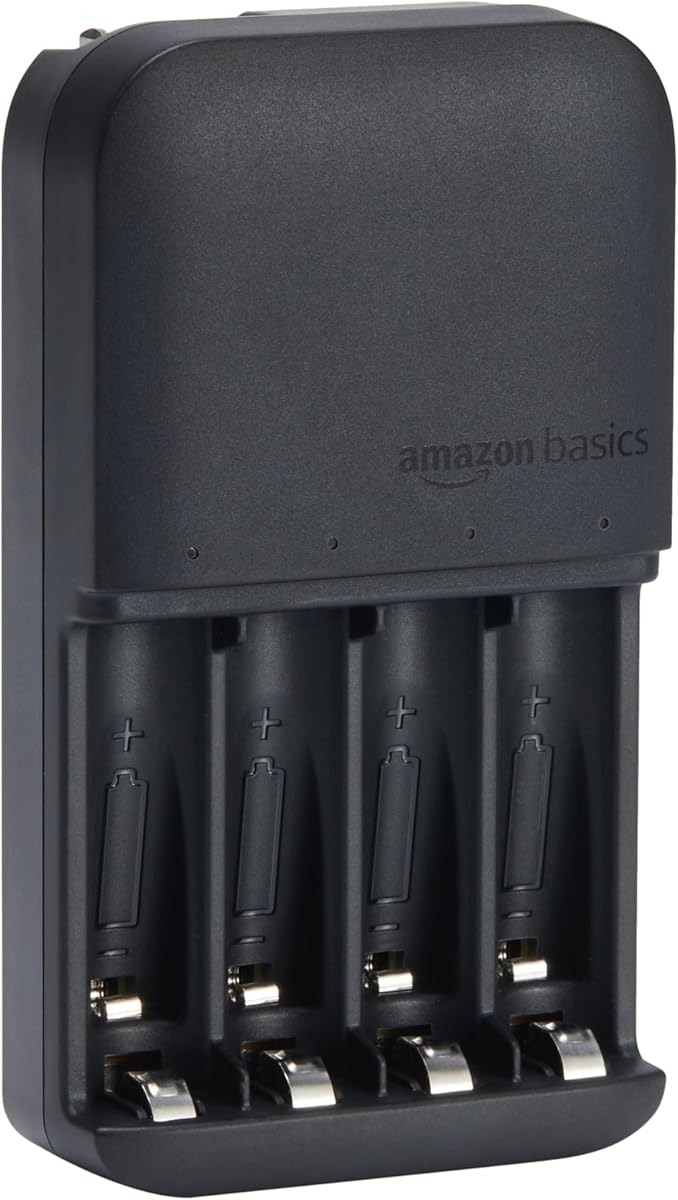
The Amazon Basics Smart Battery Charger is a compact, uncomplicated option for travelers, small households, and anyone who needs to recharge a modest number of NiMH cells. Its 4.2 rating is the lowest in the roundup, but the product still offers useful features including individual slot control, polarity detection, overcharging protection, and a foldable plug.
We may earn a commission when you buy through this link, at no additional cost to you.
This four-bay model charges AA and AAA NiMH batteries independently, allowing one to four cells to be used without filling empty positions. LED indicators communicate charging progress and completion. Stated charging windows include 3.5 hours for two AA cells, seven hours for four AA cells, two hours for two AAA cells, and four hours for four AAA cells.
The switching power design accepts 100–240V AC, although a plug converter is required in regions that do not use the included North American style. The foldable plug and slim body make the unit convenient to pack. Battery detection can indicate incorrect polarity, and the charging system moves into trickle mode when a cell is full to help reduce overcharging risk.
This charger is a sensible budget choice when four AA or AAA cells are enough and advanced battery analysis is unnecessary. It does not support NiCD cells, C or D batteries, 9V cells, hobby packs, or discharge testing. Buyers should also confirm the appropriate plug arrangement for their location. For its straightforward task, it offers a practical combination of portability, independent charging, and basic protection.
The slim housing and foldable plug reduce the space needed for storage and transport. It is a better fit for a small travel kit than an eight- or sixteen-bay stationary charging station.
Polarity detection, overheating prevention, and overcharging cut-off make the charger suitable for routine NiMH use. Trickle charging after completion adds another layer of control without requiring a complex interface.
We may earn a commission when you buy through this link, at no additional cost to you.
The right NIMH smart charger depends on battery format, quantity, chemistry, connector type, and how much diagnostic information you need. These factors help narrow the field before comparing capacity, displays, safety controls, and convenience features.
Begin with the batteries you already own. Many compact chargers accept only 1.2V NiMH AA and AAA cells, while some also support NiCD. Larger universal models add C, D, and 9V formats, and hobby chargers are designed for connected NiMH packs rather than loose consumer cells. Lithium, LiPo, LiHV, and other chemistries have different voltage and charging requirements. A charger that does not explicitly list the chemistry of your battery should not be assumed to be compatible, because incorrect charging can damage a cell or create a safety risk.
Bay count determines how many cells can charge at once. A four-bay model is adequate for a small household or travel kit, while eight bays offer more flexibility for mixed collections. Sixteen- and twenty-bay chargers suit schools, offices, photographers, and hobbyists who regularly rotate many cells. More bays are not automatically better because large chargers take more space and may take longer to complete a full load. Consider how many batteries you normally use, whether they are mixed sizes, and whether one or two cells at a time is sufficient.
Independent control means each occupied position can begin and finish its own charging cycle instead of following a shared pair-based sequence. This is especially useful when charging one AA with three AAA cells, replacing a single battery, or combining cells of different ages. Several products in this guide explicitly support partial loads and mixed formats. Check whether empty or partly occupied bays remain active, since some basic designs tie behavior to neighboring positions. Independent charging is more convenient and can make it easier to identify a cell that does not begin charging normally.
Basic LED chargers use red, green, and flashing patterns to show charging, completion, or a problem. That is sufficient for most routine users and offers lower complexity than a menu-driven device. LCD models can add mode information, and the ISDT provides detailed voltage, current, time, internal resistance, estimated capacity, and operating controls. More information is valuable for battery enthusiasts and diagnostic work, but it can also make charging less approachable. Think about whether you want a glanceable light or a tool for evaluating the condition of individual cells.
Fast charging can shorten downtime, but speed claims should be considered alongside battery capacity, charger power, heat, and the number of cells loaded at once. Some product information states that more batteries increase total charging time, and others give approximate windows for a particular number of cells. A high-current claim should not be read as a guarantee that every battery will finish in the same period. Actual results depend on the chemistry, capacity, age, and condition of the cell. For routine use, a controlled charger with sensible termination is more valuable than a headline speed figure.
Look for protection against overcharging, overcurrent, overvoltage, overheating, short circuits, reverse polarity, and improper input voltage. Detection of non-rechargeable or defective cells is especially useful because a cell that never reaches its expected voltage may otherwise remain connected indefinitely. Negative-delta-voltage cutoff, constant-current charging, and automatic trickle stages are common control methods among the products here. These features should complement correct battery selection rather than replace it. Even a well-protected charger should be used with compatible cells and kept in a ventilated, uncovered location.
Hobby batteries often use Tamiya-style connectors, but the exact lead and adapter arrangement still matters. The smaller Tenergy model includes a mini Tamiya connection and an adapter for standard Tamiya packs. The larger multi-voltage model adds alligator clips, which can be useful when a model or pack lacks a conventional connector. Confirm the pack's nominal voltage, cell count, chemistry, and charging-current recommendation before connecting anything. A charger that handles ordinary AA cells is not automatically suitable for a multi-cell RC or airsoft pack.
A compact charger with a foldable plug is easier to store and travel with than a large multi-bay station. Some products include a full power cord, which can be convenient in a permanent charging area. Several universal models accept 100–240V AC, but that does not guarantee the attached plug will physically fit every outlet. North American-style plugs may require an appropriate converter in other regions. Consider where the charger will live, whether ventilation and outlet space are available, and whether portability matters more than maximum capacity.
Begin by identifying every battery's chemistry, size, voltage, and connector. Use only cells expressly supported by the charger, and inspect them for leakage, swelling, corrosion, cracks, or physical damage. Remove questionable cells from service rather than relying on the charger to diagnose a damaged battery. For hobby packs, verify nominal voltage, cell count, and the manufacturer's recommended charging current before connecting the appropriate plug.
Place the charger on a stable, hard, and ventilated surface. Do not cover it with fabric, place it under furniture, or operate it in a sealed container. Insert cells according to the marked polarity, connect the required power cord or plug, and select an appropriate charging mode if the model offers a menu. Avoid leaving incompatible lithium, alkaline, or other cells in the slots, especially when the charger does not have dedicated chemistry detection.
Check the display or indicator lights during charging and remove a cell if you notice unusual heat, odor, swelling, corrosion, or persistent error messages. Let the charger complete its automatic cycle, and remove cells when the manufacturer indicates they are full. For long storage, use clean, dry battery cases and avoid leaving cells on a charger indefinitely. Periodically clean the contacts with a dry, lint-free cloth, and keep liquids away from the charger.
No. A NIMH smart charger is designed for rechargeable nickel-metal hydride cells, although some models also support rechargeable NiCD batteries. Alkaline cells are not rechargeable and attempting to charge them can cause leakage or damage. Always check the markings on both the charger and the battery before inserting a cell.
Most of the household chargers in this guide support both AA and AAA formats, but their slot layouts differ. Some universal models also accept C, D, and 9V cells, while hobby-pack chargers support no loose consumer batteries at all. Check the listed battery formats, cell count, chemistry, and voltage before choosing a charger for a particular collection.
A brief trickle stage helps top off a rechargeable cell after the main charging period and counteracts small declines in voltage. It is a normal part of the charging cycle for models using negative-delta-voltage cutoff. The charger should stop or greatly reduce current according to its instructions, so prolonged operation with every cell still connected is not necessary.
Only if the charger expressly supports both formats and the correct connector for the pack. A household AA/AAA charger is not automatically suitable for a multi-cell NiMH hobby pack, and a hobby charger may not accept loose cells. The Tenergy hobby models are designed for specific connected pack voltages rather than individual AA or AAA batteries.
Charging restores energy to a rechargeable cell, while discharging consumes that energy. A discharge cycle can be useful for battery analysis, balancing, or maintenance, but it also consumes the cell's charge and requires the correct voltage and current limits. Only the EBL Universal and ISDT N8 in this list explicitly provide discharge functions.
A properly designed fast charger should regulate current, detect faults, and stop or reduce charging appropriately. Safety depends on using compatible cells, following polarity instructions, and allowing the charger to ventilate. Higher charging currents may produce more warmth, so avoid covering the unit and remove any battery that becomes unusually hot, swells, leaks, or smells unusual.
A flashing indicator commonly means the charger has detected a faulty, incompatible, incorrectly installed, or non-rechargeable cell. Remove the affected battery and inspect its polarity, contacts, and physical condition. If the problem continues with a known-compatible cell, stop using that position and consult the charger manufacturer's guidance.
Not for ordinary charging. Simple LED models are sufficient when you mainly need to know whether a cell is charging, complete, or faulty. A display, numerical measurements, and discharge controls are more valuable for battery enthusiasts, photographers, collectors, and users who want to compare cell condition over time.
The ISDT N8 is the strongest all-around choice for users who value detailed battery measurements, multiple operating modes, and independent eight-slot charging. The EBL Universal Smart Charger stands out for support across AA, AAA, C, D, and 9V formats, while the Amazon Basics model offers a compact and uncomplicated option for a small set of NiMH cells.
For larger collections, capacity becomes the deciding factor. The BONAI 16-Bay and MIEKLALE 20+2 models can manage many cells simultaneously, whereas the EBL 8-Bay options provide a practical middle ground. Hobby users should instead match pack voltage, chemistry, capacity, and connector, making the two Tenergy chargers more relevant than general consumer-cell models.
Regardless of the model, correct chemistry selection, polarity, ventilation, and regular inspection matter more than any headline feature. Ratings, accessories, charging specifications, and product configurations can evolve, so check the current listing and warranty details before purchasing. Current prices and availability should also be confirmed directly with the seller.