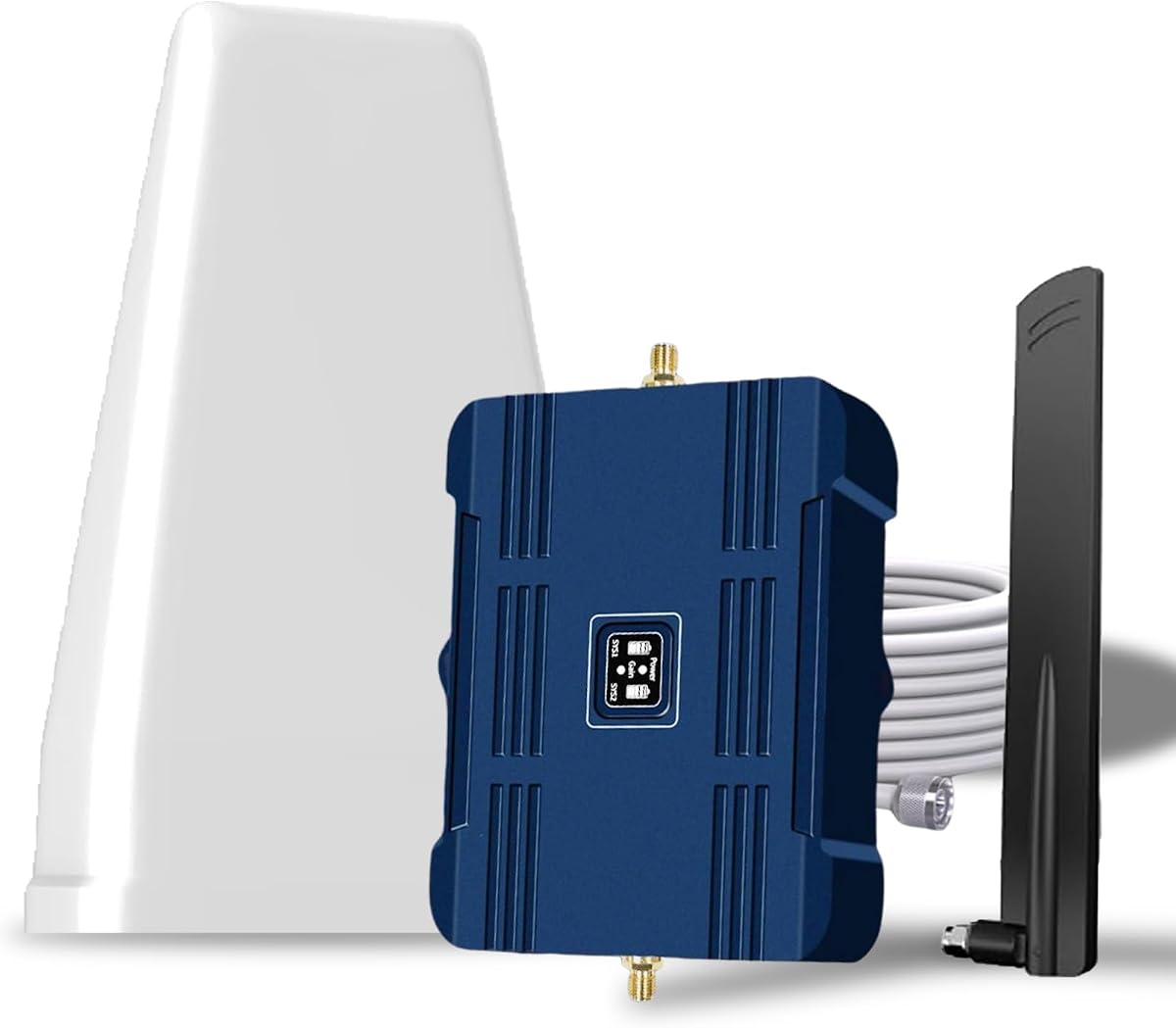
Cell Phone Booster for Home and Office
5.0Editor score
Up to 65dB maximum gain
Automatic gain control
FCC and IC certified
Our Cell Signal Repeater for Metal Building guide compares ten models across coverage, gain, antennas, carrier support, installation needs, and metal-building
Metal walls and roofs can make cellular reception inside workshops, warehouses, offices, garages, and agricultural buildings frustratingly unreliable. A suitable repeater can restore usable voice, text, and data, but the strongest result depends on outdoor signal quality, compatible frequency bands, antenna placement, and building size rather than marketing claims alone.
We compared ten boosters using the supplied specifications, focusing on maximum gain, stated indoor coverage, supported carriers and bands, outdoor antenna type, installation controls, and suitability for metal structures. The guide includes compact home-office systems, higher-capacity multi-antenna kits, directional installations for distant towers, and professional options designed specifically for demanding commercial buildings.
Our top picks highlight a versatile overall option, a capable budget model, and a premium metal-building system. Each review explains the most important strengths, limitations, and ideal user, while noting that product prices and availability change frequently and should be checked before purchasing.
5.0Editor score

4.5Editor score

4.0Editor score
The comparison below organizes all ten systems by their stated gain, intended coverage, antenna approach, and installation complexity, making it easier to identify the right model for your metal building and outdoor reception conditions.


The P50 Metal Building Booster is a compact, high-gain system built specifically for places where metal walls and roofs interfere with cellular reception. Its 4.5 rating reflects a favorable balance of stated performance and customer reception. With up to 72dB of maximum gain, 32X amplification, and coverage of as much as 3,000 square feet, it stands out as a practical option for workshops, home offices inside metal structures, basements, shops, and similar environments.
We may earn a commission when you buy through this link, at no additional cost to you.
Carrier compatibility is one of its strongest attributes. The booster supports AT&T, Verizon, T-Mobile, and Straight Talk when the connected phone uses band 2, 4, 5, 12, 13, or 17. It can also improve 5G performance when the phone's active 5G signal uses one of those supported bands. This makes the system flexible across carriers, although checking the phone's bands and the signal available outside remains an essential first step.
The important limitation is that no booster can create usable cellular service where no suitable signal reaches the outdoor antenna. The stated 3,000-square-foot coverage is also a maximum-style target rather than a guarantee for every layout, wall composition, and outdoor signal condition. Heavy metal construction, internal partitions, equipment, and antenna placement can all influence the result. Buyers should therefore expect the best performance when the outdoor location has at least two bars and the antenna is positioned clearly toward the relevant tower.
This is our overall pick because it combines a generous maximum gain with explicit metal-building positioning, major-carrier support, and a coverage target appropriate for many personal offices, small shops, and commercial work areas. It is especially suitable for users who want one straightforward system rather than a multi-antenna commercial installation. For very large warehouses or extremely remote locations, one of the professional weBoost kits may offer more capacity, but the P50 offers a more compact and approachable path to improving reception.
Metal construction is one of the toughest environments for cellular penetration, and this system is specifically marketed for shops, offices, basements, and metal buildings. Its 72dB maximum gain provides meaningful headroom for improving weak indoor service, provided the outdoor antenna can receive a usable signal.
Support for bands 2, 4, 5, 12, 13, and 17 allows use with several major U.S. carriers and networks. Buyers should still confirm that their phone and active cellular service use one of the included bands before installation.
We may earn a commission when you buy through this link, at no additional cost to you.
The Phonetone Home and RV Booster is designed for homes, recreational vehicles, metal buildings, and other locations where indoor cellular reception needs improvement. It earns a 3.8 rating and offers up to 70dB of maximum gain, 32X amplification, and a stated indoor area of as much as 4,000 square feet. Its most user-friendly feature is the 360-degree omnidirectional outdoor antenna, which reduces the need to identify and aim at a specific cell tower.
We may earn a commission when you buy through this link, at no additional cost to you.
The system operates on bands 2, 4, 5, 12, 13, and 17, supporting compatibility with Verizon, AT&T, T-Mobile, Spring, and other services where the active phone frequencies are covered. Auto Gain Control helps the amplifier adjust to the available signal, while manual gain controls and standby mode add installation flexibility. FCC approval is also a meaningful selling point for a device that is intended to work with cellular networks.
The main compromise is that an omnidirectional antenna gathers signals from every direction rather than concentrating the available power toward one distant tower. That makes installation easier, especially around metal buildings where finding a clear outdoor mounting point and identifying the tower can be inconvenient, but it may not deliver the same focused outdoor reception as a precisely aimed directional system. The 3.8 rating also suggests a more mixed customer experience than the leading products.
This booster makes the most sense for users who prioritize a straightforward plug-and-play setup, support several carriers, or do not know where the nearest tower is located. It is a sensible option for a small business or metal-framed home office with moderate outdoor reception. Buyers facing extremely weak signals or distant towers should consider a directional high-gain antenna system for greater control over the incoming signal.
The 360-degree outdoor antenna removes much of the guesswork associated with directional installation. That convenience is particularly helpful on metal properties where outdoor cable routing and unobstructed placement may already be difficult.
Auto Gain Control is valuable for maintaining stable amplification as the available signal changes. Manual gain controls and standby mode give installers additional ways to optimize or pause the system during setup.
We may earn a commission when you buy through this link, at no additional cost to you.
The weBoost Metal Building 200 is one of the most purpose-specific systems in this guide. It is configured to improve 5G and 4G LTE voice, text, and data inside metal buildings where wall and roof materials create severe reception problems. The kit carries a 4 rating and uses the weBoost Office 200 amplifier, which provides up to 72dB of gain, up to 25 dBm of uplink power, and XDR technology for changing signal conditions.
We may earn a commission when you buy through this link, at no additional cost to you.
The stated coverage extends to 10,000 square feet, making it relevant to small and medium commercial properties such as retail offices, warehouses, mechanic shops, fabrication shops, and indoor recreational facilities. Its directional Yagi outdoor antenna concentrates reception toward a single tower, potentially improving the quality of the signal the system receives before distributing it indoors. The supplied configuration is described as reaching towers approximately three to five miles away when outdoor conditions are moderately weak.
Precision matters with this product. The Yagi antenna must be aimed, and a metal roof or walls can block signals even if the outdoor antenna itself is technically visible. The system is therefore best for semi-rural properties where a tower is within the stated useful range and the installer can position and aim the antenna accurately. Its 25 dBm uplink capability is a notable feature for businesses that need reliable two-way voice and data, but it does not overcome a total lack of usable outdoor signal.
We choose this as the premium option for buyers who need more coverage and power than a compact booster can provide. It is particularly well suited to working metal buildings where reliable connectivity supports point-of-sale systems, employee phones, surveillance communications, or operational software. Although installation is more involved than using an omnidirectional antenna, the focused Yagi approach can be a major advantage for a fixed site with a known tower direction.
The Office 200 amplifier's 72dB gain and 25 dBm uplink power provide more capacity than the smaller home-oriented systems. That makes the kit better suited to daily business use, multiple devices, and larger metal interiors.
The directional Yagi antenna concentrates reception toward one tower and is described as useful at distances of roughly three to five miles. Accurate aiming is essential, and the approach is most appropriate when outdoor reception is moderately weak rather than completely absent.
We may earn a commission when you buy through this link, at no additional cost to you.
The weBoost Metal Building 100 is a dedicated system for metal structures with weak cellular service, especially those in rural or remote areas. It uses the weBoost Office 100 amplifier, which delivers up to 72dB of gain and up to 24 dBm of uplink power. The kit targets up to 8,000 square feet and is intended to support clear calls and faster data in facilities such as auto shops, warehouses, gyms, and storage-facility offices.
We may earn a commission when you buy through this link, at no additional cost to you.
Its defining component is the outdoor LPDA antenna. This high-gain directional antenna is described as focusing toward cell towers as far as 10 miles away, making it more appropriate than a broad omnidirectional setup when the user knows where a distant tower is located. The tradeoff is precision: LPDA performance depends on accurate aiming and a clear path to the tower. Users who cannot identify or reach the tower direction may receive less consistent results.
This listing does not provide a customer rating, so there is no direct rating-based comparison with the other products. The specifications nevertheless position it as a capable professional kit for challenging installations. Like every repeater, it still needs at least a weak but usable cellular signal at the outdoor antenna. The stated 8,000-square-foot figure should be treated as a maximum target influenced by the building layout, number of walls, indoor antenna placement, and signal available outside.
The Metal Building 100 is best for property owners with very weak outdoor reception and a distant tower in a known direction. It can be a strong option for remote workshops or warehouses where a standard indoor booster cannot gather enough signal. It is less convenient for users who want simple omnidirectional placement, but its focused antenna and substantial amplifier output reward careful installation.
The kit's high-gain LPDA antenna is intended to pull a usable signal from distant towers. That focus makes it a better fit for remote installations than systems designed primarily around nearby cellular coverage.
With a stated 8,000-square-foot target and 24 dBm uplink output, the system is aimed at small and medium commercial spaces. Multiple indoor users can benefit when antenna placement and outdoor signal quality are favorable.
We may earn a commission when you buy through this link, at no additional cost to you.
The HiBoost Home Office Booster combines a 4.3 rating with an installation-focused feature set. It is designed to improve signal across approximately 2,500 square feet, enough for a home office, a small commercial room, a basement, or a compact metal-framed workspace. Maximum gain is listed at 62dB, and the system can support multiple users simultaneously while increasing weak signal from one bar toward three or four bars under suitable conditions.
We may earn a commission when you buy through this link, at no additional cost to you.
Installation guidance is a major selling point. The SignalSupervisor app helps users check outdoor signal strength, identify a favorable antenna location, review installation videos, and access online support. A main-unit display provides another way to monitor signal and gain, while Automatic Gain Control adjusts performance as conditions change. This combination makes the booster approachable for first-time users who want visual feedback instead of relying entirely on guesswork.
The system supports Verizon, AT&T, T-Mobile, Sprint, US Cellular, Straight Talk, and other U.S. services, along with 5G, 4G, and 3G. Its band list includes 700–750MHz, 800–850MHz, 1900MHz, and 1700–2100MHz ranges. That provides broad compatibility, but it does not guarantee every 5G band or network experience. Its 62dB gain and 2,500-square-foot target are also more modest than the larger weBoost systems.
This HiBoost is a strong choice for a home office or small metal building where guided setup matters as much as raw capability. It suits users who want a clear installation process, app assistance, and support beyond the standard warranty. Larger warehouses, fabrication facilities, and buildings with several separated work areas will get more from a higher-capacity system with multiple indoor antennas.
The SignalSupervisor app helps identify outdoor signal strength and a better placement for the receiving antenna. The built-in display gives users immediate feedback on the system's status, making troubleshooting more understandable.
The booster supports all major U.S. carriers and a wide range of lower and mid-band frequencies. Its compact coverage target is more appropriate for a small office or workshop than a sprawling industrial property.
We may earn a commission when you buy through this link, at no additional cost to you.
The Home and Office 8,000 Sq.Ft. Booster stands out with a 5 rating, the highest numeric rating in the group, and a balanced set of specifications. It provides up to 65dB of maximum gain and is marketed for spaces ranging from 3,000 to 7,000 square feet. The stated uses include homes, offices, garages, farms, remote areas, warehouses, and metal buildings, giving it unusual flexibility for a value-oriented system.
We may earn a commission when you buy through this link, at no additional cost to you.
It supports bands 2, 4, 5, 12, 13, 17, 25, and 66 across major U.S. carriers, while boosting 5G, 4G LTE, and 3G service for multiple devices. Automatic Gain Control detects the existing signal and adjusts the system for more stable performance. FCC approval and IC certification are especially useful for metal-building buyers because they signal that the product is designed to operate within applicable regulatory guidelines without interfering with the carrier network.
The 7,000-square-foot figure should be interpreted carefully because the listing itself describes a range of 3,000 to 7,000 square feet and says coverage depends on outdoor signal. At least one or two bars outside are recommended. The system cannot manufacture a connection from zero usable signal, and dense metal walls, floors, and ceilings will reduce how much improvement reaches every corner. Buyers with a very small office may also find that the system offers more stated capacity than they need.
This is our budget-sensible pick for buyers who want broad band support, multiple-device use, and a large stated coverage area without moving to a professional directional kit. It is a strong candidate for a small warehouse, home-based workshop, or metal office with moderate outdoor reception. The perfect rating is encouraging, although the absence of a supplied review count means the depth of customer feedback cannot be evaluated from the provided data.
Automatic Gain Control monitors the available signal and adjusts amplification accordingly. This is useful in metal buildings where the signal entering through doors, windows, or penetrations can change throughout the day.
Support for major U.S. carriers and bands 2, 4, 5, 12, 13, 17, 25, and 66 makes the booster usable with many phones and plans. The listed design also supports multiple devices at once without a subscription or registration.
We may earn a commission when you buy through this link, at no additional cost to you.
The weBoost Home MultiRoom is a well-rounded booster for homes, offices, basements, rural properties, and metal buildings. It has a 4.2 rating and a stated capacity of up to 5,000 square feet or three to four rooms. Rather than concentrating on one narrow installation scenario, it aims to eliminate dead zones and improve voice quality, data performance, streaming, posting, text, and app use throughout a connected property.
We may earn a commission when you buy through this link, at no additional cost to you.
The system works with every cellular device regardless of the user's carrier, which makes it convenient for homes, shared offices, or small businesses with different providers. Its weBoost app provides step-by-step installation instructions, helps users find the nearest cell tower, and displays signal strength before and after installation. FCC approval and operation within a customer's existing wireless plan add reassurance, and the product's listed power requirements are 110–240V AC at 50–60Hz with 8 watts.
Its broad positioning also means it does not offer the specialized metal-building focus of the professional weBoost kits. The 5,000-square-foot target is suitable for many small and medium spaces, but large warehouses, fabrication plants, and metal recreational buildings may require more uplink capacity or a more extensive indoor antenna network. Actual results still depend on a usable outdoor signal and sensible antenna placement.
This booster is a good general-purpose choice for a mixed-use property with several troublesome rooms. It is particularly attractive to users who want a guided installation and do not need a highly specialized directional antenna. Buyers whose primary requirement is a large metal warehouse should compare its stated capacity with the more powerful metal-building kits before deciding.
A target of three to four rooms makes this kit appropriate for homes, small offices, and mixed-use properties. Indoor distribution is more useful when users want reliable service throughout the space rather than only beside the amplifier.
The app helps locate a nearby tower and compare signal before and after setup. These visual checks make it easier to determine whether the outdoor antenna is positioned correctly and whether the result meets expectations.
We may earn a commission when you buy through this link, at no additional cost to you.
The All-Carrier Directional Booster is a focused system built around a high-gain outdoor Yagi antenna and up to 4,500 square feet of stated coverage. It carries a 3.8 rating and supports LTE and 5G service on bands 5, 12, 13, and 17 for major carriers such as Verizon, AT&T, and T-Mobile. The product is aimed at users who have a weak but usable outside signal and want the system to concentrate it indoors.
We may earn a commission when you buy through this link, at no additional cost to you.
The ANNTLENT app helps determine the direction of the closest cell tower so the external Yagi can be aimed correctly. A flat window cable route means installers can avoid drilling in some locations, which can be particularly helpful in a finished office or home. Advanced automatic limiting control detects the incoming signal and adjusts operation, reducing shutdowns and helping maintain a stable connection.
The main limitation is its narrower band list. It does not cover every cellular frequency supported by the more versatile products in this guide, so checking the phone's supported bands is essential. Direction also matters greatly: a Yagi antenna concentrates its pattern, and pointing it in the wrong direction can sharply reduce performance. The listing also indicates that only one bar outside may still permit use, though more outdoor bars naturally support a better indoor result.
This booster is most appropriate for a fixed property where the user can identify the tower direction and prefers a window-based cable route over a permanent roof or wall penetration. It can serve a small metal office or workshop effectively when outdoor reception is limited. For users with several carrier choices, flexible 5G bands, or no desire to aim an antenna, one of the omnidirectional or multi-band systems will be easier to use.
The directional Yagi antenna focuses reception toward a particular tower, helping the amplifier gather a weak signal before distributing it indoors. This makes tower direction and accurate alignment the two most important setup considerations.
The flat window cable route can simplify installation in finished spaces. It may also be easier to remove or reposition than a permanently mounted cable run, although exterior antenna placement still requires a clear view of the relevant tower.
We may earn a commission when you buy through this link, at no additional cost to you.
The HiBoost Multi-Room 8,000 Sq.Ft. Kit is one of the strongest all-around options in the guide. It has a 4.5 rating, up to 70dB of maximum gain, and a stated coverage area of 8,000 square feet or roughly five to six rooms. Two indoor antennas, including a built-in antenna, help distribute service across homes, offices, metal buildings, cabins, rural cottages, and basements.
We may earn a commission when you buy through this link, at no additional cost to you.
Its band support includes 2, 4, 5, 12, 13, 17, and 25, allowing use with major carriers including Verizon, AT&T, T-Mobile, Sprint, and US Cellular. The listing describes support for 2G, 3G, 4G, and 5G, subject to the phone, carrier, local network, and active frequency. Automatic Gain Control adjusts the system as conditions change, while the HiBoost app and LCD display provide real-time information about signal strength, gain settings, and installation progress.
Distribution is the key advantage over a compact single-antenna booster. Two indoor antennas can be placed in separate work areas, helping signals reach rooms divided by metal walls or other dense materials. The tradeoff is installation complexity: the outdoor antenna must still collect a usable signal, and each indoor antenna must be positioned to avoid unnecessary overlap or poor distribution. The 8,000-square-foot target also varies with the strength of the signal outside.
This kit is a good match for a small business, home office, workshop, or metal building with several rooms and active users. It should appeal to anyone who values flexible monitoring and a broad carrier footprint more than the simplest possible setup. For very large commercial facilities or extremely distant towers, a professional metal-building system with higher uplink power may offer a better match.
The two-indoor-antenna arrangement can provide stronger service in separated areas than a single indoor unit. Positioning matters, so installers should place antennas where they can cover distinct rooms or work zones.
The HiBoost app and built-in LCD display let users track signal strength, gain, and setup progress. This visibility is useful when testing antenna positions or determining which areas still need additional distribution.
We may earn a commission when you buy through this link, at no additional cost to you.
The weBoost Metal Building 200 LPDA is the most specialized configuration in this guide. It uses the weBoost Office 200 amplifier with up to 72dB of gain, 25 dBm of uplink power, and XDR technology, while a directional LPDA outdoor antenna is supplied for receiving signal from distant towers. Like the Yagi version of this system, it is designed to improve 5G and 4G LTE service throughout metal commercial spaces of up to 10,000 square feet.
We may earn a commission when you buy through this link, at no additional cost to you.
The LPDA antenna differentiates this model from the 200 kit with a Yagi antenna. It is described as reaching towers farther away and providing stronger focused reception at the edge of the cellular network. That makes it a logical choice for a metal building in a semi-rural area where the nearest tower is several miles from the property. As with any directional antenna, the setup is not fully automatic: the installer must precisely align it toward the correct tower.
The product targets retail offices, warehouses, mechanic shops, fabrication shops, and indoor recreational facilities. The Office 200 amplifier's XDR technology is intended to adapt to changing signal conditions, and its 25 dBm uplink power gives it considerable two-way capacity. Nevertheless, a booster cannot recover a signal that never reaches the receiving antenna, so a usable outdoor signal and clear path to the tower remain fundamental requirements.
This listing has no supplied customer rating, making it difficult to compare satisfaction directly. It earns a place in the guide because its antenna strategy serves a distinct need: reaching farther than the standard Yagi configuration while preserving a large indoor coverage target. It is best for a permanent commercial installation with knowledgeable setup, rather than a quick, small-office upgrade.
The LPDA antenna concentrates reception toward distant towers, offering an advantage when the nearest cellular site is several miles from the building. Precise alignment is necessary to realize that potential.
A 10,000-square-foot target and 25 dBm uplink output make the kit suitable for active commercial metal buildings. The internal distribution and layout still determine how evenly usable service reaches each work area.
We may earn a commission when you buy through this link, at no additional cost to you.
The right cellular repeater depends on outdoor reception, building size, supported frequencies, antenna direction, and how evenly service must be distributed. These factors matter more than maximum gain alone.
Begin by checking the signal at the exact location where the outdoor antenna could be mounted. A booster can amplify an existing cellular signal, but it cannot create a usable connection where the tower is completely inaccessible. Many systems work better with at least one or two bars outside, while the featured P50 specifically recommends at least two bars. Test at different times of day because tower loading and surrounding activity can change signal strength.
Record the carrier, bars, and ideally the frequency band used by your phone. Also inspect nearby obstructions, roof height, and possible tower directions. The better your outdoor starting point, the stronger the likely indoor improvement.
Coverage figures are maximum targets influenced by outdoor signal, wall materials, floor plans, and antenna placement. Compact systems with stated areas around 2,500 to 4,000 square feet suit small offices, workshops, and basements. Kits claiming 5,000 to 8,000 square feet fit medium homes and commercial rooms, while the 10,000-square-foot metal-building systems target larger warehouses, shops, and recreational facilities.
Choose by usable floor area rather than marketing headline. A crowded workshop with many metal partitions may need more distribution than a similarly sized open room.
Every booster can amplify only the cellular frequencies it supports. The products reviewed cover combinations of bands 2, 4, 5, 12, 13, 17, and 25, with some adding band 66. The All-Carrier Directional Booster has the narrower set of bands 5, 12, 13, and 17, making phone compatibility especially important to confirm.
Check the phone's supported bands and ask the carrier which bands serve the property. A 5G label alone does not guarantee every 5G band will be boosted.
Omnidirectional antennas collect signals from every direction and are easier to install, making them convenient when tower location is uncertain. Directional Yagi and LPDA antennas concentrate reception toward one site, which can improve weak or distant signal capture but requires accurate aiming. The Yagi model in the guide is described as suitable for towers around three to five miles away, while the LPDA option targets more distant sites.
Choose omnidirectional for simplicity and a spread-out signal environment. Choose directional when the tower is known, distant, or obstructed by other buildings and terrain.
A booster with one indoor antenna may serve a small area well, while a multi-antenna kit can distribute service to separated rooms. The HiBoost Multi-Room product includes two indoor antennas, while other kits use dedicated panel or dome systems. Metal walls can create isolated pockets, making careful distribution more important than adding gain alone.
Map dead zones before installation and place indoor antennas where each can cover a distinct zone. Repositioning often improves consistency more than purchasing a higher-gain amplifier.
Gain describes how strongly a system can amplify the incoming signal, while uplink power determines how strongly your phone can communicate back to the tower. Products in this guide reach up to 72dB, with the professional Office 200 systems also providing up to 25 dBm of uplink. Compact options range from 62dB to 70dB. High gain is valuable, but an excessive setting can create instability or oscillation; Automatic Gain Control helps the system self-adjust.
Treat gain as one part of the system rather than a guarantee. Antenna quality, outdoor signal, cable placement, and correct configuration can be just as influential in the final result.
Automatic Gain Control is common among the reviewed products and can prevent shutdowns or unstable amplification as the signal changes. App-based guidance is especially useful because it can locate a nearby tower, compare signal before and after setup, and provide installation videos. The HiBoost products offer app and display monitoring, while the weBoost Home MultiRoom uses the weBoost app for tower finding and signal comparisons.
For a metal building, visible diagnostics save time when walls, roof geometry, and cable length complicate the installation. Choose a model with clear feedback if you are installing the system yourself.
All of the reviewed systems are described as FCC approved, with the Home and Office 8,000 Sq.Ft. Booster also carrying IC certification. Warranty and service terms vary, ranging from repair coverage and replacement periods to three-year manufacturer warranties with technical support. Review these terms, particularly when a system will support business operations.
Choose a model with appropriate certification and support for your location. Keep the installation manual and contact information readily available for troubleshooting or future service.
Start by identifying the outdoor signal, carrier, and active phone band. Mount the external antenna where it has the clearest view of the relevant tower, using an omnidirectional model for convenience or a precisely aimed Yagi or LPDA model for distant towers. Keep the antenna away from obstruction, metal flashing, and other antenna systems, and provide a secure weather-resistant mounting point.
Run the outdoor cable into the building, connect the amplifier, and position the indoor antenna or antennas in the areas that need service. If the signal does not improve, adjust antenna direction or location rather than immediately increasing gain. Use the system display or companion app to compare readings, confirm that automatic gain is operating, and ensure the booster is not cycling or shutting down.
For care, inspect connections periodically, keep the amplifier and power supply in a dry, ventilated location, and avoid placing indoor antennas directly beside the outdoor unit. Test calls, data, and applications in every important work zone. Clean exterior mounts and check cables after severe weather, and consult the manufacturer's guidance before changing antenna locations or equipment.
A repeater can improve cellular service inside a metal building when a usable signal reaches the outdoor antenna. Metal walls and roofs can block or weaken the signal, so outdoor placement and antenna direction are often more important than amplifier gain. If there is no usable signal outside, the repeater will not create one.
An omnidirectional antenna is easier to install and works well when the tower is nearby or its direction is uncertain. A directional Yagi or LPDA antenna concentrates reception toward one tower and can perform better when the tower is distant or blocked by other structures. Directional antennas require careful aiming and are less forgiving of incorrect placement.
They can improve 5G service when the phone and carrier use a supported band and the outdoor antenna receives a usable signal. A product described as 5G compatible does not mean every 5G frequency is supported. Check the listed bands and confirm that 5G service is available at the property.
More outdoor signal generally leads to better and more consistent indoor results. The P50 recommends at least two bars outside, while another system accepts one or two bars as a starting point. The ideal approach is to test the signal at the intended antenna location during different times of day before installing.
The reviewed products have stated targets ranging from approximately 2,500 to 10,000 square feet. Actual coverage depends on outdoor signal, the metal building's layout, walls, floors, antenna placement, and the number of indoor antennas. Multi-room systems may distribute service more evenly than a compact single-antenna kit.
The systems featured in this guide are described as FCC approved, and the Home and Office model is also described as IC certified. Users should follow the manufacturer's installation instructions, use the supplied or approved system components, and avoid modifying the equipment in ways that could interfere with cellular networks.
Fluctuation can result from an unstable outdoor signal, an improperly aimed antenna, too much gain, interference, or a poor indoor antenna position. Automatic Gain Control can reduce some instability, but checking the outdoor signal and repositioning the antennas is the correct first response. The app or display, when available, can help identify the problem.
Most of the reviewed systems are designed for multiple devices and are compatible with major U.S. carriers within their supported bands. The exact result depends on the carrier, phone, service area, and booster configuration. Users with devices on different carriers should confirm that each phone uses a supported band.
The P50 Metal Building Booster is the most versatile overall choice, combining 72dB of maximum gain, support for major carriers, and a stated 3,000-square-foot target in a package explicitly intended for metal structures. The Home and Office 8,000 Sq.Ft. Booster is the budget-sensible option for buyers wanting broad band support and generous coverage, while the weBoost Metal Building 200 is the premium choice for larger commercial facilities.
Before selecting any model, prioritize usable outdoor signal, supported phone bands, and the correct antenna strategy. Omnidirectional systems are convenient when tower direction is uncertain. Directional Yagi or LPDA systems are stronger choices for distant towers but demand accurate alignment. For rooms separated by metal walls, prioritize multiple indoor antennas and deliberate placement over maximum gain alone.
Finally, review the current product listing, customer feedback, availability, and price before buying. Product specifications and market conditions can change, and the best booster is the one that matches your carrier, phone, outdoor signal, building dimensions, and operating priorities rather than simply offering the largest advertised coverage number.