
ELEGOO ESP-32 Dev Boards
4.7Editor score
Three-board development set
Dual-core processing up to 240 MHz
Wi-Fi and Bluetooth 4.2
Explore the best Arduino WiFi modules for IoT, comparing connectivity, processing power, memory, programming ease, expansion options, and project fit well.
Arduino WiFi modules range from compact ESP8266 transceivers to powerful ESP32 development boards and the feature-rich Arduino UNO R4 WiFi. A good choice depends on wireless requirements, processing capacity, available inputs, programming environment, expansion options, and the level of convenience needed for your specific IoT project.
This guide compares ten current options using the supplied product specifications, including wireless connectivity, processor performance, flash memory, voltage requirements, programming interfaces, indicator features, and Arduino compatibility. It covers bare modules, development boards, multi-module packs, and boards designed for embedded wireless projects.
Each pick highlights the product's strongest use case while also explaining practical limitations. Ratings reflect the supplied customer feedback, while technical details come from the listed product information. Product prices and availability can change, so confirm the current listing and full technical documentation before purchasing.
4.7Editor score

4.7Editor score

4.5Editor score
The table below compares all ten modules by their platform type, wireless capabilities, processing hardware, programming or expansion features, and key practical considerations.



The Arduino UNO R4 WiFi is the most complete Arduino-oriented board in this guide, earning a 4.7 rating from the supplied customer feedback. It combines a Renesas RA4M1 ARM Cortex-M4 microcontroller with an ESP32-S3 wireless chip, creating a dual-core platform for connected sensing, real-time processing, control, and embedded IoT work.
We may earn a commission when you buy through this link, at no additional cost to you.
Its standout feature set extends well beyond basic networking. Wi-Fi and Bluetooth 5.0 cover common wireless requirements, while USB-C simplifies programming and power. CAN support suits real-time industrial, automotive, or robotic communication, and the Qwiic connector offers a straightforward way to attach compatible I2C sensors and peripherals.
The board also includes a 12-bit DAC, an integrated operational amplifier, and a built-in 12×8 LED matrix. Those additions reduce the need for separate components when a project needs analog output, signal amplification, or immediate visual feedback. The trade-off is that this integrated design is more substantial than a simple ESP8266 module and may be excessive for a basic network link.
Choose the UNO R4 WiFi when you want Arduino-oriented development without giving up modern wireless capabilities, local feedback, or flexible expansion. It is especially suitable for connected controls, sensor gateways, IoT demonstrations, and projects that benefit from more processing power and interfaces than a bare transceiver offers.
The RA4M1 and ESP32-S3 combination gives the board more flexibility than a single-chip wireless module. It can divide communication and application tasks across capable processors, making it a strong option for projects involving sensors, real-time logic, wireless control, or edge-processing workloads.
The 12×8 LED matrix provides an immediate way to display status, messages, or changing data without an external display. The DAC, op-amp, CAN support, Qwiic connector, and USB-C interface broaden the board's usefulness for analog, industrial, robotics, and peripheral-rich designs.
We may earn a commission when you buy through this link, at no additional cost to you.
The HiLetgo three-pack of ESP8266 ESP-01 modules is a straightforward option for makers who need several inexpensive wireless nodes. Its supplied 4.2 rating reflects generally favorable customer feedback, and the included features target basic Arduino-connected Wi-Fi projects using a compact serial wireless module.
We may earn a commission when you buy through this link, at no additional cost to you.
Each ESP8266 provides onboard processing and storage and can operate as an access point, a station connecting to an existing network, or in combined AP+STA mode. The three-module quantity is useful for sensor networks, client-to-server experiments, distributed monitoring, and projects that require several nodes.
This product is less convenient than a ready-made development board because bare ESP-01 modules require attention to power, programming, and connections. It also lacks Bluetooth and the broader pin selection or processing performance of an ESP32 platform. Those limitations are reasonable for simple Wi-Fi tasks, but they may matter for more advanced connected devices.
Select this pack when your project needs multiple cost-conscious Arduino-compatible Wi-Fi nodes and you are comfortable working with a compact module. It is a practical choice for basic automation, telemetry, and learning projects rather than a feature-heavy all-in-one platform.
Support for AP, STA, and AP+STA modes lets the module work as a standalone wireless access point, join an existing network, or perform both roles. That flexibility is useful for direct device-to-device experiments, cloud connectivity, and mixed network topologies.
Three modules make it easier to build a small network rather than a single isolated device. The pack is particularly suitable for distributed sensors, remote controls, and experiments involving communication between multiple wireless nodes.
We may earn a commission when you buy through this link, at no additional cost to you.
The ESP8266 ESP-01S is a compact Wi-Fi serial transceiver with 4MB of flash memory and a 4.4 supplied rating. It is a logical choice when a project needs a small wireless module and the maker is comfortable configuring a generic ESP8266 board target in the Arduino IDE.
We may earn a commission when you buy through this link, at no additional cost to you.
The product information specifically identifies this as the latest ESP-01S version with a stronger signal. Four megabytes of flash gives the module more storage than basic one-megabyte ESP-01 variants, which can be useful when a sketch and supporting files need additional room.
The main drawback is that it is a module rather than a complete development board. Programming instructions are provided, but the user must select the Generic ESP8266 Module option and make the necessary power and connection arrangements. There is also no Bluetooth, and the ESP8266 platform has less processing capacity than modern dual-core ESP32 boards.
Buy the ESP-01S for compact, Wi-Fi-only projects where low board size and adequate flash storage matter. It works well for simple sensors, compact controllers, and embedded Wi-Fi nodes, provided you want the leaner architecture of the ESP8266.
The 4MB flash specification is a meaningful upgrade over common one-megabyte ESP-01 modules. It provides more room for firmware and data while preserving the small footprint that makes the ESP-01 family attractive for embedded projects.
The documented setup uses the Generic ESP8266 Module selection in the Arduino IDE. This keeps the programming environment familiar while allowing the compact module to handle networked Arduino projects.
We may earn a commission when you buy through this link, at no additional cost to you.
The Aitrip five-pack of ESP8266 ESP-01 modules is aimed at Arduino projects that need several wireless transceivers. The listed 4.4 rating indicates favorable customer feedback, while the supplied specifications clearly identify the module as a three-volt device with one megabyte of SPI flash.
We may earn a commission when you buy through this link, at no additional cost to you.
Every module supports AP, STA, and AP+STA operation and works with AT commands. The product information also notes broad application areas such as smart grids, intelligent transportation, smart furniture, handheld devices, and industrial control, illustrating the ESP8266's general-purpose wireless role.
The critical consideration is electrical compatibility. The listing states that the item supports only 3.3V and that maximum I/O tolerance is 3.6V. Connecting it directly to a 5V signal source could damage the hardware. The one-megabyte flash also offers less storage than several competing ESP-01S options.
This pack makes sense for distributed sensing, automation, and multi-node wireless experiments where five compact modules are more useful than one development board. It is best for users who understand low-voltage electronics and can provide safe power and programming connections.
Five identical modules can be deployed across a larger project without mixing hardware variations. That makes the pack convenient for sensor networks, home automation experiments, and several devices communicating with a central controller.
The module operates at 3.0 to 3.6V and should not be used with 5V. Confirm that your Arduino wiring, regulators, and logic levels are safe before connecting the modules to avoid component damage.
We may earn a commission when you buy through this link, at no additional cost to you.
The ELEGOO three-board ESP32 set is one of the strongest all-around choices in the guide, combining a 4.7 supplied rating with a development-board format. It provides an ESP-WROOM-32 platform, USB-C programming, Wi-Fi, Bluetooth 4.2, and a broad set of GPIO, UART, SPI, and I2C interfaces.
We may earn a commission when you buy through this link, at no additional cost to you.
Its dual-core 32-bit processor can run up to 240 MHz, making it more capable than basic ESP8266 modules for sensor processing, automation logic, connected devices, and simultaneous wireless and application tasks. Flexible power-saving modes are also specified for compatible monitoring, sensing, and battery-oriented IoT projects.
These are development boards rather than bare modules, so they reduce setup effort considerably. The trade-off is that a compatible ESP32 software framework and board support are still required. The USB-C cable is not included, and the three-board pack may be more than a maker needs for one proof of concept.
Choose the ELEGOO set when you want several ready-to-program ESP32 boards for a multi-device project. It offers an excellent balance of processing power, wireless flexibility, expansion options, and convenience for general Arduino and IoT experimentation.
Dual-core operation at up to 240 MHz gives the boards more headroom than ESP8266-based alternatives. That extra capacity is useful when a project must handle sensor inputs, automation logic, wireless traffic, and connected-device tasks together.
USB-C handles programming and power through the CP2102 interface, while the available GPIO, UART, SPI, and I2C connections support displays, sensors, motor drivers, and other modules. Over-the-air update support adds a useful path for revising deployed firmware through Wi-Fi.
We may earn a commission when you buy through this link, at no additional cost to you.
The Arduino Nano ESP32 combines the processing capability of the ESP32-S3 with the familiar Arduino ecosystem. Its supplied rating is 4.5, and the compact board targets IoT devices, smart sensors, connected wearables, real-time data processing, and edge machine-learning projects.
We may earn a commission when you buy through this link, at no additional cost to you.
At the center is a dual-core Xtensa 32-bit LX7 processor operating up to 240 MHz. Wi-Fi and Bluetooth 5.0 cover both network-oriented and local wireless communication, while USB-C provides modern programming and power delivery. HID support opens the door to custom keyboards, mice, controllers, and other USB input peripherals.
MicroPython compatibility makes this board attractive to developers who prefer a Python-based embedded environment for rapid iteration. The board without headers is compact, but that specification may require soldering or a compatible carrier before use. It is also not the most immediately approachable option for someone focused only on learning basic serial AT commands.
The Arduino Nano ESP32 is a strong choice for compact wireless products, custom controls, and mixed Arduino or MicroPython workflows. It is particularly appealing when Bluetooth 5.0 and HID support are meaningful requirements rather than optional extras.
The ESP32-S3 provides a dual-core 240 MHz platform within a compact board format. It is well suited to small connected products that need more processing capacity than a basic ESP8266 module but do not require the larger UNO R4 footprint.
Arduino IDE support and MicroPython compatibility give developers two practical approaches. USB-C simplifies connectivity, while HID support allows the board to function as a custom keyboard, mouse, controller, or other programmable input device.
We may earn a commission when you buy through this link, at no additional cost to you.
The four-pack ESP8266 ESP-01S provides a balanced option for projects needing several compact Wi-Fi modules. It carries a 4.4 supplied rating and is described as a reusable wireless transceiver with self-calibrated RF construction for consistent performance.
We may earn a commission when you buy through this link, at no additional cost to you.
The listed applications include wearable electronics, wireless location-sensing devices, home automation, and sensor networks. Because the package contains four modules, it supports small multi-node experiments where each node needs an independent wireless connection to a central device or network.
The supplied product information is less detailed than that of some competing listings, so buyers should verify flash capacity, voltage requirements, and programming arrangements before committing to a design. As with other bare ESP8266 modules, safe power regulation and correct programming connections are essential. There is no Bluetooth support.
This four-module pack is a good match for compact sensor networks, automation nodes, and wearable or location-oriented prototypes. It is most useful when having several identical wireless endpoints matters more than onboard development conveniences.
The listed reusability makes the modules suitable for iterative prototyping. You can build and test one wireless endpoint before scaling the same basic configuration across four devices.
Wearables, location-sensing devices, home automation, and sensor networks all benefit from small wireless endpoints. The four-pack supports this distributed approach without requiring four different hardware platforms.
We may earn a commission when you buy through this link, at no additional cost to you.
The five-pack ESP8266 ESP-01S is a well-specified option for building a modest wireless network. Its supplied 4.5 rating, 4MB flash per module, 115200 baud rate, and explicit voltage warning make it easier to evaluate for a planned multi-node project.
We may earn a commission when you buy through this link, at no additional cost to you.
Every module includes 4MB of flash, and the listing provides a programming guide. Users are instructed to select Generic ESP8266 Module in the Arduino IDE and use SPI MODE as the flash mode for the ESP-01S DOUT protocol. That guidance helps reduce a common source of setup difficulty with bare ESP8266 modules.
The strict three-point-three-volt requirement is the most important limitation. These modules should not be connected directly to a five-volt signal source. They also need a proper programming arrangement and power delivery, so the package does not provide the turnkey convenience of a development board.
Choose this five-pack for sensor networks, IoT nodes, automation experiments, and other builds that need a small fleet of Wi-Fi modules with 4MB of storage. It is particularly attractive when future firmware revisions may require more room than a one-megabyte module offers.
Using five matching modules reduces the chance that slight hardware differences will complicate a distributed project. The common 4MB specification also makes capacity planning consistent across every node.
The specified Generic ESP8266 Module selection and SPI flash mode give you a clear starting point in the Arduino IDE. Use a safe 3.3V supply and confirm the required programming connections before uploading a sketch.
We may earn a commission when you buy through this link, at no additional cost to you.
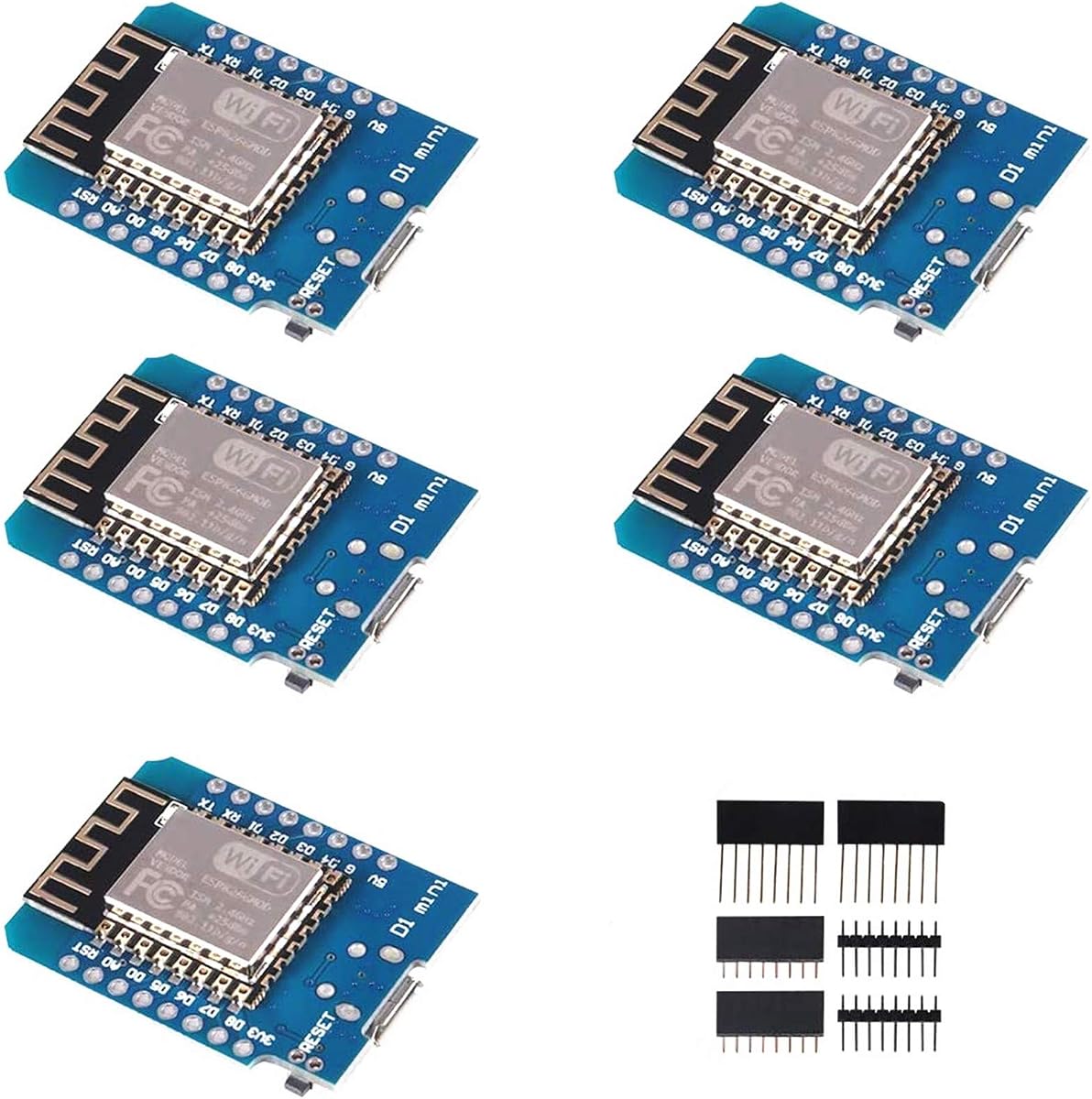
The ESP8266 ESP-12F D1 Mini is a development board rather than a bare transceiver, making it easier to connect to a breadboard and prototype without a separate programmer. The supplied rating is 4.5, and the five-board package is useful for larger connected experiments.
We may earn a commission when you buy through this link, at no additional cost to you.
The D1 Mini form factor provides 11 digital input/output pins with interrupt, PWM, and I2C support, except on D0 as stated in the product information. It also provides one analog input with a listed maximum of 3.2V. Micro-USB handles programming, while the onboard ESP8266EX-based board supports Arduino, WeMos, and Lua-oriented workflows.
One detail deserves attention: the title references 4M bytes, while the detailed bullet list also mentions 1MB flash. Buyers should verify the exact memory configuration of the received boards before relying on a specific storage plan. The listed onboard switching power supply is specified as 5V and 1A, and a resettable fuse is also noted.
This is a strong choice for breadboard prototypes, IoT nodes, and projects needing easy GPIO access. Its five-board quantity supports distributed builds, while the development-board layout saves time compared with wiring bare ESP-01 or ESP-01S modules.
The D1 Mini format is easier to use in temporary circuits than a tiny bare module. Its 11 digital pins support common interrupt, PWM, and I2C functions, with the stated D0 exception, making it practical for sensors, controls, and small displays.
The board can be programmed in a compatible Arduino IDE environment and is based on the ESP8266EX platform. That familiarity makes it appealing to makers moving from classic Arduino sketches into Wi-Fi-connected prototypes.
We may earn a commission when you buy through this link, at no additional cost to you.
The ten-pack ESP8266 ESP-01 is designed for makers who need a large number of compact wireless nodes. Its supplied rating is 5.0, the highest in the group, and the package includes ten identical serial Wi-Fi transceiver modules for distributed Arduino projects.
We may earn a commission when you buy through this link, at no additional cost to you.
The ESP8266 architecture provides onboard processing and storage, while AP, STA, and AP+STA modes support different network arrangements. The listing also notes Arduino platform compatibility and LWIP support in AP+STA mode, which makes the modules relevant to network-client, direct-access-point, and combined networking experiments.
The most important trade-off is that these are bare modules rather than development boards. A first-time builder will need to account for programming access, safe power regulation, and correct signal connections. The supplied information also omits a precise flash-memory figure, so applications that need a known storage capacity should verify the hardware before committing to a large build.
For classroom projects, sensor deployments, and makers building a substantial mesh of inexpensive endpoints, the ten-pack offers excellent scalability. It is less appropriate for a single prototype, where a ready-made development board would be much more convenient.
Ten identical modules are useful when a project needs many independent endpoints, such as sensor nodes, remote controls, or classroom demonstrations. The larger quantity makes it easier to test behavior across a real multi-device network.
AP, STA, and AP+STA modes let the modules serve different roles within a network. Combined with Arduino and LWIP compatibility, this flexibility supports both conventional client connections and direct wireless arrangements.
We may earn a commission when you buy through this link, at no additional cost to you.
The right Arduino WiFi module depends on project complexity, available space, power constraints, programming experience, sensor count, and whether you need Wi-Fi alone or also require Bluetooth and modern expansion interfaces.
A bare ESP8266 module is appropriate when size, cost, and a specific wireless design matter most. A development board is easier to prototype because it exposes pins, handles programming, and often includes a regulator and USB interface. More integrated boards such as the Arduino UNO R4 WiFi and Arduino Nano ESP32 provide more processing power, local indicators, and a broader selection of interfaces. Begin with the least complex hardware that can reliably meet the project's requirements, because extra features can make wiring and firmware development more demanding.
Most projects in this category need 2.4GHz Wi-Fi, but Bluetooth can be essential for nearby accessories, phone interaction, beacons, or custom input devices. The ESP8266 selections provide Wi-Fi only. The ELEGOO ESP32 boards include Bluetooth 4.2, while the Arduino UNO R4 WiFi and Arduino Nano ESP32 list Bluetooth 5.0. Check the exact wireless standard required by your phone, sensor, controller, or counterpart device rather than assuming all Bluetooth versions are interchangeable.
The Arduino UNO R4 WiFi combines an ARM Cortex-M4-based RA4M1 with an ESP32-S3, while the ELEGOO boards and Arduino Nano ESP32 use dual-core ESP32-family processors capable of reaching 240 MHz. These options offer more headroom for simultaneous networking, sensor processing, automation logic, and real-time data handling. Basic ESP8266 modules are sufficient for many simple switches, telemetry devices, and network clients. More processing power becomes useful when firmware performs complex calculations or supports edge-oriented workloads.
Flash storage affects how much firmware and supporting data a module can hold. The ESP8266 ESP-01S listings with 4MB offer more room than the one-megabyte ESP-01 and Aitrip options. The D1 Mini product information contains conflicting memory references, so verify the actual specification before use. Projects with growing libraries, local files, or OTA-related requirements should leave additional storage headroom whenever possible.
The ESP8266 products are especially sensitive to voltage. The Aitrip and five-pack ESP-01S listings explicitly state 3.3V operation, and the Aitrip listing warns against five-volt use with a maximum 3.6V I/O tolerance. Use an appropriate regulator and confirm logic levels before connecting the modules to an Arduino. Integrated ESP32 development boards are generally more convenient for prototyping, but their power requirements and regulator behavior should still be understood before a project is deployed.
Bare ESP8266 modules usually require a breadboard or adapter, external programming connections, and an appropriate board target in the Arduino IDE. The supplied ESP-01S documentation recommends Generic ESP8266 Module, while the five-pack ESP-01S also specifies SPI mode for the DOUT protocol. Development boards remove much of that wiring, and the Arduino-branded boards provide a more unified Arduino workflow. MicroPython compatibility on the Arduino Nano ESP32 may also appeal to Python-oriented developers.
A project with several sensors, displays, actuators, or motor drivers may need more accessible pins than a compact ESP-01 can offer. The ELEGOO boards provide GPIO, UART, SPI, and I2C connections. The D1 Mini exposes 11 digital pins with interrupt, PWM, and I2C support, apart from the stated D0 limitation, plus one analog input. The UNO R4 WiFi adds Qwiic and CAN, which can simplify compatible sensor expansion and reliable real-time communication.
Multi-module packs are useful for classroom exercises, distributed sensor networks, and projects that need several identical endpoints. They do not make a single-node prototype more convenient. For visible status feedback without adding a display, the Arduino UNO R4 WiFi includes a 12×8 LED matrix. This makes it especially attractive for immediate visual messages, event indicators, and interactive demonstrations.
Begin by identifying the exact module and board configuration, then install the appropriate board support in the Arduino IDE. For the listed ESP8266 products, select Generic ESP8266 Module, and for the five-pack ESP-01S, select SPI mode for the DOUT protocol. Confirm that the selected framework matches the hardware and connect the board using its documented programming interface.
Power the hardware safely before applying any programming signals. Bare ESP8266 modules require a suitable 3.3V supply and careful attention to logic levels. The ESP-01S packages explicitly do not support five-volt operation. When using a development board, follow the board's USB-C or Micro-USB instructions and ensure any attached sensors use compatible voltage ranges.
Develop and test the project in stages: verify basic serial communication, connect and read the sensors, add local output, then introduce Wi-Fi or Bluetooth connectivity. Test the complete device at its intended power source and in the actual wireless environment. Protect bare modules from shorts, static discharge, moisture, and accidental five-volt connections, and use the manufacturer's current documentation before updating firmware or altering hardware.
Not exactly. An ESP8266 module is a compact wireless component that can be used with Arduino-compatible projects, while an Arduino WiFi board is a complete development platform with additional processing, programming, power, and expansion features. The ESP8266 products in this guide are modules or D1 Mini development boards, while the UNO R4 WiFi and Nano ESP32 are more complete Arduino-branded boards.
No, the listed ESP8266 modules provide Wi-Fi rather than Bluetooth connectivity. If your project requires Bluetooth, consider the ELEGOO ESP32 boards with Bluetooth 4.2 or the Arduino UNO R4 WiFi and Nano ESP32, both of which list Bluetooth 5.0. Confirm that the connected peripheral supports the same Bluetooth version and relevant profiles.
The supplied listings for several ESP8266 products emphasize that they support 3.3V and should not be used with five volts. A direct five-volt connection can damage the module or create unsafe logic levels. Use an appropriate regulator or a development board that handles the required voltage conversion safely, and check the exact documentation for your selected module.
The supplied product guidance recommends selecting Generic ESP8266 Module in the Arduino IDE. For the five-pack ESP-01S listing, the module uses the DOUT protocol, so the instructions specify choosing SPI MODE as the flash mode. Correct board and flash settings are important because mismatched options can prevent successful programming.
A development board is generally the easiest starting point because it exposes connections and includes programming hardware. The ELEGOO ESP32 set is convenient for standard Wi-Fi and Bluetooth experiments, while the Arduino Nano ESP32 suits compact projects and offers both Arduino and MicroPython workflows. A bare ESP8266 is more appropriate once you are comfortable handling low-voltage power and programming connections.
The number depends on how many independent wireless endpoints the project requires. A three-pack works well for a small network or class demonstration, a four- or five-pack offers more deployment flexibility, and a ten-pack suits larger experiments. Remember that the host controller, coordinator, and any separately powered nodes may require additional hardware beyond the Wi-Fi modules themselves.
The ELEGOO boards list Bluetooth 4.2 with Bluetooth Classic and BLE support, and the Arduino UNO R4 WiFi and Arduino Nano ESP32 list Bluetooth 5.0. The ESP8266 choices are Wi-Fi-only. For a BLE project, verify the precise radio implementation and required profiles in the documentation for the specific board you purchase.
More flash provides greater flexibility for firmware, libraries, and supporting files. The listed 4MB ESP-01S options are generally the safer choice when storage requirements are uncertain, while one-megabyte modules can suit tightly scoped sketches. The D1 Mini listing contains both memory references, so confirm the received board's actual specification before relying on a particular capacity.
The Arduino UNO R4 WiFi is the best all-around option in this guide because it combines dual-core processing, Wi-Fi, Bluetooth 5.0, modern USB-C, CAN, Qwiic, analog features, and a built-in LED matrix. The ELEGOO ESP32 set stands out for ready-made development convenience and three-board flexibility, while the Arduino Nano ESP32 delivers compact ESP32-S3 performance with USB-C, Bluetooth 5.0, HID, and MicroPython support.
Prioritize the platform that matches your actual project rather than simply choosing the most feature-rich board. Basic networking, home automation, and sensor nodes can be handled well by ESP8266 modules, but Bluetooth, higher processing capacity, easier programming, and broader interfaces point toward an ESP32-based option. Multi-node projects should consider matching packs, while single-device builds may benefit more from one development board.
Before ordering, verify voltage, flash capacity, pin availability, programming requirements, and wireless compatibility. Then check the current product listing, documentation, and price, since technical revisions, bundle contents, and commercial terms can change over time.