
AGFRC 20A BLHeli_S ESC
4.3Editor score
20A compact racing ESC
Broad digital protocol support
Competition-focused lightweight design
Discover the best Escs for Racing Quadcopter, with 10 expert-reviewed options compared for voltage, current, protocols, mounting, size, and build fit.
Electronic speed controllers are the central nervous system of a racing quadcopter, translating pilot commands into precise motor output while managing current, heat, and signal timing. A suitable ESC must suit the battery, motor, flight controller, frame, and racing style rather than simply offer the highest current rating.
This guide compares ten ESC options for racing quadcopters using their stated voltage ranges, current capabilities, supported throttle protocols, firmware, mounting dimensions, and physical features. It covers individual four-piece ESC sets, integrated 4-in-1 boards, and a complete flight controller stack.
Each product review highlights the configuration that makes it distinctive, along with practical trade-offs and ideal buyer profiles. The top selections cover budget, versatile, and premium use cases, while ratings, availability, and pricing can change over time.
4.3Editor score

5.0Editor score

The table below compares all ten controllers by core electrical capability, protocol support, construction, and likely racing-build fit.
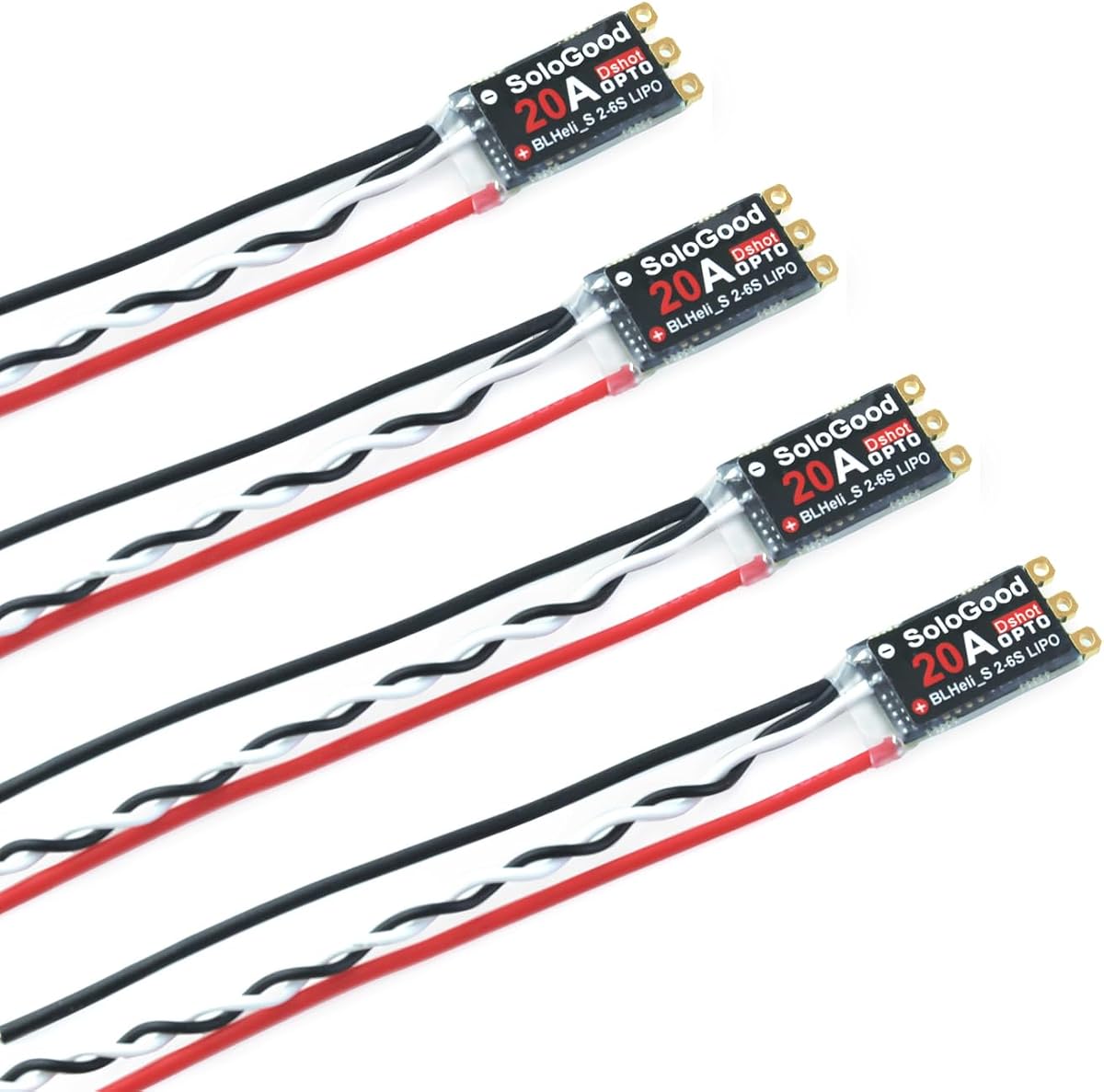




This four-piece 20A ESC set carries a 4.4 rating and targets FPV, QAV, multirotor, and quadcopter builds. Its main appeal is the combination of four individual controllers, BLHeli_S firmware, DShot support, and operation from 2S through 4S LiPo batteries. That makes it a practical option for compact builds that need one ESC per motor rather than a single integrated board.
We may earn a commission when you buy through this link, at no additional cost to you.
The twisted-pair throttle signal cable is designed to reduce crosstalk during transmission, an important consideration in a racing quadcopter where electrical noise can affect control reliability. The controller also offers adjustable throttle range for compatibility with different receivers and a smooth speed-control feel. Its optimization for multi-axis use extends beyond racing to fixed-wing and helicopter applications, making the set more versatile than a narrowly specialized racing ESC.
The main limitation is its 20A current class. That can suit lighter motors and smaller racing builds, but it leaves less performance headroom for aggressive throttle combinations than the 40A, 55A, 60A, 65A, and higher-current alternatives in this guide. Its 2-4S voltage range also makes it less appropriate for builds using 5S or 6S packs. Buyers should match the controller to actual motor and propeller demand rather than relying on headline current figures alone.
This set is best for builders assembling a lightweight 3S or 4S quadcopter who values individual ESC wiring, broad protocol support, and simple firmware familiarity. It is less compelling for heavy 5S or 6S racing builds that require greater thermal and electrical headroom. For its intended class, though, it provides a sensible, flexible foundation with particularly useful signal-noise management.
The twisted-pair throttle cable is intended to reduce crosstalk, helping preserve clean command transmission in a compact multirotor where motors, power leads, and radio equipment are packed closely together.
An adjustable throttle range allows the ESC to work with a broader selection of receivers, giving builders more freedom when assembling or upgrading the control side of a racing quadcopter.
We may earn a commission when you buy through this link, at no additional cost to you.
The LittleBee 20A set is designed for racing and freestyle quadcopters with an emphasis on compact integration, clean motor control, and fast digital signaling. Its 23x12x4mm dimensions are particularly useful in tight builds where board area is at a premium, while the four-piece format gives each motor a dedicated ESC.
We may earn a commission when you buy through this link, at no additional cost to you.
DShot support and the stated muted mode are intended to provide responsive digital control with quieter and more efficient operation. The controller comes with a preloaded BLHeli_S bootloader and firmware, reducing the setup required before configuration. Its stated 20A continuous rating and 25A burst capability for as long as 10 seconds give users a clear picture of its intended operating envelope.
The 2-4S LiPo support keeps this set within the mainstream lightweight and mid-size racing categories. It does not offer the voltage flexibility of controllers that accept 6S, 8S, or even 8S packs, nor does it provide the continuous-current headroom seen in the premium 160A model. Those limitations are not inherently flaws, but they narrow the set of builds for which it is suitable.
This ESC is a strong candidate for a compact 3S or 4S racing build where space, weight, quick response, and low noise are priorities. A buyer with a high-power 5S or 6S build should look toward a higher-voltage 4-in-1 controller. Because no customer rating is supplied, buyers should also consult current user feedback for long-term reliability observations.
At 23x12x4mm per controller, the LittleBee boards are small enough for constrained frames and offer a practical alternative to a larger integrated ESC assembly.
DShot signaling supports responsive commands, while muted mode offers an alternative operating profile for pilots who place noise or efficiency at the top of their priorities.
We may earn a commission when you buy through this link, at no additional cost to you.
The HGLRC 60A 4-in-1 ESC has a 4.3 rating and combines four motor channels on one board for FPV racing and freestyle aircraft. Supporting 2S through 6S LiPo batteries gives it broader voltage coverage than most 20A sets, while 60A output positions it well for more demanding racing builds.
We may earn a commission when you buy through this link, at no additional cost to you.
Support for DShot600, DShot300, and DShot150 allows pilots to choose among three digital communication rates. That selection can be useful when balancing response characteristics with compatibility across receivers and flight controller configurations. The controller also uses an immersion-gold design intended to improve high-temperature and current resistance, with large ESC pads and a direct plug-in connection to the flight controller.
The direct connection design is a significant convenience advantage. Instead of separately installing and wiring four separate controllers, the builder can use a more compact integrated solution. The trade-off is reduced serviceability and flexibility: a fault or wiring issue can involve the shared assembly rather than one easily isolated individual ESC. Frame dimensions, mounting pattern, and connector orientation should therefore be checked before selecting it.
This controller is a good match for a 5S or 6S racing quadcopter that benefits from integrated wiring and higher current capability. It may be less appealing to builders who prefer modular ESCs, need a nonstandard mounting layout, or want to replace one motor circuit independently. For a conventional compact stack, however, it offers a capable and straightforward electrical core.
Combining four ESC channels on a single board reduces the number of separate motor controllers and simplifies the physical wiring plan in a compact racing stack.
DShot600, DShot300, and DShot150 support gives builders several signal options to coordinate with their flight controller, receiver, and tuning setup.
We may earn a commission when you buy through this link, at no additional cost to you.
The MAD AMPX 40A Pro has a 5.0 rating and stands out as a flexible individual ESC for multirotors operating from 2S to 6S. Its 40A output class sits between compact 20A controllers and high-current 4-in-1 boards, making it a versatile middle ground for builders who want separate ESCs without moving into a much larger electrical platform.
We may earn a commission when you buy through this link, at no additional cost to you.
New core software is intended to improve throttle response, while high intelligent and adaptive default settings automatically adjust timing for a broad range of applications. Signal frequencies above 600Hz and compatibility with a wide range of flight controllers reduce the need for extensive electrical matching. Crosstalk reduction in signal transmission further supports dependable command delivery in a crowded airframe.
Physical planning is important. The 40A-A board measures 64.3×19.6×8.9mm, with 75mm input and output leads and a 110mm signal lead. These long connections offer flexibility for motor placement, but they also need to be routed carefully to avoid entanglement, interference, or interference with other components. As individual controllers, four units are required for a standard quadcopter.
The AMPX 40A Pro is our Editor's Choice because it combines strong published rating performance with adaptable timing, broad voltage support, and individual-controller flexibility. It is an excellent choice for a 3S, 4S, 5S, or 6S racing build whose frame lacks a suitable integrated ESC stack. Buyers should confirm frame clearance and plan signal-wire routing before assembly.
Adaptive default timing is designed to make the controller usable across a wide range of motor and propeller combinations, reducing the amount of manual setup required for a new build.
Using one controller per motor provides placement flexibility and makes individual wiring routes easier to understand, provided the frame has enough room for all four boards.
We may earn a commission when you buy through this link, at no additional cost to you.
The AGFRC XR-20A has a 4.3 rating and is explicitly designed for competition FPV drones. It combines a compact, lightweight format with 20A output, BLHeli_S firmware, and support for several digital and analog throttle protocols, giving it unusual compatibility for an entry-oriented individual ESC.
We may earn a commission when you buy through this link, at no additional cost to you.
DShot600, DShot300, and DShot150 are supported, as are PWM from 1000 to 2000 microseconds, Oneshot125, Oneshot42, and Multishot. The hardware PWM drive is designed for low noise and smooth throttle response, while damped light provides a more sensitive response and can reduce motor speed during active braking. These features make the controller adaptable to different receivers and tuning preferences.
The principal constraint is current capacity. Twenty amps is appropriate for lighter motors and lower-demand 3S or 4S builds, but it does not provide the operating margin of the 40A AMPX, 55A Radiolink, 60A HGLRC, or 65A and higher options. A pilot should calculate likely motor demand and avoid using aggressive motor and propeller combinations that exceed the controller's intended class.
The XR-20A is our Best Budget pick for a lightweight competition quadcopter or a build where broad receiver compatibility matters. It is especially attractive for pilots who want access to modern DShot protocols without giving up older One-Shot and Multishot standards. Its strengths make it a practical, compact choice for lighter racing builds, provided the electrical load is matched appropriately.
Support for DShot rates, PWM, Oneshot125, Oneshot42, and Multishot makes the XR-20A unusually adaptable across receivers, flight controllers, and established tuning setups.
Low-noise hardware PWM, fast response, and damped-light operation help pilots retain control while reducing motor speed during active braking.
We may earn a commission when you buy through this link, at no additional cost to you.
The SEQURE E160 G2 is the premium high-power selection in this guide, offering 160A continuous current per channel and peak current up to 280A. It supports 4S through 8S LiPo batteries, making it intended for demanding FPV builds that need substantial electrical headroom rather than lightweight race-day simplicity.
We may earn a commission when you buy through this link, at no additional cost to you.
A large metal heat sink is designed to improve heat dissipation, support stable high-power output, and contribute to service life. The dual-pad battery connection uses a parallel configuration intended to simplify welding and increase current-carrying capability. Those features are particularly relevant to builders who expect hard throttle, rapid current changes, and sustained aggressive flying.
The built-in ammeter is one of its most distinctive features. It supports telemetry transmission with real-time updates for motor speed, temperature, current, and other data, giving pilots more visibility into system behavior. The controller also supports all DShot signals along with PWM, One-Shot, and Multi-Shot, while automatic throttle-signal detection simplifies startup across a variety of control systems.
This is not the natural choice for a small, light, low-power racer. Its size, weight, thermal hardware, and extreme current class are more appropriate for high-performance 6S or 8S aircraft with aggressive motors. For those builds, the E160 G2 offers the strongest combination of current capacity, heat management, protocol support, and telemetry. Prospective buyers should check current user feedback because no customer rating is supplied.
The integrated ammeter can transmit current and related system data through telemetry, helping pilots understand motor load and diagnose unusual behavior during testing.
A large metal heat sink is intended to dissipate the heat generated by very high current operation, improving the controller's suitability for demanding racing and freestyle builds.
We may earn a commission when you buy through this link, at no additional cost to you.
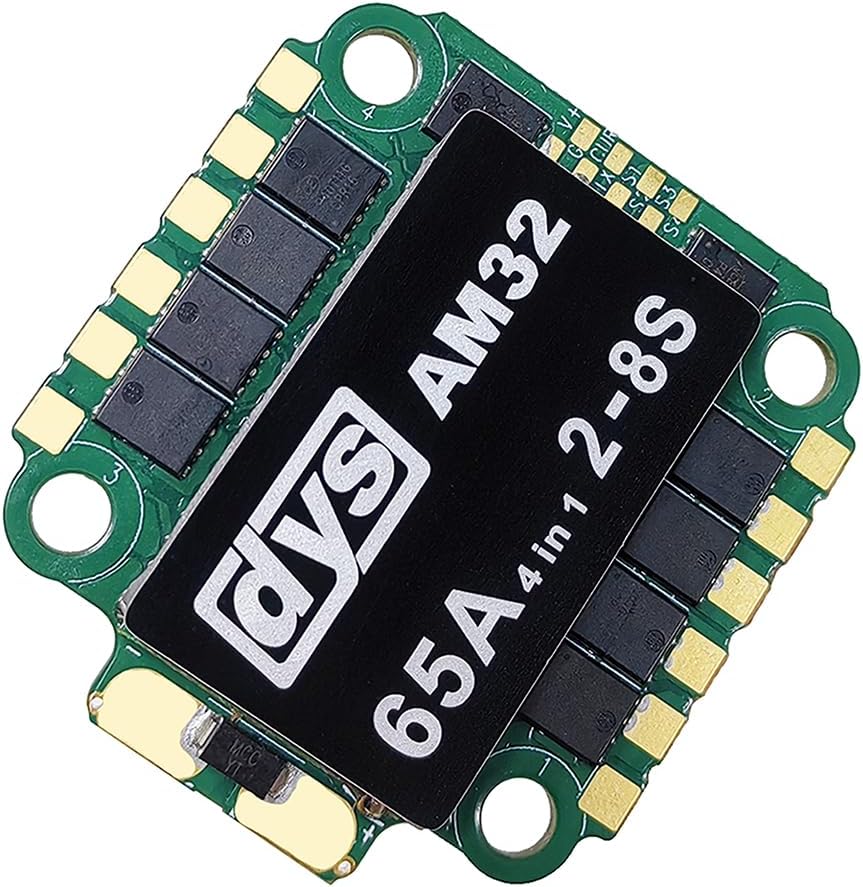
The DYS AM32 65A is a 4-in-1 brushless ESC with a 2.9 rating, designed for FPV racing and freestyle quadcopters using F4 or F7 flight controllers. It combines four motor channels, 65A output, and a broad 2-8S input range, making its electrical envelope considerably wider than that of most 20A controllers.
We may earn a commission when you buy through this link, at no additional cost to you.
Its 32-bit AM32 firmware supports precise multirotor control, while upgraded premium MOSFETs are described as delivering a 15% performance improvement. The stated 30.5×30.5mm installation pattern with four-millimeter holes provides a common layout for many drone frames, which can simplify stack planning. These are meaningful advantages for builders who want a single integrated board spanning several voltage classes.
The 2.9 rating is the lowest published score among the products with a numerical rating, and that should prompt more caution. It may reflect mixed experiences with installation, reliability, or performance that cannot be determined from the supplied specifications alone. The shared 4-in-1 construction also makes fault isolation less convenient than with four independent ESC boards. Checking recent buyer feedback and ensuring the flight controller's signal requirements align with AM32 is sensible.
The DYS AM32 65A may suit builders who prioritize wide voltage support, 30.5mm compatibility, and an integrated layout. It deserves closer scrutiny than the better-rated alternatives because of its 2.9 rating. For a high-stakes race build, the lower score and limited user history should be weighed against the convenience of the shared 4-in-1 format.
The 2-8S input range allows the same controller platform to serve several racing configurations, provided the motors, propellers, and flight controller are configured for the selected voltage.
The 32-bit AM32 architecture and upgraded MOSFETs form a modern control platform intended to provide precise response and improved performance within a compact integrated board.
We may earn a commission when you buy through this link, at no additional cost to you.
The SEQURE AIO Stack is more than an ESC: it integrates a flight controller and a 70A 4-in-1 brushless controller into one package. Its 3.3 rating, 2-8S support, 150A peak current capability, and support for up to eight motors make it a flexible platform for multirotor projects that can benefit from a consolidated stack.
We may earn a commission when you buy through this link, at no additional cost to you.
The flight controller uses an STM32H743 MCU and STM32G071 processor, with a 16MB black box, MPU6000 gyro, and onboard barometer for flight-data capture. A 5V/10V dual BEC output provides separate power for DJI O3 and analog VTX equipment, reducing the need for additional power-management hardware. WS2812 LED support adds another useful feature for night flying.
Its mounting options of 20x20mm and 30.5×30.5mm are designed to suit many common frames, and angled solder pads are intended to make assembly easier. As a complete integrated system, it reduces component count and simplifies connections, but it also offers less freedom than choosing a separate flight controller and ESC. Firmware, motor configuration, VTX requirements, and connector compatibility must all be considered before installation.
The AIO Stack is a strong option for a builder who wants a ready-made control platform with generous voltage and motor support. It is less suitable for someone who already has a preferred flight controller or needs very specific board dimensions and connector layouts. Its 3.3 rating warrants checking recent customer experiences, but the integrated feature set is especially compelling for experimentation and multirotor development.
Combining the flight controller and ESC reduces the number of separate components and connections, allowing builders to focus more on frame, motor, and propulsion configuration.
Support for up to eight motors creates opportunities for multirotor layouts beyond a conventional quadcopter while retaining broad battery-voltage compatibility.
We may earn a commission when you buy through this link, at no additional cost to you.
The Radiolink FLYCOLOR 55A is a 4-in-1 ESC with a 4.4 rating, offering 55A continuous and 65A peak current for 3S through 6S battery setups. It is explicitly aimed at high-speed racing multirotors, with dimensions of 45x41x5.8mm and a weight of 15.8 grams.
We may earn a commission when you buy through this link, at no additional cost to you.
Two firmware options broaden the controller's compatibility. Bluejay supports DShot300 and DShot600, while BLHeli_S supports Oneshot125, Oneshot42, and Multishot modes. The hardware includes an EFM8BB21 MCU with an eight-bit C8051 core operating up to 50MHz, plus a dedicated three-in-one driver IC intended to create smoother motor starts.
The firmware is specifically designed for multirotors to improve overall behavior, while hardware-generated motor PWM is intended to sharpen throttle response and reduce noise. One point to verify is mechanical fit: at 45x41mm, this board is larger than the common 30.5×30.5mm mounting standard used by several other 4-in-1 options. A frame designed around the larger footprint may limit where it can be installed.
The FLYCOLOR 55A is a compelling choice for a 4S, 5S, or 6S racing quadcopter that can accommodate its larger dimensions. It balances meaningful current capability with a relatively compact 5.8mm thickness and provides both digital and analog protocol options. It is less suitable for 2S racers because its input range begins at 3S, and frame clearance should be checked before ordering.
Bluejay and BLHeli_S support gives builders access to DShot rates as well as One-Shot and Multishot modes, making the controller easier to align with different receiver and tuning requirements.
A dedicated driver IC and hardware-generated PWM are designed to produce smoother starts, cleaner response, and reduced motor noise during demanding multirotor operation.
We may earn a commission when you buy through this link, at no additional cost to you.
The SEQURE 65A AM32 is a 4-in-1 controller with a 3.5 rating, built around a 32-bit AT32F421 processor and designed for 2-6S racing and freestyle drones. Its 65A continuous rating, 120A peak rating, and 30.5mm hole spacing place it squarely within the common 5-inch and compact racing-build market.
We may earn a commission when you buy through this link, at no additional cost to you.
Its PWM frequency can be adjusted from 8kHz to 96kHz, offering a broad tuning range for motor and propeller combinations. DShot600, DShot300, and DShot150 are supported, along with Oneshot, Multishot, and PWM. This protocol range makes the board practical for both modern digital control systems and setups that still rely on established analog signals.
High-power MOSFETs are intended to improve conversion efficiency, reduce losses, and extend flight time. A multilayer PCB design strengthens over-current capability and heat dissipation, while angled solder pads are intended to make assembly easier. The 30.5mm installation spacing is versatile, though buyers should still confirm the full board outline, connector position, and available stack clearance.
The SEQURE 65A AM32 is worth considering for 4S through 6S builds that need more current capability than a 20A controller but do not require the extreme output of the E160 G2. Its 3.5 rating calls for attention to current customer feedback before committing to a race-critical build. Mechanically and electrically, however, it offers a familiar footprint and a well-rounded protocol and voltage range.
The multilayer PCB and high-power MOSFETs are designed to manage over-current demand while improving conversion efficiency and thermal performance during sustained racing flights.
PWM frequencies from 8kHz through 96kHz provide meaningful flexibility when matching motor response, noise characteristics, and the selected throttle protocol.
We may earn a commission when you buy through this link, at no additional cost to you.
Choosing a racing quadcopter ESC involves balancing voltage, current, protocol, firmware, physical dimensions, thermal design, and the propulsion demands of the finished aircraft.
The ESC's supported battery range must match the voltage your motors, propellers, and flight controller are designed to handle. Options in this guide range from 2-4S individual controllers to 2-6S and 2-8S 4-in-1 systems. A 20A controller may be appropriate for a light 3S build, while 5S and 6S racers generally benefit from a controller with a higher voltage rating and more substantial current capability. Going beyond the ESC's stated input range can damage electronics, while choosing a controller with much more capacity than the build needs may add unnecessary size and weight.
Choose a voltage range that covers your intended pack and leaves no ambiguity about compatibility. Also verify the battery connector, lead thickness, and any manufacturer-specific voltage limitations in the flight controller.
Continuous current indicates the controller's stated sustained output class, while peak current describes its short-duration capacity. A racing build can demand high current during rapid acceleration, hard cornering, and aggressive throttle changes, so a controller with limited headroom may become hot or enter protective behavior. The products here range from 20A continuous controllers to the SEQURE E160 G2's 160A continuous and 280A peak capability. The highest number is not automatically best, however; motor demand, propeller pitch, and battery voltage determine the appropriate class.
Match the controller to the propulsion system's realistic load rather than selecting on peak-current figures alone. For sustained racing use, thermal capability and proper cooling deserve as much attention as the headline rating.
The ESC and receiver must use compatible throttle signals. DShot600, DShot300, and DShot150 appear across many of the recommended boards, while PWM, One-Shot125, One-Shot42, and Multishot provide compatibility with a wider range of existing radio systems. AM32 and BLHeli_S also differ in the software environment and tuning workflow. Checking the receiver, flight controller, and firmware before assembly can prevent an otherwise capable ESC from being inconvenient or incompatible.
Digital DShot is a common modern choice for racing, but retaining One-Shot or Multishot support can be valuable when upgrading an established build. Choose the protocol set that matches your current equipment rather than assuming every firmware feature is interchangeable.
Individual ESCs place one controller beside each motor, offering flexible wire routing and straightforward motor-level organization. A 4-in-1 board combines all four channels on one PCB, reducing the component count and simplifying the stack. Integrated boards are convenient in common racing frames, but their shared layout can make individual fault isolation and replacement less convenient. Individual controllers require more physical space and more connections, yet can make fitting unusual frame layouts easier.
Choose a 4-in-1 controller when its outline, mounting holes, and connectors match the frame and you value a compact stack. Choose separate ESCs when placement flexibility, modular wiring, or serviceability is the priority.
A 30.5×30.5mm hole pattern is common, but it does not guarantee that every controller fits. The Radiolink FLYCOLOR measures 45x41mm, while the SEQURE AIO Stack includes an entire flight-controller assembly, and integrated boards may have taller components or fixed connector locations. Measure the available area, check screw positions, and leave room for wire bends and solder joints. Height can be just as important as width and length in a tightly stacked racing frame.
Treat the full board outline—not only the mounting-hole spacing—as the deciding measurement. If several options fit, compare connector orientation and access to the battery and motor leads before choosing.
BLHeli_S, Bluejay, and AM32 represent different approaches to ESC firmware. BLHeli_S is preloaded on several products and can be flashed through the signal cable, while AM32 products use a 32-bit control platform. Firmware affects available protocols, configuration options, telemetry, and the tools used to tune motor behavior. Buyers should also verify the flight controller's supported ESC protocol and ensure the receiver and flight controller are configured consistently.
Firmware familiarity can be as important as electrical performance. If you already tune BLHeli_S-based builds, that experience may reduce setup time, while AM32 may suit a new system if the flight controller and configuration process are fully compatible.
Racing ESCs operate in confined frames where airflow is limited, making heat dissipation a central reliability concern. Large metal heat sinks, multilayer PCBs, immersion-gold components, and large current pads can all support thermal performance, although their usefulness depends on the airframe and motor load. Individual ESCs placed near motors may benefit from prop wash, while a stacked board can depend more heavily on frame airflow. A controller that fits neatly but cannot dissipate heat is not a good match for sustained high-current flight.
Consider how the board is mounted, whether propeller wash reaches it, and whether solder joints have enough physical space. Favor clearances, robust pads, and a layout that supports service without stressing cables.
Published ratings can provide a useful indication of customer experience, but they are not a substitute for technical compatibility. Ratings range from 2.9 to 5.0 in the supplied data, while two products have no numerical rating. For race-critical builds, current reviews should be examined for repeated concerns involving heat, connection stability, firmware, or installation. A high average rating does not override a physical fit issue, and a lower-rated item may still suit a particular setup well.
Use ratings as one signal, then compare them with voltage, current, dimensions, and protocol requirements. If there is no published rating, seek recent buyer feedback and verify that the product's documented features fit the planned build.
Begin by confirming that the ESC's cell count, current class, protocol, firmware, and physical dimensions match the frame and propulsion system. Connect the battery and motor leads with power disconnected, observing correct polarity and the manufacturer's wiring arrangement. For a 4-in-1 board, verify that the flight controller's connectors and signal interface are compatible before fitting the stack, and ensure the frame provides appropriate clearance for every component.
After installation, perform a controlled bench test with the propellers removed. Confirm that the flight controller detects all four motors, that directions can be corrected safely, and that the receiver and flight controller use a compatible throttle protocol. Listen and observe for abnormal noise, heat, or inconsistent starting behavior. Increase motor direction changes only one at a time, and use the appropriate firmware configuration tools to set timing, motor direction, and other available options.
For each flight session, inspect solder joints, connectors, wires, and board surfaces for looseness, discoloration, or heat damage. Keep the ESC and flight controller stack clear of carbon dust and debris, and avoid obstructing airflow around large heat sinks. Use a battery configuration and motor load that remain within the controller's stated limits. If performance becomes inconsistent or the ESC becomes unusually hot, stop testing and inspect the propulsion, wiring, and cooling arrangement before continuing.
Choose an ESC that supports the exact cell count of the battery and motors you plan to use. A 4S racer needs a controller rated for 4S, while a 6S build requires 6S capability. Do not rely on a controller's higher maximum rating as permission to exceed the voltage, current, or thermal limits of the motors, propellers, flight controller, or battery. Always verify the complete build configuration before purchase and installation.
No. Higher current ratings provide more headroom, but they do not make every motor combination perform better. A light 3S build may work well with an appropriately sized 20A ESC, while an aggressive 6S or 8S racer may need much more current capacity and thermal support. The best controller is one matched to the propulsion load, frame, battery, and available cooling rather than simply the product with the largest headline figure.
A 4-in-1 board is convenient and compact when its dimensions, mounting pattern, and connectors match your frame. It also reduces the number of separate controllers to install. Four individual ESCs provide more flexible placement and wiring, which can be valuable in unusual frames. Decide by checking physical clearance, serviceability, cooling, and connector orientation before assuming that an integrated board is always easier to install.
These are different ESC firmware platforms with distinct configuration workflows, supported protocols, and tuning characteristics. BLHeli_S is used on several products in this guide, Bluejay appears on the Radiolink option, and AM32 powers the DYS and SEQURE 65A controllers. The firmware must work with your flight controller, receiver, and preferred throttle protocol. Check all three devices and the available configuration options before committing to a build.
Active braking behavior is closely associated with the supported digital throttle protocol and the controller's damped-light or braking implementation. The AGFRC XR-20A explicitly states that damped light is enabled for more sensitive response and reduced motor speed, and it supports DShot alongside several analog protocols. Other controllers support DShot rates as well, but specific braking features and configuration options should be verified in their documentation and firmware.
The mounting-hole pattern may be compatible while the complete board still fails to fit because of its outline, height, connectors, or cable bends. Some controllers use the common 30.5×30.5mm pattern, while others have a larger rectangular footprint. Measure the full available stack area, including components above and below the board, before buying. A controller that fits mechanically is still only suitable if its electrical ratings and protocols match the build.
Abnormal heat, inconsistent motor behavior, unexpected reset events, or noticeably reduced performance can all indicate a thermal or electrical problem. High temperature is more likely when the controller is overworked, poorly cooled, surrounded by tightly packed components, or paired with an aggressive motor and propeller combination. Stop the test, allow the equipment to cool, and inspect motor load, solder joints, airflow, and the ESC's stated current limits before making further flights.
Telemetry is optional for many racers, but it can provide valuable information about current, temperature, motor speed, and other system data. The SEQURE E160 G2 includes a built-in ammeter specifically for real-time telemetry reporting. Other controllers may not offer equivalent built-in sensing, even if they communicate through the flight controller. Consider telemetry as an added diagnostic tool rather than a substitute for correct current and voltage matching.
The MAD AMPX 40A Pro is the most balanced Editor's Choice, combining adaptive timing, a 5.0 rating, 2-6S support, and flexible individual ESC placement. The AGFRC XR-20A stands out as the Best Budget option for lighter builds because it combines a compact format with extensive protocol support, while the SEQURE E160 G2 takes the Best Premium position for high-power builds that need 160A continuous current, telemetry, and substantial thermal hardware.
Prioritize the match between battery voltage, motor demand, and current capability before comparing features. Then confirm the firmware and throttle protocols work with your flight controller and receiver. Mechanical fit, mounting pattern, connector position, cooling, and wire routing are just as important because an electrically capable ESC can still be unsuitable if it cannot be installed cleanly or operated within its thermal limits.
Before making a final purchase, verify the current product listing, specifications, compatibility notes, and customer feedback. Ratings, availability, and pricing can change, and firmware or hardware revisions may alter what a buyer receives. Taking time to match every published specification with the intended frame and propulsion setup is the safest route to a compatible racing quadcopter build.