
Endoscope Camera with Light: 5" 1080P HD Dual-Lens Inspection Borescope Camera for Sewer
4.4Editor score
5-inch HD display
16.4-foot semi-rigid cable
Dual-lens viewing
Eight adjustable LEDs
A handheld sewer camera makes hidden drain and pipe problems visible without requiring immediate excavation. Useful features include a long semi-rigid cable, bright screen, camera-mounted LEDs, waterproof construction, and enough reach to navigate common residential lines. The right model depends on pipe diameter, bend severity, and whether documentation matters.
We compared the ten products in this guide using their published specifications, including probe length, display size, image resolution, lighting, waterproof rating, recording capabilities, accessories, and practical limits. The list covers compact borescopes, long-reel plumbing systems, phone-connected cameras, and dedicated units designed to document sewer inspections.
Each review identifies the use case that best fits the camera and explains important compromises, such as limited elbow navigation, missing recording features, shorter reach, or the added bulk of a full reel system. Ratings and availability can change, and current prices should be checked before purchase.
4.4Editor score

4.3Editor score
4.5Editor score
As an Amazon Associate we earn from qualifying purchases.
The table below places all ten cameras side by side, emphasizing cable reach, viewing hardware, lighting, documentation, and water resistance. The largest differences are between compact handheld borescopes and dedicated reel-based sewer inspection systems.



This handheld sewer camera combines a 5-inch HD screen, 1080P imaging, and a 16.4-foot semi-rigid probe in a format that is approachable for homeowners and useful for quick plumbing diagnostics. Its 4.4 rating reflects a generally capable package, particularly when the large dedicated display and dual-lens design are considered. The front and side views can be switched without removing the probe from the pipe.
We may earn a commission when you buy through this link, at no additional cost to you.
The main strengths are practical rather than specialized. Eight adjustable LEDs illuminate dark drains and pipe walls, while the probe is rated IP67 for wet and dirty environments. A 170-degree wide-angle view helps reveal the interior of a pipe, and the 1.2- to 4-inch focus range is suited to close inspection of cracks, corrosion, and buildup. The semi-rigid cable holds its shape, which makes it easier to guide around an obstacle than a completely flexible cord.
There are meaningful limitations. The camera cannot take pictures or videos, so it is a live diagnostic tool rather than a documentation system. Its 16.4-foot length also falls well short of the 50- and 100-foot options in this guide. Users working on deep drains, long lateral runs, or commercial lines should consider a reel-based model with recording support.
Despite those trade-offs, this is the strongest general-purpose choice for routine residential inspection. It is especially appealing to users who do not want to manage an app or connect a phone. Plumbers can use the dual lens to examine blockage points, while homeowners can use it for periodic checks of accessible drains without the complexity of a full sewer camera reel.
The ability to switch between forward and side views makes it easier to distinguish a blockage in the center of a pipe from material attached to its wall. That versatility helps when one perspective alone cannot show the full condition of the line.
The 5-inch display is more comfortable than a small handheld monitor, particularly under a sink or beside a floor drain. Keeping the phone away from wet and dirty work areas also reduces the likelihood of accidental damage.
We may earn a commission when you buy through this link, at no additional cost to you.
The DEPSTECH DS520 combines a 50-foot semi-rigid cable with a 5-inch IPS screen and three lenses, making it an unusually capable option within the guide. Its 4.3 rating is supported by a flexible feature set that includes split-screen viewing, five viewing modes, adjustable illumination, and file-transfer capability. It is designed for plumbers, serious DIYers, mechanics, and home inspectors who need more reach than a compact borescope.
We may earn a commission when you buy through this link, at no additional cost to you.
Its triple-lens arrangement includes a front view and two side views with different close-focus ranges. Users can select angles without continually twisting the cable, and the split screen makes it possible to compare views. A 2.0-megapixel image system and IP67 waterproofing help it function in wet drain lines, automotive spaces, walls, and HVAC ductwork. Files can be moved to a computer with the supplied data cable, while a hook and magnet help retrieve small dropped objects.
The main compromise is bulk. A 50-foot semi-rigid cable and separate monitor make this less convenient for quick household checks than a 10- to 16-foot handheld borescope. The product also lacks a dedicated flexible-pipe locator, so finding the exact location of a defect in a buried line would require an additional tool and separate procedure.
For users seeking substantial reach and multiple perspectives without moving to a full reel system, the DS520 is a persuasive choice. Its long warranty and support coverage add reassurance, while the three lenses make it particularly adaptable. It is best suited to a technician who will use the camera repeatedly and wants captured documentation.
Different lenses offer distinct focus distances and angles, allowing the camera to move from broad forward observation to detailed side-wall inspection. This makes the system more versatile across varying pipe depths and debris types.
At 50 feet, the semi-rigid probe reaches substantially farther than the compact borescopes in this list. It is better suited to straight and gently curving runs, provided the line is not filled with debris.
We may earn a commission when you buy through this link, at no additional cost to you.
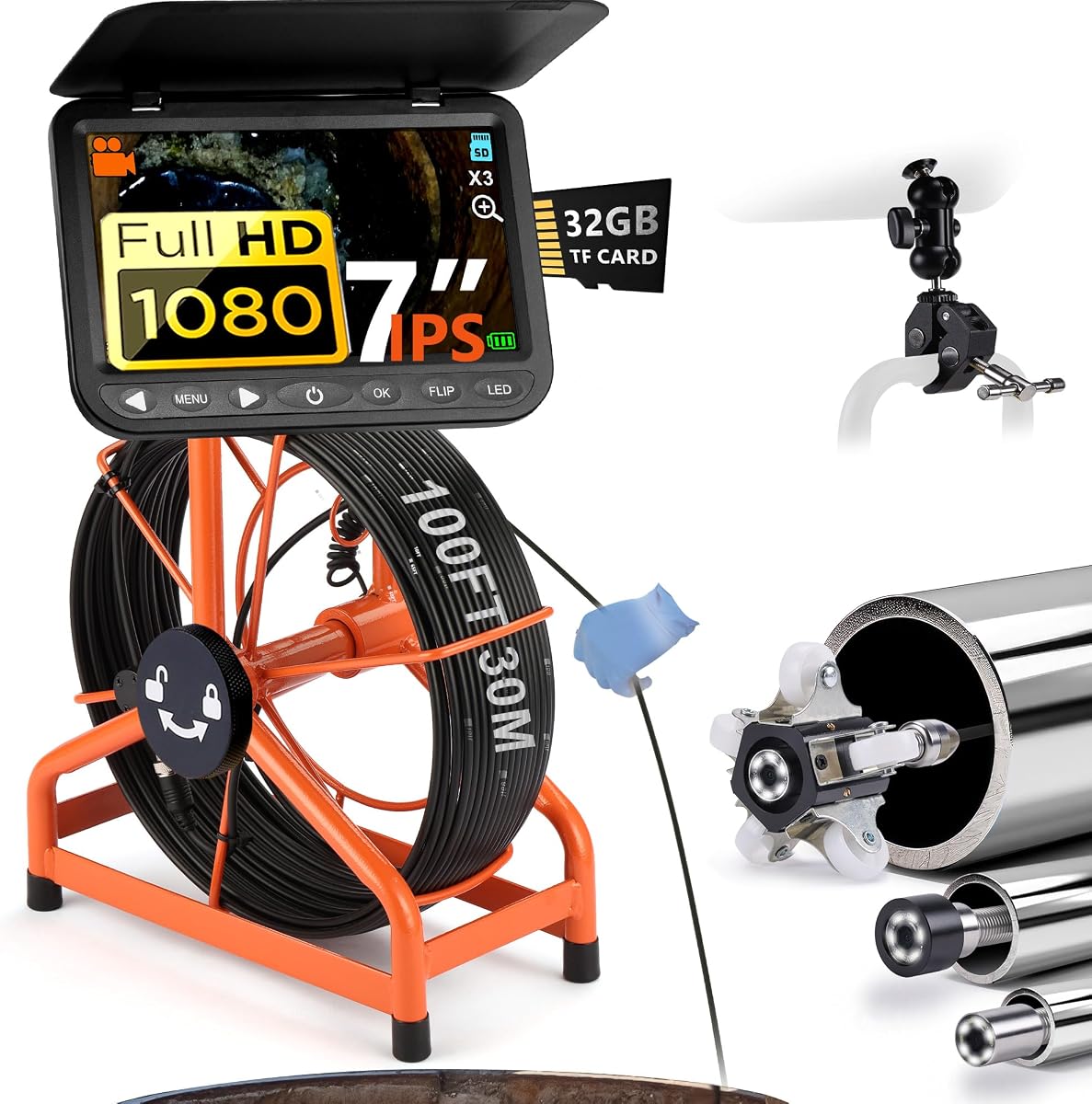
The [ChoosePRO®] 100FT system is the most specialized sewer inspection package in the guide, combining a 100-foot marked cable, 7-inch IPS display, 1080P camera, DVR recording, and 32GB memory card. Its 4.5 rating reflects a strong combination of reach, visibility, and documentation. It is intended for plumbers, property inspectors, drain specialists, and serious homeowners who need a complete record of an inspection.
We may earn a commission when you buy through this link, at no additional cost to you.
The camera head is rated IP68, includes six adjustable LEDs across three brightness levels, and uses a flexible stainless-steel spring tip to negotiate bends and corners. The 16× zoom helps reveal small cracks, blockages, and rust. Real-time viewing and instant playback are supported, and footage can be transferred through the SD card or USB-C. A 5000mAh battery provides more than eight hours of operation and can also draw power from a power bank while in use.
This system also pays attention to working conditions. The cable is marked in feet, making it easier to estimate the location of an issue. Its thicker reel tubing improves structural stability, while aluminum clamps provide a more secure display mount than basic plastic attachments. Sleeves for both smaller and larger pipes broaden its usefulness, although those accessories add to the setup.
The trade-off is size and weight. A 100-foot reel, seven-inch monitor, cable accessories, and case require more space than a compact borescope. The semi-rigid cable also cannot negotiate every tight elbow. Even so, this is the most complete option for professional documentation, and it is the strongest recommendation when recording, depth reference, and extended reach matter more than portability.
Built-in recording and 32GB of storage allow an inspector to preserve evidence of a blockage, crack, or root intrusion. The ability to play back footage immediately and transfer files makes the system useful for both analysis and customer reports.
A marked cable gives operators a practical reference for estimating how far the probe has traveled. That information can be valuable when comparing a visible defect with the physical layout of the drain line.
We may earn a commission when you buy through this link, at no additional cost to you.
The DEPSTECH DS620 is a 50-foot triple-lens endoscope with a 5-inch IPS screen, 32GB memory card, and 7.9mm waterproof camera. Its 4.4 rating suggests a balanced tool for users who want detailed views, long reach, and saved media. The DS620 also includes a carrying case, adjustable camera lighting, and an ergonomic handheld host.
We may earn a commission when you buy through this link, at no additional cost to you.
Its three lenses provide front and dual side perspectives, making it possible to inspect both the path ahead and the inside wall of a pipe. The 1080P system is paired with a large IPS display, while adjustable lights and the stated Bluart 3.0 technology are intended to improve the visibility of hidden flaws. Photos and video can be stored on the included 32GB card, and the rechargeable battery supports up to four hours of continuous use.
This is a more documentation-focused camera than the DS520, although it still lacks a dedicated reel locator. Its slim 7.9mm probe and IP67 rating suit damp environments, while the semi-rigid cable holds shape well enough to reach into walls, ceilings, cylinders, and drains. The four-hour runtime is adequate for many residential jobs but shorter than the premium 100-foot system's battery life.
The DS620 is best for plumbers, mechanics, and advanced DIYers who need to preserve findings for later review. It is less convenient for occasional users because the case, 50-foot cable, and monitor add bulk. Even so, its combination of triple viewing, storage, and reach makes it one of the most balanced choices in the guide.
A 32GB card provides enough room for many inspection clips and images without requiring an immediate computer connection. It is particularly useful when a homeowner, contractor, or property manager wants evidence of the pipe's condition.
Forward and side lenses help show both obstructions in the route and damage along the wall. Switching perspectives can make a hairline crack or small obstruction easier to identify than a single view would.
We may earn a commission when you buy through this link, at no additional cost to you.
This 100-foot pipe inspection system is built for long drain surveys, industrial work, and professional jobs that require both reach and recorded evidence. It combines a 1080P camera, six LEDs, a 5-inch DVR display, a 32GB card, and a 5000mAh battery. Its 4.2 rating places it slightly behind the most highly rated models, but the specification set remains substantial for a dedicated plumbing camera.
We may earn a commission when you buy through this link, at no additional cost to you.
The camera and cable are designed for damp, dusty, and greasy environments, while the IP68 rating provides a high level of protection for submerged or dirty lines. A 30-meter semi-rigid cable reaches into long pipes, tanks, and other hard-to-access spaces, and tape markings help operators estimate the distance to a suspected issue. The display supports live viewing, one-click photos, and synchronized video recording.
Storage and organization are particularly good features. The built-in toolbox keeps the host, lens accessories, hook, and other components together, while the integrated design is intended to make the system ready for transport to a worksite. The sturdy shell should also suit repeated use in maintenance environments.
Compared with the triple-lens systems in this list, the principal limitation is viewing flexibility. The product description identifies a single camera system rather than multiple side angles. Its 100-foot reel and integrated construction also make it less portable than a compact endoscope. Even so, professionals who prioritize long reach, distance reference, recording, and organized storage will find this system highly practical.
The DVR display and 32GB card support synchronized video, still images, and later analysis. That documentation is useful when a drain condition needs to be explained to a customer or reviewed by another technician.
The host and toolbox are combined in a portable package, reducing the chance that small accessories will be left behind. It is a thoughtful arrangement for technicians who regularly move between job sites.
We may earn a commission when you buy through this link, at no additional cost to you.
The SKYBASIC industrial endoscope combines a 32.8-foot semi-rigid cable with a 4.3-inch color LCD and eight adjustable LEDs. Its 4.4 rating places it among the stronger compact products in the guide, while its live-view-only design keeps the operation straightforward. It is a practical middle ground for users who want more reach than a short borescope without carrying a full 50- or 100-foot reel.
We may earn a commission when you buy through this link, at no additional cost to you.
Starting the system requires a long press of the power button, and no phone, application, or software is needed. The camera offers a 2- to 10-centimeter best-focus range, which is practical for examining nearby pipe walls and retrieving visible objects. The included hook, magnet, and side mirror expand its usefulness for automotive, household appliance, wall, drain, and general maintenance inspections.
The main limitation is that the endoscope cannot take or store photos or videos. It is therefore best for live diagnosis rather than formal documentation. The 4.3-inch screen is smaller than those on the DEPSTECH models and the premium [ChoosePRO®] system, and the product description does not state a formal IP waterproof rating even though the product is described as waterproof for sewer tools.
This is a good selection for homeowners, renters, car enthusiasts, and light-duty maintenance users who need flexible access to drains, wall cavities, engines, or appliances. It offers a meaningful balance of reach, image clarity, and simplicity. Those who must create shareable evidence of an inspection should choose a model with built-in recording instead.
The camera works without a phone or downloaded application, which makes it convenient for occasional use. There is no need to manage device pairing, update software, or troubleshoot a connection before using the scope.
The included hook and magnet can help retrieve lightweight objects or fasteners from inaccessible gaps. These add practical value beyond drain inspection and make the camera useful for automotive and household searches.
We may earn a commission when you buy through this link, at no additional cost to you.
The 16.5-foot 1920P endoscope is a compact live-view camera with a 4.3-inch IPS display, 170-degree viewing angle, and IP67-rated probe. Its 4.5 rating is tied to the combination of high stated resolution, color and brightness controls, and a short camera head designed for tight spaces. It is a strong choice for users who need close visual detail more than long reach or recorded documentation.
We may earn a commission when you buy through this link, at no additional cost to you.
The 1920 by 1080 image system is supported by eight adjustable LEDs and an optimal focusing distance of 2 to 10 centimeters. Color flip and brightness shift functions give the operator useful ways to make edges, residue, and surface damage easier to distinguish. The 7.9mm probe and 1.29-inch lens can maneuver into narrow pipes, while the semi-rigid cable can be bent and directed around obstacles.
There are two important limits. The camera cannot take or store photos, and the cable is less than 17 feet long, so it is not appropriate for deep main lines or long building runs. A dedicated screen keeps the operation simple and avoids exposing a phone to the pipe environment, but this convenience comes at the cost of documentation.
The best use for this model is close-range inspection of accessible drains, wall cavities, automotive components, and appliance interiors. Its 4.5 rating and useful image controls make it appealing for DIY users, while its small probe and short lens help it reach awkward angles. Choose a longer system when the distance to a suspected defect is unknown.
The camera head is approximately half the length of conventional lenses, reducing the chance that it will catch on a pipe rim or obstacle. This makes the scope more suitable for narrow drains and confined service openings.
Color flip and brightness adjustment can make pipe walls and debris easier to interpret. These controls are valuable when shadows, moisture, or similar colors obscure the shape of a crack or obstruction.
We may earn a commission when you buy through this link, at no additional cost to you.
This phone-connected endoscope turns a compatible iOS or Android device into the viewing monitor for a 16.4-foot semi-rigid camera. It carries a 4.3 rating and differentiates itself with dual lenses, eight adjustable LEDs, and an IP67 waterproof probe. It is aimed at users who are comfortable downloading an application and want to avoid carrying a separate handheld screen.
We may earn a commission when you buy through this link, at no additional cost to you.
The camera provides close-range images and video at a stated 1920 by 1440 resolution. Users can connect through the supplied Android, Lightning, or USB-C interfaces, then search for the SUP-ANESOK application or scan the provided QR code. Semi-rigid construction gives the cable a useful balance of shape retention and maneuverability, while the illumination controls help reveal details in dark pipes and enclosed spaces.
The biggest dependency is the user's phone. Image results can vary by device, and the product information specifically notes that some Android models may appear slightly blurry because of system differences. Users also need to protect their phone from moisture and contamination, even though the probe itself has a strong waterproof rating.
This model is best for smartphone owners who value a large familiar display and flexible viewing without a dedicated monitor. It is less suitable for shared professional equipment, wet environments, or users who want a self-contained recording system. Within that group, the dual lenses and adjustable lights make it a capable live inspection option.
Using a phone or tablet can make the live view larger and more familiar than a compact built-in screen. It also reduces the number of separate components a technician needs to carry between inspections.
The stated resolution describes the camera output, but final clarity depends on the connected device and application. Prospective buyers should verify compatibility and review recent user feedback about their specific phone model.
We may earn a commission when you buy through this link, at no additional cost to you.
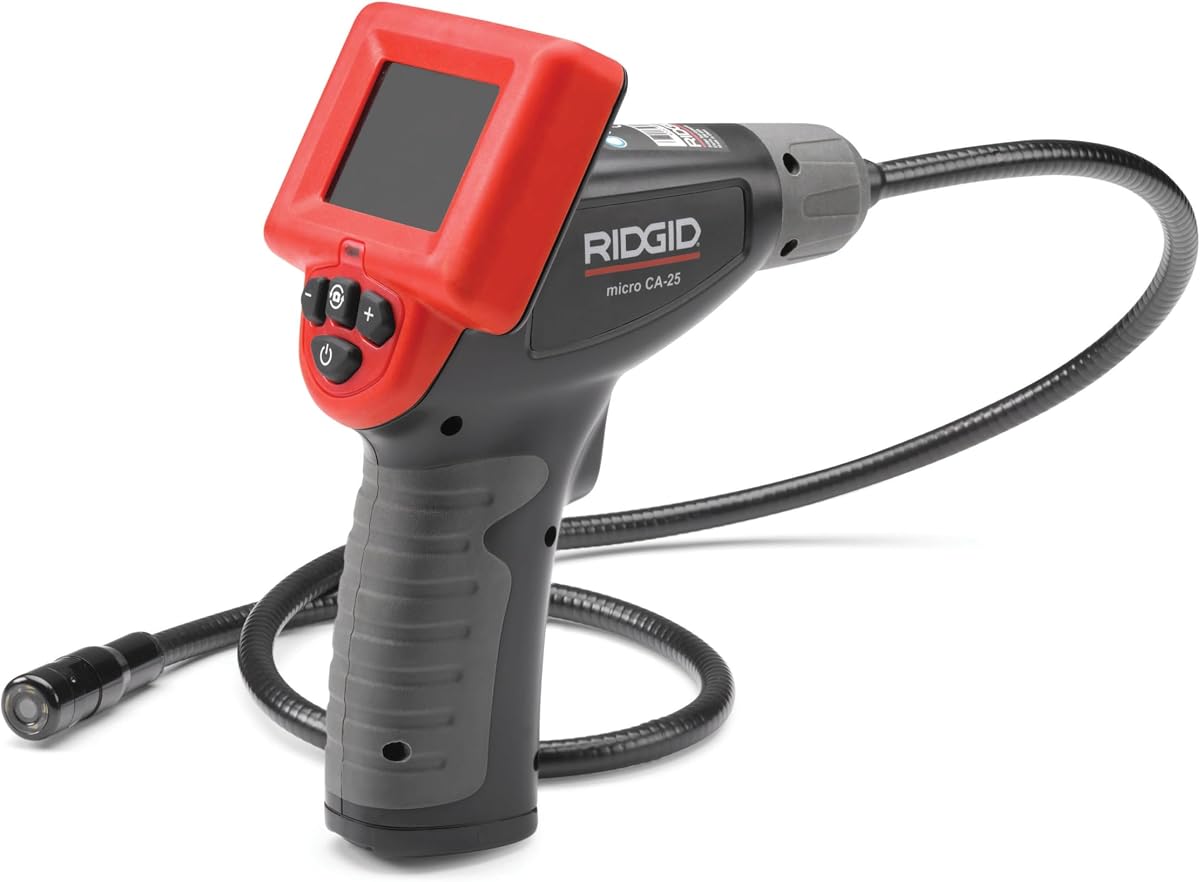
The RIDGID Micro CA-25 is a compact hand-held inspection camera with a four-foot cable, a three-quarter-inch aluminum head, four adjustable LEDs, and a separate display. Its 4.5 rating makes it one of the strongest short-reach options in the guide. It is designed for visual diagnosis in tight spaces rather than long sewer-line surveys.
We may earn a commission when you buy through this link, at no additional cost to you.
The camera head and cable are waterproof, allowing use in gaps, holes, and submerged areas. An ergonomic pistol grip supports one-handed operation, and the image can be rotated 180 degrees for more comfortable viewing. A video-out feature can transfer the live image to external devices or programs such as RIDGIDConnect, offering a path to digital integration without a built-in storage card.
The primary limitation is obvious: four feet of cable. It cannot handle a standard residential drain line or reach a blockage in a long sewer lateral. It also does not offer built-in recording storage, and its separate screen and accessories make it less convenient for quick household use than an integrated compact borescope.
Despite that limited reach, the Micro CA-25 is well suited to mechanics, electricians, maintenance technicians, and plumbers checking localized spaces. The rugged aluminum head, straightforward controls, and external video option compensate for the short cable in applications where the inspection point is already close. It is a specialist tool rather than a substitute for a full sewer camera.
The anodized aluminum camera head is designed to withstand use in tight and demanding environments. Its compact diameter also allows it to enter openings that would reject a larger probe.
The ability to send live video to an external device or compatible program can support more involved inspection workflows. It is useful for technicians who already use a particular software or display system.
We may earn a commission when you buy through this link, at no additional cost to you.
The Teslong Dual Lens 50FT camera is designed to inspect blockages, cracks, and root intrusions in accessible drain lines. It pairs a 50-foot semi-rigid cable with forward and side cameras shown together on a 4.3-inch IPS display. Its 4.2 rating reflects a straightforward tool with a useful dual-view design, although it lacks several features found in the premium reel systems.
We may earn a commission when you buy through this link, at no additional cost to you.
The front camera has six LEDs for looking down the line, while the side camera has one LED for examining pipe walls. A split-screen display makes both perspectives visible at once, reducing the need to change lenses or guess what is outside the central view. The display also tilts and rotates 180 degrees, which helps when the operator is standing over an access point or crouching beneath a sink.
Its capabilities have clear boundaries. The semi-rigid cable works well in straight PVC sections but has limited ability to navigate tight 90-degree elbows and P-traps. Murky water can also reduce visibility, and the TF memory card is not included. The rechargeable 3000mAh battery is intended to support all-day drain inspections, but exact runtime is not stated.
This camera is a sensible choice for plumbers, home inspectors, and facility maintenance teams that primarily work on straight drain runs. Its dedicated screen and lack of phone or Wi-Fi dependence simplify operation, while the dual view provides more information than a single forward camera. For severe bends, deep lines, or extensive documentation, a 100-foot recording system is the better fit.
Seeing forward and side views together makes it easier to recognize the location and shape of an obstruction. A blockage ahead can be considered alongside wall damage that would be hidden by a forward-only camera.
Tilting and rotating the 4.3-inch screen improves visibility in locations where a fixed monitor would be difficult to read. Brightness adjustment also helps when working in direct sunlight or a dark utility area.
We may earn a commission when you buy through this link, at no additional cost to you.
The most important starting point is the pipe system being inspected. Cable length, probe diameter, bend handling, lighting, documentation, and display quality should be matched to the job rather than selected from specification lists alone.
Match reach to the actual distance, not the deepest possible blockage. Consider where the camera will enter the line and how much slack is needed to maneuver.
Expect smooth, long-radius turns to work best. Severe fittings require either a more flexible cable or a professional-grade approach.
Prioritize a clear live view and usable controls over resolution labels alone. A larger dedicated screen can be more valuable than extra pixels when the image is properly illuminated.
Choose adjustable illumination rather than a fixed light. The ability to reduce brightness in reflective water is as important as having enough light in a dark drain.
Choose recording when the inspection may lead to a repair estimate, service report, dispute, or insurance claim. Choose live viewing for simple household troubleshooting.
Waterproofing applies to the probe and cable, not necessarily every component. Keep the display and connection points dry.
Prioritize comfortable controls, secure storage, and enough battery for the longest expected inspection. Accessories are useful only when they match the work.
Balance reach against portability. The most capable system is not the most convenient if it must be carried between jobs or stored in a small cabinet.
Begin with a basic safety check before inserting the probe. Shut off or protect the line as appropriate, identify the cleanout or drain access point, and remove obstacles that could scratch the lens. Wear gloves, eye protection, and clothing suitable for dirty or wet work. If the line may contain hazardous material or the suspected blockage is deep, call a qualified professional rather than forcing the camera into an unsafe location.
Connect and power the unit according to its instructions, clean the lens with a soft cloth, and confirm that the display, lights, and recording controls work before feeding the cable. Advance the probe gradually while watching the live image. Use the forward lens to follow the pipe and the side lens to inspect the wall. Adjust brightness to control glare, and use the marked cable or known insertion depth to estimate the defect's location. Avoid abrupt pushing, twisting, or sharply bending the cable at the reel.
After the inspection, power the unit down before retracting the probe, wipe the lens and cable, and allow wet parts to dry. Store the camera in its case with the cable loosely coiled or arranged as directed. Check the connector for moisture or debris, keep the display away from standing water, and recharge the battery according to the manufacturer's instructions. A camera used in dirty or salty environments should be inspected more frequently for cracked seals, loose connectors, and damaged insulation.
A 30- to 50-foot camera is the most practical range for many residential drain lines because it provides useful reach without the weight of a 100-foot reel. Shorter scopes are appropriate when the cleanout is close to the suspected blockage. Measure the route and consider bends before selecting a length, since a longer semi-rigid cable cannot overcome every tight fitting.
Most semi-rigid cameras struggle with sharp P-traps and tight 90-degree elbows. A more flexible cable may navigate those fittings, but it can be harder to control and may not push far without assistance. Removing the trap or using an appropriate cleanout is often more reliable. The Teslong 50FT model specifically notes limited performance in tight P-traps and 90-degree elbows.
Recording is valuable when you need proof for a repair estimate, service report, property inspection, or dispute. It is less essential for a quick household check where you only need to identify an obvious obstruction. DVR systems with a memory card also tend to provide more complete documentation, while live-only borescopes are simpler and usually more compact.
An IP67- or IP68-rated camera head is designed to resist water and dust under specified conditions, making it suitable for wet drain environments. The rating does not mean the display, cable connector, charging port, or entire host can be submerged. Keep non-rated components dry and follow the manufacturer's cleaning and storage instructions.
Blurring can result from dirty lenses, moisture on the camera face, murky water, low contrast, or an image displayed on a less capable phone. Wipe the lens before and during use, lower the LED brightness if reflections are washing out the picture, and flush the line with clean water when appropriate. For phone-connected models, verify compatibility because some Android systems may produce a softer image.
A borescope is a compact handheld scope intended for short-range access to drains, walls, engines, appliances, and other confined spaces. A sewer camera reel uses a much longer cable, a larger display, and often DVR recording for professional drain inspection. A borescope is easier to carry, while a reel provides greater reach and documentation.
Yes. Many borescopes in this guide are also designed for engine, duct, wall, and appliance inspection. The hook, magnet, and mirror accessories can help retrieve small objects or inspect areas behind components. Choose a model with a short, maneuverable probe for automotive work even if it will also be used for occasional drain checks.
The marked cable on dedicated 100-foot systems can help estimate the distance to a visible defect, while a tape measure can provide a similar reference on other models. A standalone locator is generally required to determine the exact underground position of a buried line. If location precision is essential for excavation, include a compatible pipe locator in the overall inspection plan.
The 5-inch 1080P dual-lens endoscope is the most versatile general pick in the guide because it combines a dedicated display, two viewing directions, adjustable lighting, and simple operation. The DEPSTECH DS520 offers more reach and multiple lenses at a lower-tier position, while the [ChoosePRO®] 100FT system stands apart for professional documentation, depth markings, large-screen viewing, and extended battery life.
Prioritize the constraints of the actual job rather than the longest cable or highest resolution alone. Straight household lines favor a 30- to 50-foot semi-rigid camera, while serious documentation and deeper surveys call for a 100-foot DVR system. Tight elbows, murky water, the size of the display, and the need for saved footage can matter more than any individual specification.
Finally, check the current product listing, included accessories, warranty, and latest user feedback before purchasing. Ratings, product configurations, and prices change over time, and the details available at the time of purchase should determine which camera is the right fit for your inspection needs.