
No Clean Solder Flux Paste 4 Pack
4.5Editor score
Fine tips support precise dispensing
Four 10cc syringes included
Lead-free and halogen-free formula
Discover the best solder flux paste for repair, PCB work, desoldering, and DIY projects, with ten options compared for control, residue, and versatility.
Solder flux paste helps heat move cleanly through a joint, breaks down surface oxides, and gives solder a better chance of wetting the metal beneath it. A useful formula should spread predictably, resist running, work with common electronics solders, and leave either minimal residue or residue that is safe to leave in place.
The products below were compared using their stated composition, packaging, dispensing method, intended applications, residue claims, and compatibility information. The list includes traditional jar flux, syringe-applied paste, liquid flux for comparison, and kits that pair paste with desoldering wick for a more complete repair setup.
Each review explains where the option stands out and where its format may be less convenient. The top picks cover an all-around rosin paste, a precision multi-syringe set, and a bundled desoldering solution. Product availability and prices can change, so check the current listing before purchasing.
4.5Editor score

4.7Editor score

4.7Editor score
This side-by-side comparison covers jar, syringe, liquid, and bundled options, with particular attention to dispensing control, soldering compatibility, repair applications, residue, and included accessories.



SRA Solder 135 is a semi-solid rosin paste in a 2oz jar, earning a 4.7 customer rating in the supplied data. Its most appealing feature is the balance between useful activity and manageable handling: the listing describes a rosin-activated, type RA flux with an active temperature range of 93–315°C, or 200–600°F. That makes it a broad option for ordinary electronics soldering rather than a narrowly specialized product.
We may earn a commission when you buy through this link, at no additional cost to you.
The paste is described as having a solder-wax consistency that offers better control than a freely flowing liquid. Users can dip a copper wire or apply a small quantity directly to a PCB pad, while the flux helps solder spread and wet the surface. It is formulated for both lead and lead-free alloys, which broadens its usefulness for mixed repair benches, older equipment, and newer hobby projects.
The trade-off is the container. A jar is convenient for moderate amounts of work and can serve several jobs without repeated syringe handling, but it does not provide the pinpoint delivery possible with a narrow dispensing tip. This product also does not include desoldering braid, so buyers who regularly replace surface-mount components may want a separate wick.
It is a strong all-around recommendation for hobbyists, students, and general repair work. Choose it when predictable paste handling, broad solder compatibility, and a less demanding application method matter more than syringe-level precision or a bundled removal tool.
The semi-solid format gives the user more control than liquid flux while remaining easy to apply from a jar. It is especially convenient for wires, through-hole joints, and general PCB tasks where a small bead of paste is enough.
Compatibility with both leaded and lead-free solder makes this a practical shelf option for mixed projects. The stated operating range also covers the temperatures commonly encountered in general electronics work.
We may earn a commission when you buy through this link, at no additional cost to you.
This four-syringe set is built for users who want controlled flux placement rather than a general-purpose jar. It holds a 4.5 customer rating, and its two fine tips make the product particularly attractive for small PCB pads, tight gaps, SMD work, and other tasks where excess material can cause problems. Four 10cc containers also provide convenient backups for a repair bench or separate work areas.
We may earn a commission when you buy through this link, at no additional cost to you.
The listing describes a high-activity rosin formula that removes oxidation and improves solder wetting. It is lead-free, halogen-free, non-corrosive when used as directed, and intended to leave minimal residue. The paste stays where it is placed instead of spreading like a thin liquid, while the push-style syringe allows the user to place small amounts exactly where they are needed.
One caveat is environmental sensitivity. The manufacturer notes that the product has normal flow performance at room temperature but may thicken in extremely cold conditions. That means it should be stored away from cold exposure and tightly resealed after use. A syringe also requires more deliberate handling than a jar, although the included fine tips help reduce waste.
This is a particularly strong choice for beginners practicing controlled application and for experienced users working around dense or delicate assemblies. It also works well for phones, instruments, appliances, PCB maintenance, and general rework where clean results and accurate placement are priorities.
The included fine tips are the defining advantage for tiny pads and crowded assemblies. They let the user limit flux to the work area instead of coating a wider section of the board.
Four capped syringes provide redundancy without changing the formula. Separate containers can remain at different workstations or be reserved for jobs where contamination or frequent use is a concern.
We may earn a commission when you buy through this link, at no additional cost to you.
This kit pairs a 10cc container of no-clean solder flux paste with 10 feet of desoldering wick braid and holds a 4.7 customer rating. The combination addresses a common repair need: adding solder to a joint or pad and later removing excess solder when replacing a component. The braid measures 0.1 inch wide, making it relevant to small boards rather than bulky chassis work.
We may earn a commission when you buy through this link, at no additional cost to you.
The flux is described as halogen-free, non-corrosive, and fluid enough to help remove solder from circuit boards. The copper wick uses a woven design intended to improve capillary action and absorb redundant solder. Together, the two components support tasks such as removing relays, desoldering old wires, correcting mistakes on small PCBs, and replacing keyboard switches.
The main limitation is that the paste portion is only 10cc, and a ten-foot braid is a general removal aid rather than a substitute for specialized extraction equipment. It may also be less suitable than a fine syringe for densely packed micro-components. Buyers who need careful flux dosing for very small joints may want a separate precision dispenser.
Despite those limits, this is the most complete option in the roundup for anyone who both solders and desolders. It is a convenient first repair kit, a useful bench companion, or a compact way to keep both essential materials together in one place.
Pairing flux with copper braid covers two stages of rework. The paste supports soldering and wetting, while the braid absorbs unwanted solder when components or connections need to be removed.
The 0.1-inch braid and stated small-board applications make this combination useful for electronics work. It is particularly relevant to repair benches that regularly handle compact PCBs and removable components.
We may earn a commission when you buy through this link, at no additional cost to you.
This option supplies two 1.2oz jars containing 35g of semi-solid rosin flux each, and its customer rating is 4.6. The twin-jar format is straightforward and practical: one container can remain on the bench while the other acts as a reserve or is kept for a separate work area. Total included paste is stated as 70g.
We may earn a commission when you buy through this link, at no additional cost to you.
The product description highlights its non-corrosive character in dry conditions and notes that rosin provides insulation when dry. It also presents the paste as resistant to dumping, giving the user a more controlled material than ordinary liquid flux. Its stated applications extend to soldering instruments and working with gold, copper, tin, iron, and other metals.
Compared with the syringe products, the main disadvantage is less precise placement. A user must work from a jar and apply paste with a brush, applicator, or the soldering process itself. The listing also does not make residue behavior a central selling point, so users who specifically want a clearly defined no-clean formula may prefer another option.
For general electronics repair, lead-free soldering, and DIY work, this is a useful and uncomplicated set. It is especially suitable for people who prefer a paste they can pick up in controlled amounts and want two jars rather than a single container or syringe.
Keeping a second jar available reduces interruptions and makes it easy to divide work between projects. This is simpler than managing several syringes and is appropriate for less precision-intensive tasks.
The paste is specifically presented as semi-solid and less likely to dump than a liquid. That characteristic is useful when the goal is to keep flux near a joint before heating.
We may earn a commission when you buy through this link, at no additional cost to you.
The Crivon kit combines a rosin flux syringe with copper solder wick braid and earns a 4.6 customer rating. Rather than focusing on only one stage of the repair process, it is organized around an apply–remove–rework workflow. That makes it relevant to component replacement, general PCB maintenance, and electronics projects in which both new solder and solder removal are needed.
We may earn a commission when you buy through this link, at no additional cost to you.
Its paste is described as controlled-viscosity and low residue, helping it remain on traces instead of spreading unpredictably. The listing says it improves solder flow and transfer between the iron tip, solder, and PCB pad while promoting even wetting. The wick is presented as a way to absorb excess solder, reduce bridges, and support component replacement.
The listing is less specific than some competing products about exact wick length and container volume. It also makes broad compatibility claims without listing every tool or alloy detail. For buyers who need hard measurements or a particular syringe tip size, checking the current package information would be sensible.
Even so, the kit is well matched to a compact electronics bench. It offers enough workflow coverage for beginners learning rework and experienced technicians who want flux and desoldering tools conveniently paired. The low-residue and controlled-viscosity claims make it especially appealing for neat SMD and general PCB work.
A paste that remains stable on a trace is valuable when only one pad or group of pads needs treatment. The stated viscosity is intended to reduce spreading while supporting smooth flow under heat.
Keeping wick braid alongside the paste avoids a common bench gap during rework. The combination supports component replacement, bridge correction, and routine circuit board maintenance.
We may earn a commission when you buy through this link, at no additional cost to you.
This 30ml RMA liquid flux in a dropper bottle provides a different application experience from the paste options in the roundup. It has a 4.6 customer rating and is described as a rosin mildly activated formula with a neutral pH. The dropper allows the user to place small liquid amounts directly at a work area, which can be useful for wetting larger regions or reaching recessed joints.
We may earn a commission when you buy through this link, at no additional cost to you.
The product listing states that it removes oxides from tin-lead, lead-free, gold, silver, and copper alloys. It is also presented as RoHS certificate compliant, non-corrosive, low volatility, and free from lead, zinc chloride, and ammonium chloride. After soldering, the formulation is intended to produce low-residue joints with smooth, uniform appearance.
Liquid flux requires more care than a paste or syringe because it can flow beyond the intended joint. Users should control the dropper and avoid flooding sensitive areas. It also does not satisfy a strict need for a paste texture, although the broader electronics use of flux makes it a valuable comparison point.
Choose this option when controlled liquid application is preferred, particularly for general electrical soldering, rework, and larger areas. It is a solid alternative when rosin activity, low volatility, and dropper convenience are the leading criteria.
A dropper offers intuitive, incremental dosing and can reach joints that are difficult to cover with a brush. Small amounts can be added directly before heating, though care is still needed to prevent spread.
The stated compatibility includes common leaded, lead-free, gold, silver, and copper alloys. That makes the dropper useful for mixed electronics work rather than a single solder system.
We may earn a commission when you buy through this link, at no additional cost to you.
The five-piece kit includes three flux paste dispensers and two desoldering wick pieces, earning a 4.5 customer rating. Its plunger-style dispensers are designed to deliver flux smoothly and precisely, while the wick components provide a way to remove excess solder. The assortment is aimed at electronics repair, including BGA, SMT, appliances, instruments, and mobile phone work.
We may earn a commission when you buy through this link, at no additional cost to you.
The KL-558 paste is described as a highly active rosin flux that removes oxide layers, provides excellent wetting, resists oxidation, and leaves no residue. The listing also states that it produces a non-irritating odor and low smoke, with RoHS compliance. The wick is described as high-purity oxygen-free copper intended to absorb excess solder quickly.
Highly active flux can be effective on stubborn oxidation, but it should be applied deliberately and kept within the intended work area. Users should also verify the exact dimensions of the two wick pieces for their own repair plans, because the listing does not provide detailed measurements. The kit also offers less material per dispenser than some of the larger syringe sets.
This is a good option for a repair kit requiring several paste dispensers and separate wick pieces. It is particularly relevant to users who value organized, repeatable dispensing and want both soldering and desoldering materials ready at the bench.
Three paste dispensers allow separate units for different jobs, benches, or stages of a project. This can reduce repeated handling and make the kit more convenient for regular repair work.
The stated high activity targets oxide removal and supports wetting on surfaces that resist easy solder flow. Controlled plunger dispensing helps keep the application focused around the joint.
We may earn a commission when you buy through this link, at no additional cost to you.
MG Chemicals 8341 is a 10ml no-clean flux paste supplied with a pneumatic dispenser, plunger, and dispensing tip. It has a 4.7 customer rating, matching the highest rating in the supplied product set. Its format resembles professional bench dispensing equipment more closely than a basic jar, making it a logical choice for users who want repeatable, localized application.
We may earn a commission when you buy through this link, at no additional cost to you.
The product is credited with superior fluxing ability and instant wetting. After soldering, the rosin residue is described as non-corrosive, non-conducting, and moisture resistant. It is also compatible with both lead-free and leaded solder systems, allowing a single material to serve mixed projects without changing application habits.
The 10ml capacity is small, and the pneumatic-style dispenser may be more than a casual hobbyist needs. Buyers who anticipate substantial consumption may find larger syringe or jar options more economical. Those who value fine control for repeated service work, however, may appreciate the included tip and plunger arrangement.
This is a strong recommendation for precision electronics work and professional-style bench organization. It is particularly compelling for users who want a small, dedicated dispenser and a clearly stated no-clean residue that is non-conductive and moisture resistant after soldering.
The included pneumatic dispenser, plunger, and tip create a controlled application path for small amounts of flux. That format can make repeat work more consistent than applying paste from an open jar.
The rosin residue is described as non-conductive, non-corrosive, and moisture resistant. These characteristics are relevant in electronics assemblies where residue behavior matters after the joint is complete.
We may earn a commission when you buy through this link, at no additional cost to you.
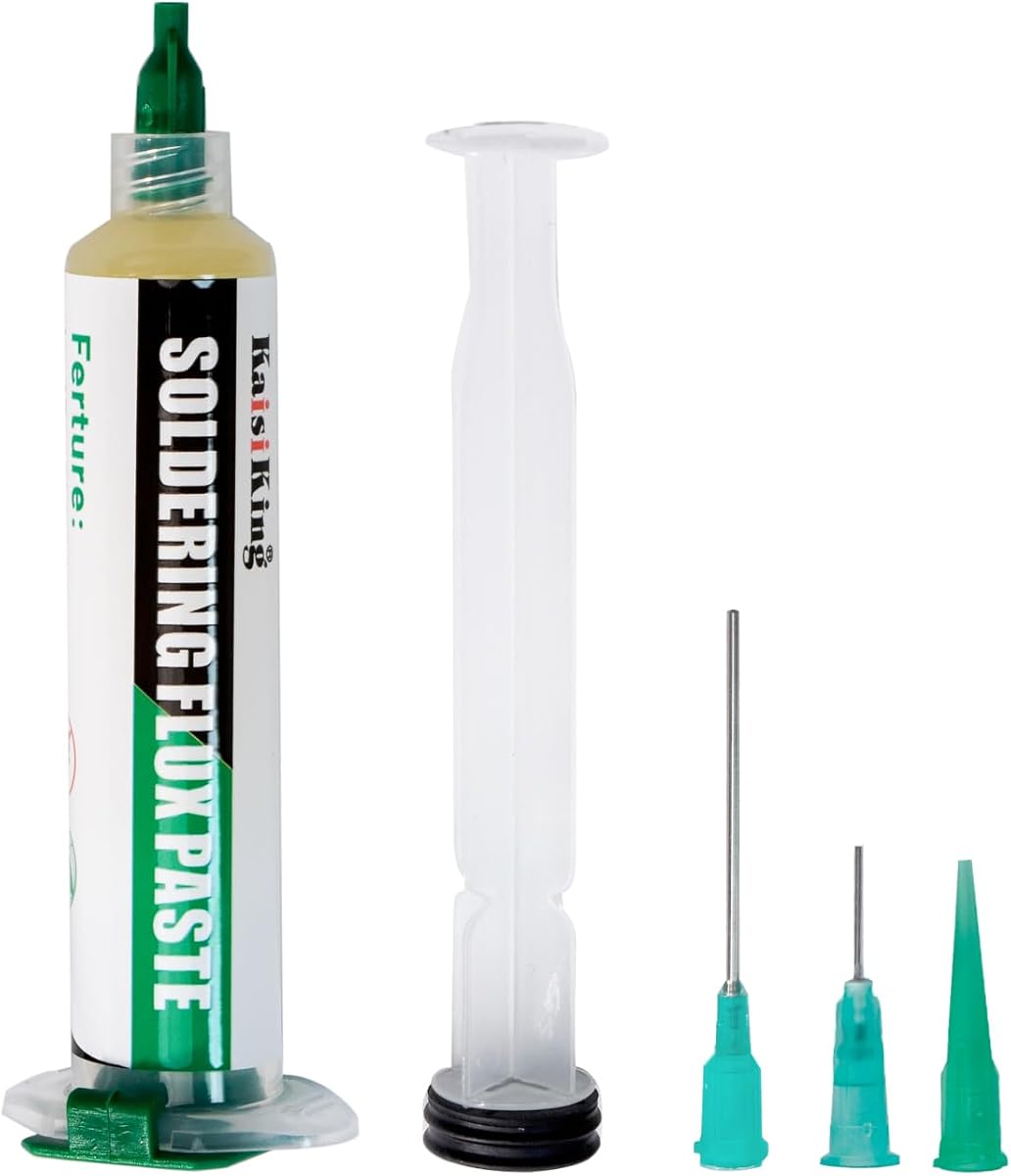
Kaisiking No Clean Soldering Flux Paste uses a push-type syringe and has a 4.5 customer rating. It is formulated from high-purity rosin materials and is described as lead-free, halogen-free, and non-corrosive. It can support repairs involving either lead-based or lead-free solder, making it a versatile option for users who do not know which alloy an older assembly contains.
We may earn a commission when you buy through this link, at no additional cost to you.
The paste is promoted for stable performance, low volatility, reduced smoke, and smooth flow. Its application is straightforward: the user gently pushes the plunger so flux slowly emerges, allowing the material to be placed near the joint before heating. A sealing cover can be replaced after use, helping protect the remaining paste.
The listing does not state the syringe capacity, which makes it harder to compare expected coverage with products whose volumes are explicit. It also provides no desoldering braid and does not describe the supplied tip in as much detail as some competing products. For precise microelectronics, buyers may want to confirm the opening size.
Despite the missing measurements, it is a useful general-purpose choice for instruments, copper, tin, gold, iron, circuit boards, and routine repair or rework. Its slow dispenser flow and broad solder compatibility make it approachable for both beginners and experienced users who prefer a simple syringe.
The push-style mechanism releases paste gradually instead of releasing a large uncontrolled amount. This makes the syringe approachable for beginners and convenient for repeated small applications.
Support for both leaded and lead-free solder simplifies bench planning. The rosin material is also described as non-corrosive and insulating when dry, which suits general electronics work.
We may earn a commission when you buy through this link, at no additional cost to you.
The two-pack version of SRA Solder 135 provides two 2oz jars of no-clean rosin paste and carries a 4.7 customer rating. It shares the central benefits of the single-jar version: a semi-solid consistency that limits goop and spreading, compatibility with lead and lead-free alloys, and residues that the listing says do not need to be cleaned.
We may earn a commission when you buy through this link, at no additional cost to you.
The format is useful for high-volume hobby work or a busy repair bench. Two jars reduce the chance of running out during a project and can be assigned to different work areas. The paste can be applied to copper wire, circuit boards, and other common electronics surfaces before the solder is heated.
As with any jar format, pinpoint application is less precise than with a syringe. The jars are better suited to general work, through-hole connections, wires, and routine projects than to densely packed microcomponents where every drop must be controlled. There is also no desoldering wick in the package.
This two-pack is a good choice for users already comfortable with SRA 135 or anyone who wants a substantial general-purpose supply. It is particularly useful for car audio, computers, RC vehicles, drones, instruments, consoles, model railroading, and common microcontroller projects.
Two 2oz jars provide enough material for repeated electronics projects and reduce interruptions from running out. Separate containers can also be kept at different work locations.
The paste is described as having a solder-wax consistency that is easier to control than liquid flux. Its no-clean claim and compatibility with both common solder types make it versatile for general use.
We may earn a commission when you buy through this link, at no additional cost to you.
The best solder flux paste depends on the size of the joint, the type of solder, the amount of control you need, and whether your work includes desoldering. These factors help separate a convenient general-purpose jar from a precision syringe or a complete repair kit.
Paste should stay close to the intended joint long enough for the solder to melt and wet the surface. A semi-solid or wax-like consistency offers a middle ground between the easy flow of liquid flux and the precise placement of a syringe. It is useful for wires, through-hole joints, and larger pads, although dense SMD work may call for a narrower dispensing tip.
Consider how much precision the job requires. A jar is simple, durable, and suitable for occasional application, but the user must control the amount with an applicator. A push syringe provides incremental flow, while a pneumatic-style dispenser can support repeated and highly controlled application. The right choice is the one you can operate accurately without creating excess residue or waste.
Verify that the flux works with the solder alloy in your project. Many options in this guide support both leaded and lead-free solder, which is useful for older devices and modern electronics. The stated compatible metals also matter when working on unusual assemblies involving gold, silver, copper, tin, or iron rather than standard PCB pads.
A no-clean formula is designed to leave residue that can remain after soldering, but users should still follow the product instructions and inspect sensitive assemblies. Look for stated non-corrosive, non-conductive, and moisture-resistant properties when residue remains in place. Liquid and paste fluxes are not interchangeable in behavior, so follow the manufacturer’s cleaning guidance for the exact product.
Rosin flux can range from lightly activated to more active formulations. Greater activity can help remove stubborn oxide and improve wetting, but it also calls for more controlled application. Highly active paste may be useful on aged or oxidized surfaces, while standard no-clean rosin is often sufficient for clean, well-prepared electronic joints.
A flux paste is only one part of some repairs. If the job involves replacing relays, switches, connectors, or other components, copper desoldering wick provides a way to absorb unwanted solder. Kits that include both paste and braid are more complete for rework, while separate wick offers flexibility to choose the width and quantity that best fit the board.
Small syringes are ideal for precision work and jobs that must remain uncontaminated, while multiple jars or larger containers may be better for frequent use. Pay attention to the instruction to reseal containers after application. Some pastes may thicken in very cold environments, so storing them at room temperature away from heat and direct sunlight helps maintain consistent flow.
No-clean means the residue is intended to be electrically benign enough to remain, not that the product removes every need for inspection or cleaning. Look for clear claims about wetting, oxide removal, residue behavior, and corrosion resistance. Highly specific applications such as BGA, SMT, mobile phones, or microelectronics can also help identify a formula positioned for those tasks.
Prepare the work area before opening the flux. Clean the component leads, pads, or wires so that loose dirt is not mistaken for contamination that the flux must remove. For a repair involving an old joint, adding fresh solder to a newly cleaned lead can improve heat transfer and make the old connection easier to release. Keep the iron, board, and materials arranged so the work can be completed without repeatedly repositioning the assembly.
Apply a small amount of flux to the joint or to the solder as it approaches the heated area. With a syringe, press the plunger gently and stop as soon as the required quantity emerges. With jar paste, use a clean brush, applicator, or the tip of the soldering iron to place a controlled bead. Heat the pad and component together, then feed solder into the heated joint rather than holding solder directly against the iron.
After the joint is complete, inspect it for bridging, insufficient wetting, or excess residue. Remove unwanted solder with desoldering wick if the kit includes it. Reseal every container immediately, clean the syringe tip before it dries, and store the paste away from heat and direct sunlight. Allow extremely cold paste to return to room temperature before judging its flow, and follow the product instructions for any residue or cleaning requirement.
Solder flux paste is applied to a joint before or during heating to help remove surface oxides and improve how solder wets the metal. It is commonly used on PCBs, through-hole connections, SMD components, wires, and electronics repairs. Flux does not replace solder, so the appropriate solder alloy is still needed to form the electrical connection.
A no-clean flux is formulated so its residue can generally remain in place without being an expected source of corrosion or conduction. Nevertheless, sensitive, high-impedance, high-voltage, or heavily contaminated assemblies may benefit from inspection or cleaning. Follow the product instructions and the requirements of the device being serviced rather than assuming every residue situation is identical.
Paste flux is often easier to keep localized and works well for general electronics, through-hole joints, and applications where a small bead is needed. Liquid flux flows more freely and can cover larger or less accessible areas quickly. The best choice depends on the joint, the available dispensing method, and how precisely you need to control where the material goes.
Yes, if the flux is specifically labeled for lead-free use. Many products in this roundup support both lead-free and leaded alloys, while some are specifically lead-free. Always confirm compatibility and follow the soldering temperature requirements of the solder and component manufacturer.
Flux helps remove or disrupt surface oxides during soldering, which can improve wetting on a joint. It does not reliably repair deeply corroded copper, contaminated pads, or physically damaged traces. Severely oxidized areas may need mechanical cleaning, replacement, or board-level repair before a good joint can be created.
Flux paste is enough for many new solder joints because it improves wetting during heating. Desoldering wick becomes useful when excess solder must be removed, a bridge needs correction, or a component is being replaced. Kits that include both are especially convenient for regular rework, while a separate wick allows you to select a particular width.
Paste can thicken when exposed to cold temperatures, loses moisture, or remains open longer than intended. Keep the container tightly sealed, store it away from heat and direct sunlight, and allow cold paste to return to room temperature before use. If the material has changed substantially or no longer flows properly, replace it according to the manufacturer’s guidance.
Yes, provided the tip is kept clean and the syringe is resealed after use. Flux residue can dry around the opening and restrict flow, so wipe or carefully clear the tip before storing it. Keep separate syringes for separate projects when contamination could affect a sensitive repair.
SRA Solder 135 in the single jar stands out as the best overall option because its semi-solid consistency is easy to control, it supports both leaded and lead-free solder, and it covers a wide range of hobby and repair applications. The four-pack syringe option is the best budget choice for precision placement, while the flux-and-wick bundle is the best premium pick for a complete removal and rework setup.
Prioritize the dispensing format that matches your work. Choose a jar for general jobs and easy access, a fine syringe for dense boards, and a liquid dropper when quick wetting of larger or less accessible areas matters most. Also check the stated alloy compatibility, residue behavior, activity level, and whether the repair needs copper desoldering wick.
Finally, check the current listing, package contents, customer feedback, and price before buying. Formulations, accessories, and seller offers can change over time, and the most useful option is the one that matches both your soldering tasks and the level of control your components require.