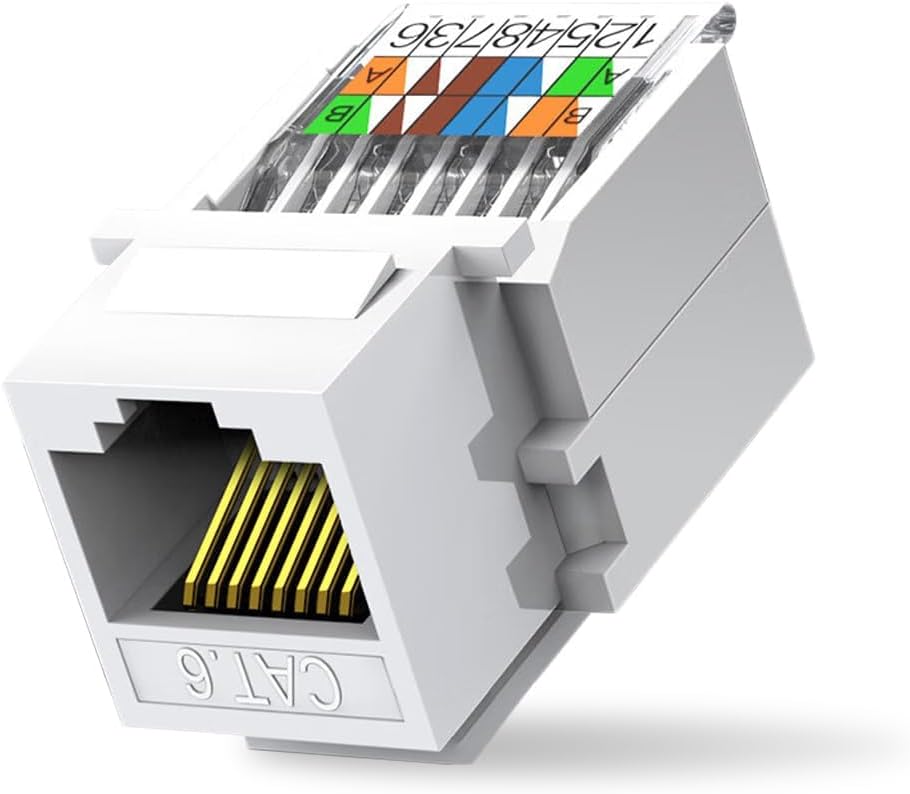
10-Pack Cat6 Tool-Less RJ45 Keystone Jack, White
4.3Editor score
Toolless wire termination
ANSI Category 6 compliant
Gold-plated connector contacts
Includes dust-proof shutter
Suited to wall plates
Compare the best Ethernet Keystone Jack options for structured cabling, evaluating Cat6 and Cat6A performance, wiring methods, fit, durability, and installation
An Ethernet Keystone Jack provides a secure, permanent connection between solid Ethernet cable and a wall plate, patch panel, or surface-mount box. A quality jack should fit its enclosure correctly, support the intended network category, terminate cleanly, and resist corrosion and everyday mechanical stress. The right choice depends on cable type, wiring method, port density, and installation environment.
This guide compares ten RJ45 keystone products based on their supplied specifications, compatibility, termination options, construction, performance claims, and intended applications. It includes conventional Cat6 termination jacks, a shielded Cat6A option, a toolless design, a slim high-density model, and two inline coupler alternatives. These categories are distinguished because couplers and bulk-cable termination jacks serve fundamentally different installation needs.
Each review explains the product's strongest attributes, practical limitations, and ideal buyer. The top selections represent a balanced shortlist, while the full comparison covers smaller projects, large wiring runs, and installations with special space, shielding, or toolless requirements. Product availability and prices can change, so buyers should verify current listings and confirm enclosure compatibility before purchasing.
4.3Editor score

4.7Editor score

4.5Editor score
The comparison below distinguishes bulk-cable termination jacks from inline couplers and highlights the most important differences in network category, wiring method, enclosure fit, and installation purpose.


This Cable Matters 10-pack is a conventional Cat6 bulk-cable termination solution with a 4.6 rating. It is designed for standard keystone openings in patch panels, wall plates, and surface-mount boxes, giving it broad relevance for structured-cabling projects. Its strongest combination of features is Category 6 performance, clearly marked T568A and T568B layouts, and compatibility with both 110 and Krone impact tools.
We may earn a commission when you buy through this link, at no additional cost to you.
The jack accepts 23 and 24 AWG unshielded twisted-pair cable and is specified for speeds up to 10 Gigabit Ethernet while remaining backward compatible with 10/100 Mbps Ethernet. Its 110-style blocks, dual IDC terminals, strain relief, gold-plated contacts, and snap-in retaining clip are all relevant to a dependable finished installation. The fire-retardant housing is also appropriate for a product expected to remain mounted inside a wall plate or network enclosure.
The main caveat is that the punch-down stand is not included in this particular 10-pack. That makes the bundle less convenient than Cable Matters options that include a stand, particularly for installers laying out many terminations. The stated support for tool-free 90-degree termination offers another route, but the supplied information does not specify every detail of that process, so installers should follow the product instructions and verify wire seating.
This is a strong choice for a modest number of Cat6 drops where a standard enclosure and a professional punch-down tool are available. It suits home offices, small business rooms, and expansions that do not require Cat6A shielding. Buyers who value a balanced feature set, UL Listed construction, and compatibility with established wiring standards will find this package easier to recommend than a specialized or toolless-only design.
The dual IDC terminals accept 110 or Krone impact tools, giving experienced installers more flexibility when working with preferred wiring equipment. T568A and T568B labels support consistent color mapping, while the retaining clip helps stabilize the jack after the conductors are seated.
The stated 10 Gigabit Ethernet capability and Category 6 standard compliance make this jack appropriate for modern structured-cabling runs. It is also backward compatible with earlier Ethernet cable categories, which can be useful when an existing installation includes mixed cable types.
We may earn a commission when you buy through this link, at no additional cost to you.
The VCE 25-pack combines a 4.7 rating with UL Listed construction and broad Cat6 installation support. It is positioned as a practical option for professional installers and DIY users who want a sizable group of matching jacks for residential or commercial wiring. The white 90-degree format is familiar and readily suited to common patch panels, surface-mount boxes, and wall plates.
We may earn a commission when you buy through this link, at no additional cost to you.
Its specification supports up to 10 Gigabit Ethernet transmission, full Cat6 performance, and backward compatibility with Cat5 and Cat5e cable. T568A and T568B are supported through color-coded 110-style blocks, while the IDC terminals work with 110 impact tools and provide strain relief for 23 and 24 AWG Ethernet cable. These details make the product especially suitable for straightforward professional punch-down work.
The height-dislocated gold-plated contacts are designed to reduce near-end crosstalk and resist corrosion, addressing two meaningful concerns in installed Ethernet connections. A slim standard profile and integrated snap-in clip help with fit and retention. The tradeoff is that this is a tool-based design rather than a true toolless model, so a suitable 110 impact tool is still needed for dependable termination.
The 25-unit count suits installers working across several rooms, a small office, or a structured cabling project with multiple drops. It is less attractive for a single-port repair, but the large quantity reduces the need to mix products across a project. Overall, it is a well-rounded recommendation for buyers seeking a 4.7-rated Cat6 package, UL Listed construction, and installer-oriented features.
Height-dislocated gold-plated contacts are intended to lower near-end crosstalk while preserving stable transmission. The gold-plated construction also supports corrosion resistance, making the package well suited to long-term structured-cabling use.
Twenty-five matching jacks are useful for installers who want consistent wiring hardware throughout a larger residence or office. The white 90-degree housing works with common standard keystone openings and helps maintain a uniform installation.
We may earn a commission when you buy through this link, at no additional cost to you.
This 25-pack of Cable Matters Cat6 Keystone Jacks carries a 4.7 rating and includes the accessory missing from the company's 10-pack offering. Its punch-down stand is a meaningful convenience for installers who want to position the jack securely while arranging and seating conductors. The package remains a conventional, standards-oriented solution for permanent bulk-cable terminations.
We may earn a commission when you buy through this link, at no additional cost to you.
Each jack is designed for standard keystone openings and accepts 23 or 24 AWG unshielded twisted-pair cable. It supports 10 Gigabit Ethernet, remains backward compatible with 10/100 Mbps Ethernet, and is specified to meet or exceed Category 6 requirements under ANSI/TIA/EIA 568-C.2. T568A and T568B wiring labels, 110-style blocks, and dual IDC terminals provide a clear framework for consistent installation.
A potential drawback is the physical quantity. Buyers completing a small number of drops may not need 25 jacks, while professional contractors may appreciate having a consistent supply available. Like most conventional keystone terminations, the product expects careful conductor placement and proper tool use; included support accessories simplify the process but do not replace correct wiring technique.
This package is best recommended to installers undertaking a sizable Cat6 project who value a punch-down stand, UL Listed construction, 10 Gigabit Ethernet support, and 110 or Krone tool compatibility. It also works well for a contractor maintaining a consistent stock of white jacks. For most buyers, the included stand makes it more installation-ready than the otherwise similar 10-pack.
A dedicated punch-down stand keeps the jack supported while the installer arranges wires and applies the impact tool. That added stability can make repeated terminations more consistent and reduces the need to improvise a way to hold each jack in position.
The Category 6 performance claim, 10 Gigabit Ethernet support, and compatibility with 10/100 Mbps Ethernet provide useful flexibility. Backward compatibility also helps when a room contains existing Cat5e or Cat5 cabling that needs to work with newer Cat6-terminated infrastructure.
We may earn a commission when you buy through this link, at no additional cost to you.
The Cable Matters shielded Cat6A jack is the specialized option in this list, with a 4.5 rating and a full metal jacket intended to reduce EMI/RFI interference and crosstalk. It is built for installations where higher-category performance, shielded cabling, or environmental interference is a more important consideration than purchasing the largest possible quantity of standard Cat6 jacks.
We may earn a commission when you buy through this link, at no additional cost to you.
The product is specified as 10GBASE-T channel compliant and backward compatible with Cat6 and Cat5e bulk cable. It supports tool-free termination using the included cap, as well as 110 impact-tool termination through its IDC modules. Universal T568A and T568B labels, an integrated metal collar for strain relief, and a secure snap-in clip make it suitable for standard wall plates, patch panels, and keystone blank outlets.
An auto-closing shutter protects the RJ45 contacts from dust and debris until a patch cable is inserted. That is particularly useful in unfinished or less frequently accessed spaces. The product also supports IEEE 802.3at PoE+ applications up to 30W when paired with compatible Cat6A Ethernet cable, making it relevant to PoE IP cameras, access points, and other networked devices.
This six-pack is best for installers who need shielded Cat6A endpoints rather than ordinary Cat6 terminations. Buyers should use compatible shielded cabling and follow the product's termination instructions. It is not a pass-through coupler; it is intended to terminate bulk Ethernet cable properly, which makes it a more substantial network component than an inline jack.
The full metal jacket is designed to reduce electromagnetic and radio-frequency interference as well as NEXT, AXT, and alien crosstalk. This makes the jack more relevant to data center-style networks, commercial spaces, or installations near potential interference sources than an ordinary unshielded jack.
Support for PoE+ applications up to 30W makes the product useful for compatible IP cameras and access points. The auto-closing shutter adds a separate layer of protection by keeping dust and debris away from the RJ45 contacts before a cable is connected.
We may earn a commission when you buy through this link, at no additional cost to you.
The Rapink 10-pack is a slim Cat6 UTP option with a 4.6 rating, built primarily for installations where free space around ports is limited. It is intended to fit 24-port and 48-port high-density patch panels, faceplates, surface-mount boxes, and other RJ45 network outlets, giving it a distinct advantage in structured cabling and data center environments.
We may earn a commission when you buy through this link, at no additional cost to you.
The jack accepts 23 through 26 AWG stranded or solid Ethernet cable, giving it broad conductor compatibility. Gold-plated contacts are specified for data transmission up to 10G over a 550 MHz Ethernet network, and the product is described as compatible with the TIA-568.2-D standard. Color-coded T568A and T568B labels support consistent termination, while compatibility with traditional 110 wire tools provides a familiar installation route.
The slim snap-in design makes the product practical for crowded enclosures, but it remains a tool-based keystone rather than a toolless alternative. Its unshielded construction also makes it less suitable than the shielded Cat6A option for installations where shielding is explicitly required. These are design distinctions rather than universal flaws, provided they match the wiring plan and environmental demands.
This product is a good fit for high-density networks, large wall plates, and installers who need a slim Cat6 jack with broad AWG support. It is also suitable for Cat5e and Cat5 cabling according to the product title, although buyers should still confirm whether those legacy categories satisfy the intended application. For ordinary spaces, the standard Cable Matters or VCE packages may be easier to source, but Rapink stands out where compactness matters most.
The slim profile helps jacks sit closely together in 24-port and 48-port panels without consuming unnecessary space. That makes the product especially relevant to data center applications and other high-density environments where every millimeter of enclosure depth matters.
Support for 23 through 26 AWG stranded or solid conductors provides flexibility across a wide range of Ethernet cable. T568A and T568B labels reduce ambiguity, while 110-tool compatibility supports efficient professional termination.
We may earn a commission when you buy through this link, at no additional cost to you.
The ZoeRax toolless Cat6 jack is a practical alternative for wall-plate projects where avoiding an impact tool is a priority. It has a 4.3 rating, the lowest among the listed products, but its straightforward setup and focused compatibility may still make it a useful fit for the right installation. The stated process is to align wires with the color-coded labels, insert them, and secure the cover.
We may earn a commission when you buy through this link, at no additional cost to you.
The jack supports 24–26 AWG round or flat stranded wire and is exclusively specified for solid 23 AWG Cat6 cable. It adheres to ANSI/TIA/EIA 568-C.2 standards and is compatible with PoE, while gold-plated connectors and solid copper conductors are intended to provide durable, corrosion-resistant connections. A dust-proof shutter helps protect the connection point.
Its most important limitation is that it is incompatible with patch panels. That rules it out for many structured-cabling and data center applications, even though it fits surface-mount boxes and wall plates. The product data also suggests that solid 23 AWG cable is the only solid-conductor option, so installers should inspect their cable before starting and choose another model if their wiring does not meet that requirement.
This is a good choice for a small home-network extension, an added wall outlet, or a multi-port wall plate where accessible toolless termination matters. It is not the best pick for a high-density patch panel or an installation built around mixed solid and stranded conductor types. Its lower rating should be considered alongside those clearly stated application boundaries.
The snap-down cover eliminates the need for a conventional impact tool during termination. This can reduce the learning curve and equipment requirements for a homeowner installing a small number of accessible wall outlets, although wire order and seating still require care.
The design accepts 24–26 AWG stranded conductors and solid 23 AWG Cat6 cable, but it cannot be used in patch panels. Verifying both the cable type and the intended enclosure before ordering prevents avoidable compatibility problems.
We may earn a commission when you buy through this link, at no additional cost to you.
The Sokqovt product is a Cat6 female-to-female inline keystone coupler rather than a jack for terminating bulk cable. It earns a 4.7 rating and offers a 4.7-rated, tool-free way to connect two Ethernet cables. That distinction makes it valuable for temporary extensions, reorganizing existing connections, or adding a usable network port without performing a new punch-down termination.
We may earn a commission when you buy through this link, at no additional cost to you.
The coupler snaps into standard network ports and is described as supporting up to 100 meters of combined cable length without reducing transmission speed. It is also specified for data transmission up to 10G. Its slim dimensions allow it to fit in wall plates and patch panels, including crowded 24-port racks and six-port wall plates, where neighboring connectors could otherwise rub against one another.
Unlike a conventional keystone, it does not terminate conductors from a cable run. Instead, two already terminated RJ45 cables plug into the female ends. That makes installation much faster, but it also creates an additional connection in the link. The product is therefore a convenience solution rather than a substitute for properly terminating bulk Ethernet cable in a permanent structured-cabling system.
The 24-pack is well suited to network organizers, temporary work areas, or users who need several extension points. Color-coded units can help identify connected services and simplify cable management. It is less appropriate for an installer who needs a clean, permanent endpoint directly from in-wall cable, because that requirement calls for a terminating keystone rather than an inline coupler.
Two finished patch cables can be connected through the female-to-female coupler without a punch-down tool. This makes the product convenient for reorganizing a temporary network or reaching a port location where permanent in-wall wiring is not available.
The narrow body is designed to fit closely spaced wall plates and patch panels without interfering with adjacent units. That makes the coupler useful where enclosure depth and port density would make a standard-sized keystone inconvenient.
We may earn a commission when you buy through this link, at no additional cost to you.
The VCE Cat6 PoE keystone coupler is another inline connection product, but its defining attributes are UL Listed construction, gold-plated contacts, and a 25-unit pack. With a 4.7 rating, it fits well within a home office, media center, or general network organization where a compact coupler can add flexibility without requiring field termination.
We may earn a commission when you buy through this link, at no additional cost to you.
The housing uses flame-retardant materials and is UL Listed under E521847. High-conductivity gold-plated contacts are intended to resist corrosion and support stable communication. The precision-engineered body snaps securely into a standard keystone wall plate or patch panel, helping reduce wobble and keep the connected cables aligned.
The coupler supports voice, data, audio, and video applications, and the supplied information identifies it as PoE-capable. As with any inline connection, it does not terminate bulk Ethernet cable. It requires two existing RJ45-terminated cable ends, and buyers should consider whether an extra interface is appropriate for their network topology and application requirements.
The black 25-pack is useful for organized color-coding, repeated network changes, and projects that need several inline connection points. It is a strong fit for a workbench or temporary network assembly, but it is not the appropriate choice for creating a permanent wall outlet from an in-wall cable run. For that task, buyers should select a Cat6 bulk-cable termination jack with punch-down blocks.
Gold-plated contacts are designed to resist corrosion and maintain a stable connection through repeated use. The snap-in fit keeps the coupler aligned in compatible wall plates and patch panels, reducing movement around the plugged-in cables.
Because the unit connects finished cables, it can make it easier to reorganize home-office, media-center, or temporary networking arrangements. The 25-unit quantity supports repeated deployments without requiring a bulk termination operation.
We may earn a commission when you buy through this link, at no additional cost to you.
The Cable Matters Rapid-Install 25-pack is a slim Cat6 option designed to broaden installation flexibility. Its 4.6 rating reflects a well-rounded specification: 10 Gigabit Ethernet support, backward compatibility with 10/100/1000 Mbps Ethernet and Cat5e cable, and compatibility with standard or slim keystone openings.
We may earn a commission when you buy through this link, at no additional cost to you.
Its most notable feature is support for tool-free, impact-tool, and crimp-tool termination. It includes universal T568A and T568B labels, uses 110-style blocks, and is compatible with 110-style tools. The product information also notes compatibility with Cable Matters RJ45 Crimp Tool model 180169, although the tools themselves are sold separately. A punch-down stand is included to support the jack during installation.
The slim housing is intended for high-density installations and works with Leviton QuickPort systems and slim Cat6 Decora-style wall plates. This enclosure compatibility is valuable but still requires verification because decorative plates and multi-port frames can vary. The impact-resistant, fire-retardant housing, gold-plated contacts, IDC covers, and snap-in clip support a secure, professional installation.
This package is a good recommendation for installers who want one model that can accommodate several termination preferences. It is particularly attractive for mixed projects involving different wall-plate systems or installers who may use both punch-down and crimp methods. The included stand offsets the need for separate support, although buyers must still obtain any required termination tool.
Supporting tool-free, impact-tool, and crimp-tool methods allows the jack to adapt to different installer preferences and available equipment. Universal wiring labels help maintain consistent T568A or T568B assignments across the installation.
The slim profile is compatible with standard and slim openings, including Leviton QuickPort systems and slim Cat6 Decora-style plates. Buyers should still compare the physical dimensions of the selected faceplate or enclosure before installation.
We may earn a commission when you buy through this link, at no additional cost to you.
The Cable Matters 50-pack is the largest bulk termination set in the guide and carries a 4.7 rating. It is aimed at contractors, installers, and advanced users who need a substantial supply of matching white Cat6 keystone jacks. The standard 90-degree form is designed for ordinary patch panels, wall plates, and surface-mount boxes rather than specialized high-density environments.
We may earn a commission when you buy through this link, at no additional cost to you.
It accepts 23 and 24 AWG unshielded twisted-pair cable and supports up to 10 Gigabit Ethernet while remaining backward compatible with 10/100 Mbps Ethernet. Each jack is specified to meet or exceed Category 6 performance under ANSI/TIA/EIA 568-C.2. T568A and T568B labels, 110-style blocks, dual IDC terminals, and compatibility with both 110 and Krone impact tools support professional workflow.
A punch-down stand is included, which is useful when performing many terminations. The fire-retardant housing, gold-plated contacts, dual IDC covers, strain relief, and snap-in retaining clip address durability and connection security. The principal drawback is simple: 50 jacks may be excessive for a homeowner or a small office, leaving unused hardware after the project ends.
For a large home, office fit-out, school, or repeated installation work, this pack offers a convenient way to standardize on one component. It is less compelling as a spare-parts purchase unless the installer expects several future drops. The product's strongest case is high-volume structured cabling, where consistent hardware and a supplied termination stand improve workflow efficiency.
Fifty matching jacks help an installer standardize wall plates and patch panels throughout a substantial deployment. The white 90-degree format is conventional, making the package suitable for widely used standard keystone openings.
The included punch-down stand provides stable support while conductors are arranged and seated. Dual IDC terminals accept 110 or Krone impact tools, giving technicians flexibility when completing a high number of drops.
We may earn a commission when you buy through this link, at no additional cost to you.
Selecting an Ethernet Keystone Jack requires matching the connector to the cable, wiring plan, enclosure, and network category. The following factors cover the practical distinctions that most affect installation success and long-term usability.
The first distinction is whether the device terminates raw bulk cable or simply joins two finished cables. A standard keystone jack has 110-style punch-down blocks and accepts conductors from a cable run, creating a permanent endpoint in a wall plate, patch panel, or surface-mount box. An inline coupler is female-to-female, requires two RJ45-terminated patch cables, and creates a modular extension point. Products in this guide include both types, so shoppers should confirm which task they actually need before comparing specifications.
Choose a bulk-cable terminator for in-wall wiring, new structured cabling, permanent wall outlets, and organized patch-panel infrastructure. Choose an inline coupler for temporary arrangements, extension without field termination, media-center setups, and situations where cables need to be connected and disconnected quickly.
Most of the selection consists of Cat6 UTP jacks that support 23 and 24 AWG cable, while the Rapink model accepts a broader 23–26 AWG range. The shielded Cat6A option is intended for higher-category installations and compatible Cat6A cabling. Cable category, conductor gauge, shielding, and the network's intended performance must all agree; a high-rated jack cannot compensate for undersized or incorrectly constructed cable.
Match the jack to the installed cable and design standard. For standard Cat6 networks, choose a Cat6 termination jack for permanent wiring. For Cat6A, consider a Cat6A-rated shielded termination model, especially where PoE+ or interference resistance is important.
AWG describes conductor diameter, and not every jack accepts every gauge or combination of solid and stranded wire. The VCE and standard Cable Matters models are specified for 23 and 24 AWG UTP cable. The Rapink jack accepts 23–26 AWG stranded or solid Ethernet conductors. The toolless ZoeRax model accepts 24–26 AWG stranded wire and solid 23 AWG Cat6 cable, making it less flexible for mixed cable inventories.
Check the jacket markings and cable construction before ordering. If the installation contains solid and stranded conductors, select a model that explicitly accepts both. Matching gauge and conductor type improves termination consistency and avoids last-minute substitutions.
Impact-tool termination provides strong control for professional work and is common on standard 110-style keystones. Toolless termination can simplify small projects by allowing a user to align conductors and secure a cover without a traditional impact tool. Some products support toolless, impact-tool, and crimp-tool methods, which can be useful for mixed workflows but may require careful adherence to the manufacturer's instructions.
Choose the method that matches both your experience and the available equipment. Professional installers may favor punch-down blocks and dual IDC terminals. Home users who value simplicity should consider a toolless jack, while checking whether it supports patch panels and the exact cable type in use.
Keystone openings differ in shape, depth, and spacing. Most products here are described as fitting standard keystone blanks, patch panels, wall plates, or surface-mount boxes, but the exact enclosure should be checked before installation. The Rapink model emphasizes a slim design for 24-port and 48-port high-density panels. The Rapid-Install model similarly addresses standard and slim openings and names Leviton QuickPort and slim Cat6 Decora-style plates.
Measure the opening and compare the jack dimensions, orientation, and surrounding clearance. Also verify whether the product is permitted in the intended enclosure. The toolless ZoeRax model, for example, fits wall plates and surface boxes but is specifically not compatible with patch panels.
Port density can determine whether a standard or slim jack is practical. Slim models consume less depth and are better suited to crowded panels and high-density installations. A 90-degree jack commonly presents the cable downward or sideways depending on the enclosure, while the shielded Cat6A product uses a 180-degree format with both toolless and impact-tool options. The choice should reflect the cable routing and available space around each port.
Prioritize a slim profile when ports are tightly packed or cable management space is restricted. In a conventional residential wall plate with plenty of clearance, a standard 90-degree jack may be easier to source and terminate.
UTP jacks are appropriate for many conventional structured-cabling environments. A shielded jack adds metal construction intended to reduce EMI/RFI interference and crosstalk, making it relevant for Cat6A systems, data center applications, or locations near equipment that may produce interference. Shielded cabling should be used consistently with a shielded jack, and the connection must be assembled according to the cable and connector instructions.
Select UTP for ordinary Cat6 installations unless the project specifies shielding. Choose the shielded Cat6A option when the wiring design calls for higher performance, PoE+ capability, or improved interference control.
Power over Ethernet can influence connector selection, particularly in modern offices and surveillance installations. The toolless Cat6 jack and shielded Cat6A jack are listed as PoE compatible, while the Cat6A model supports IEEE 802.3at PoE+ up to 30W with compatible Cat6A cable. Standards references such as ANSI/TIA/EIA 568-C.2, UL Listing, and TIA-568.2-D compatibility offer useful evidence of an intended use, but they should be matched to the project's local requirements.
Look for a punch-down stand when completing many terminations, as the Cable Matters 25-pack, Rapid-Install pack, and 50-pack include one. Tools are generally separate, so confirm access to a compatible 110 or crimp tool and arrange a clear, stable work area before beginning.
Begin by identifying the jack type and verifying compatibility. For a terminating keystone, confirm the enclosure, cable category, conductor gauge, and wiring standard before cutting or arranging the cable. The common choices in this guide are T568A and T568B; an installation should use one scheme consistently on both ends of each link. For an inline coupler, connect two properly terminated RJ45 cables instead of attempting to punch down conductors into the coupler.
Prepare the cable according to the product instructions, expose only the conductor length needed for the termination block, and arrange the wires in the indicated color order. With an impact-tool jack, place the jack in its punch-down stand, seat each conductor in the proper IDC slot, and use the appropriate 110 or Krone tool as applicable. With a toolless jack, align the wires with the color-coded guides and secure the cover in the stated sequence. The toolless product suggests handling one or two wires at a time for easier alignment.
After termination, inspect the seating of every conductor, close or secure the IDC cover, and snap the jack fully into the wall plate, patch panel, or surface-mount box. Test each completed link for correct wiring and performance, and correct any failed connection before concealing the cable. Keep ports dry and free of dust, avoid repeated bending at the plug, and do not force a connector into a damaged or obstructed port. For coupler-based connections, check both cable ends and the coupler if intermittent performance occurs.
An Ethernet Keystone Jack terminates a solid Ethernet cable inside a wall plate, patch panel, or surface-mount box, providing a permanent RJ45 network port. It is especially useful for structured cabling because the cable can be routed behind the wall and the finished room retains a clean, professional outlet. The jack must be wired consistently at both ends of the cable run.
No. A standard keystone jack terminates bulk cable using punch-down or toolless contacts, whereas a female-to-female coupler joins two cables that already have RJ45 plugs. The coupler in this guide can extend an existing connection up to 100 meters according to its product information, but it adds an inline interface and is not a replacement for properly terminating permanent cabling.
Cat6 is appropriate for many standard structured-cabling projects and can support up to 10 Gigabit Ethernet when the entire channel meets the relevant category requirements. Cat6A is the more specialized option and may be warranted for Cat6A cable, PoE+ applications, high-performance networks, or locations where shielding and interference control are important. Always align the jack with the installed cable and project design.
T568A and T568B are two color-coded arrangements for assigning eight conductors to the eight RJ45 positions. Either scheme can produce a correctly wired link as long as the same scheme is used at both ends. The products in this guide include T568A and T568B labels to help installers maintain consistent conductor order.
It depends on the model. Conventional Cat6 jacks generally use a 110 or Krone impact tool, while the toolless option uses a snap-down termination process. The Rapid-Install product supports several approaches, including tool-free, impact-tool, and crimp-tool termination, but the appropriate tool must be available. Check the product's instructions before beginning and avoid forcing conductors into incorrect IDC slots.
Only if the jack is designed for patch-panel openings and dimensions. Most standard Cat6 models in this guide are compatible with common patch panels, but the toolless ZoeRax model is explicitly not compatible with patch panels. The slim Rapink model is intended for high-density 24-port and 48-port panels, while the Cable Matters Rapid-Install model supports standard and slim openings. Physical fit should always be confirmed before ordering.
They are not always necessary. Unshielded Cat6 UTP is common in ordinary residential and small-office installations. Shielded Cat6A becomes more relevant when the project specifies Cat6A cable, uses PoE+, operates in a high-performance structured-cabling environment, or encounters potential interference. Shielding works best when the cable, jack, and overall wiring design consistently support it.
First check that the plug is fully seated, the port is clean, and the correct wire scheme was used at both ends. For a terminating jack, inspect the conductor seating in each IDC slot and look for a wire that is reversed, pinched, or not fully pressed into place. For a coupler, test the two cables separately and inspect the coupler's contacts. Testing the link with known-good equipment can help distinguish a termination problem from a cable, device, or network issue.
The VCE UL Listed 25-pack stands out as an editor's choice for installers seeking a strong 4.7 rating, UL Listed construction, Cat6 performance, and a practical 25-unit quantity. The ZoeRax toolless 10-pack is the budget-oriented pick for accessible wall-plate projects that do not require patch-panel compatibility. For specialized infrastructure, the shielded Cat6A option offers metal construction, 10GBASE-T channel support, toolless or punch-down termination, and PoE+ capability.
Most buyers should prioritize compatibility before features. Confirm whether the product is a true terminator or an inline coupler, verify the wall plate or panel dimensions, match the AWG and conductor type, and select the wiring scheme before ordering. High-density installations may favor the Rapink slim design, while large projects can benefit from the included punch-down stand found in several Cable Matters packs.
Finally, remember that listings, availability, and prices change over time. Review the current product page and manufacturer instructions, confirm that all included components match your installation plan, and check local wiring requirements where applicable. With those checks in place, the right Ethernet Keystone Jack can provide a clean, dependable endpoint or connection point for years of network use.
Based on the supplied product data, this guide evaluates ten Ethernet Keystone Jack options for home, office, data center, and structured-cabling projects.