
ASUS Dual GeForce RTX 3050 6GB OC
4.7Editor score
Six GB GDDR6 memory
Compact two-slot design
Dual Axial-tech fan design
The best GPU for CS2 guide compares ten options for 1080p, 1440p, and 4K, focusing on memory, cooling, power, and build fit.
A capable GPU for CS2 should deliver responsive competitive play while also handling demanding maps, high settings, and multitasking without unnecessary bottlenecks. The right choice depends on your monitor, preferred resolution, PC case, power supply, and the level of visual detail you want in Counter-Strike 2.
This guide compares ten graphics cards using the supplied specifications, including GPU architecture, video memory, bus width, cooling features, clock speeds, power requirements, and physical design. It covers entry-level, mainstream, high-refresh, 1440p, and 4K-oriented options from ASUS, GIGABYTE, ASRock, and XFX.
Each review explains who the card is likely to suit and where it may fall short, while the buying guide highlights the factors that matter most for CS2. Product details and availability can change, so verify the current listing, dimensions, connector requirements, and price before making a purchase.
4.7Editor score

4.8Editor score
4.6Editor score
The comparison below highlights the key hardware differences among these ten graphics cards, helping CS2 players match memory capacity, performance tier, cooling, and physical requirements to their particular gaming setup.


The ASUS Dual GeForce RTX 3050 6GB OC Edition is a practical entry point for players who want a dedicated GPU for CS2 without moving into the premium graphics market. Its supplied rating is 4.7, and the card combines Ampere streaming multiprocessors, second-generation RT cores, and third-generation tensor cores with a modest two-slot design. Those features give it a more modern foundation than an entry card without dedicated graphics performance.
We may earn a commission when you buy through this link, at no additional cost to you.
Its most appealing trait for CS2 is the combination of six GB of GDDR6 memory and support for DLSS through the listed third-generation tensor cores. DLSS can help the renderer produce a higher target resolution and scale the result, although the exact benefit depends on the game mode, settings, monitor, and available performance headroom. The card's listed OC boost clock of 1500 MHz also leaves room for factory-tuned performance relative to the default 1470 MHz mode.
The main compromise is memory capacity. Six GB may be adequate for competitive play at common desktop resolutions, but it leaves less breathing room for high-resolution textures, aggressive settings, modern applications, and future titles. The two-slot design is also beneficial for fitting the card into smaller cases, although buyers must still verify the card's exact length, connector needs, and available PSU capacity.
This is the best budget-oriented recommendation for a CS2 player joining from integrated graphics or building a straightforward 1080p gaming PC. It should not be mistaken for a high-end 4K option, but its 4.7 rating, DLSS capability, compact format, and dedicated 6 GB memory pool make it a sensible way to enter modern GPU gaming.
For a new gaming PC centered on 1080p CS2, this card provides a straightforward upgrade path with dedicated memory and tensor-based upscaling support. Its compact two-slot layout also makes it more approachable for builders assembling a smaller or already occupied system.
Third-generation tensor cores support DLSS, while Axial-tech fans use smaller hubs and longer blades intended to improve downward airflow. IP5X dust resistance and a stainless-steel bracket add practical durability for a long-term gaming build.
We may earn a commission when you buy through this link, at no additional cost to you.
The GIGABYTE Radeon RX 9070 XT Gaming OC 16G is a strong choice for CS2 players who want more than a basic competitive setup and plan to game at 1440p on a high-refresh display. Its 4.7 rating reflects a well-regarded card with a substantial 16 GB GDDR6 memory allocation, a PCIe 5.0 interface, and the WINDFORCE cooling system.
We may earn a commission when you buy through this link, at no additional cost to you.
Sixteen GB of video memory gives the card room for higher texture settings and a more generous margin when moving between gaming, desktop applications, and other GPU-accelerated tasks. That advantage is more visible outside basic 1080p competitive play, where memory pressure and texture quality are less restrictive. The supplied information does not list exact frame rates, so performance should instead be evaluated against your target resolution and settings.
Cooling is handled by WINDFORCE with Hawk fans and server-grade thermal conductive gel, while RGB lighting provides a visual option for cases with glass panels. Those details are appealing for a showcase build, although buyers who prefer a restrained appearance may find the lighting unnecessary. The card's physical dimensions and power requirements should be checked against the intended chassis and PSU.
Choose this model when a 16 GB pool, modern Radeon XT performance, and PCIe 5.0 support align with a 1440p or mixed-use gaming system. It gives CS2 players a generous hardware buffer without moving into the cost and physical demands of the range's highest-end models.
The 16 GB GDDR6 configuration is the defining feature of this card. It offers ample room for higher visual settings and multitasking compared with six-gigabyte alternatives, making it a better fit for players who do not intend to remain strictly at baseline competitive settings.
WINDFORCE cooling combines Hawk fans with server-grade thermal conductive gel to manage heat during extended gaming sessions. A capable cooling system is particularly useful for CS2 players who keep the game running for hours or use demanding visual settings.
We may earn a commission when you buy through this link, at no additional cost to you.
The ASUS Dual Radeon RX 9060 XT 16GB GDDR6 combines a generous memory allocation with a flexible cooling design and a 4.7 rating. It is a sensible middle ground for CS2 players who want more memory than an entry-level model but do not need a flagship graphics card, particularly at 1080p or 1440p.
We may earn a commission when you buy through this link, at no additional cost to you.
The supplied clock information is particularly notable, with OC mode reaching up to 3250 MHz boost and 2640 MHz game clock. Default mode lists up to 3230 MHz boost and 2620 MHz game clock. These figures give users two operating profiles, while the dual BIOS switch makes it easy to alternate between a quieter configuration and a performance-oriented one without changing software.
The card uses two Axial-tech fans with longer blades and a barrier ring designed to increase downward air pressure. Its dual ball fan bearings are stated to last up to twice as long as sleeve-bearing designs, improving long-term durability. The trade-off is a 2.5-slot body, which demands more clearance than a compact two-slot card and may affect adjacent hardware.
This model is most attractive to players who want a quiet card for lighter sessions but also want access to a higher clock profile for competitive matches. Its 16 GB of GDDR6 memory also makes it more flexible across settings and applications than a six-gigabyte choice.
The dual BIOS switch is a useful feature in a gaming PC that serves two roles. Use the Quiet profile for desktop work or lighter gaming, and switch to Performance when maximum listed clocks and active cooling are priorities.
Sixteen GB of GDDR6 creates a comfortable buffer for CS2 at elevated settings and for a system that also runs content-creation software. The memory capacity is especially attractive for buyers comparing this card with more expensive RX 9070 XT and RTX 5080 models.
We may earn a commission when you buy through this link, at no additional cost to you.
The ASRock Radeon RX 9070 Challenger 16GB OC stands out as the most balanced recommendation in this guide. It carries a 4.8 rating, uses AMD's RDNA 4 architecture, and offers 16 GB of GDDR6 memory on a wide 256-bit bus. For CS2 players targeting 1440p or considering a future 4K upgrade, it combines useful capacity with substantial bandwidth.
We may earn a commission when you buy through this link, at no additional cost to you.
Its listed specifications include 56 compute units, 3584 stream processors, third-generation ray-tracing cores, and second-generation AI accelerators. The factory boost clock reaches 2520 MHz, with a 2070 MHz game clock. Memory operates at 20 Gbps, giving the card 4096 bits of theoretical addressable memory bandwidth before overhead, which is valuable for high-resolution textures and other memory-intensive work.
Triple fans and a 0dB Silent mode make this a flexible choice for a gaming room where idle noise matters. The catch is physical and electrical: the supplied dimensions are 290 by 123 by 51 mm, the card occupies 2.5 slots, and it uses two eight-pin power connectors. A 700W PSU is recommended, making compatibility checks essential before purchase.
This card is our Editor's Choice because it balances memory, clock speed, cooling, and platform capability without requiring the flagship power and physical footprint of the RTX 5080 options. It is a particularly attractive choice for a new 1440p CS2 system with a suitably sized case and robust power supply.
The 256-bit bus and 20 Gbps memory specification provide a healthy bandwidth foundation without the extreme demands of a top-tier card. That balance makes this GPU appealing for high-refresh 1440p play and future workloads beyond CS2.
A triple-fan design spreads thermal work across more blades, while the advertised 0dB Silent behavior can keep the card inactive during light tasks. It is a useful contrast to cards with permanently active fans in shared or relatively quiet gaming spaces.
We may earn a commission when you buy through this link, at no additional cost to you.
The ASUS Dual GeForce RTX 5060 Ti 16GB OC Edition brings NVIDIA's Blackwell architecture and DLSS 4 to a dual-fan graphics card with 16 GB of GDDR7. Its 4.7 rating and high listed AI performance make it a compelling modern option for CS2 players who value upscaling features and a generous memory pool.
We may earn a commission when you buy through this link, at no additional cost to you.
The card's headline AI figure is 767 TOPS, reflecting the Blackwell generation's emphasis on dedicated AI acceleration. DLSS 4 can be useful for reaching a desired frame-rate target, but users should understand that it is an upscaling technology rather than a substitute for native rendering power. The OC profile reaches 2632 MHz, compared with a listed 2602 MHz in default mode.
Two Axial-tech fans, a 2.5-slot design, 0dB technology, and a dual BIOS switch provide a good balance of cooling and flexibility. Dual ball fan bearings are listed as lasting up to twice as long as sleeve-bearing designs. Compared with the RTX 5080 cards in this guide, the physical design is less imposing, although exact dimensions and power requirements should be verified.
Choose this GPU when you want a newer NVIDIA platform, GDDR7 memory, and DLSS 4 without moving directly to flagship pricing. It works especially well as a 1080p or 1440p card for a new system, while its 16 GB allocation provides additional flexibility for settings and multitasking.
DLSS 4 support and 767 AI TOPS position this card around modern AI-assisted rendering and upscaling. For CS2, the useful question is whether the target resolution and desired frame rate leave enough headroom for the selected graphics mode to respond effectively.
The dual BIOS system lets owners move between Quiet and Performance configurations. This is convenient for a PC that alternates between CS2 matches, everyday desktop work, and more demanding applications that benefit from the higher OC clock.
We may earn a commission when you buy through this link, at no additional cost to you.
The GIGABYTE GeForce RTX 5080 Gaming OC 16G is a high-end option for players who want premium NVIDIA hardware for CS2, modern gaming at 4K, and demanding GPU-accelerated applications. Its 4.6 rating is solid, and the specification set includes Blackwell architecture, DLSS 4, 16 GB of GDDR7 memory, and a 256-bit interface.
We may earn a commission when you buy through this link, at no additional cost to you.
That combination targets bandwidth-intensive workloads and high-resolution outputs. Sixteen GB is enough to avoid choosing the card on memory capacity alone, making the RTX 5080 more compelling when raw rendering capability, upscaling support, and future headroom matter. The WINDFORCE cooling system is designed to manage the higher thermal demands associated with a card in this class.
The biggest drawback is system readiness. A GeForce RTX 5080 belongs in a build with a capable processor, modern PCIe platform, sufficient power supply, and enough physical room. Exact connector and PSU requirements are not included in the supplied data for this particular model, so the manufacturer's specifications and current listing should be checked before ordering.
For CS2 alone, the card may be more than a competitive player needs, especially at 1080p or 1440p. It becomes more compelling in a premium system aimed at 4K, high-refresh output, multitasking, and future games where additional GPU headroom can be used.
The RTX 5080's Blackwell architecture and GDDR7 memory make it relevant when CS2 runs at 4K or alongside demanding applications. At lower resolutions, a more affordable card may deliver a better value proposition even if it cannot match the flagship tier.
The included WINDFORCE cooling system is intended to handle sustained GPU workloads. Its effectiveness should be considered alongside case airflow, ambient temperatures, fan curves, and the card's position in the chassis.
We may earn a commission when you buy through this link, at no additional cost to you.
The ASUS Prime Radeon RX 9070 XT 16GB GDDR6 OC Edition combines 16 GB of memory with some of the highest listed clock speeds among the Radeon options here. Its 4.6 rating reflects a capable high-end card, and the OC profile reaches up to 3030 MHz boost and 2480 MHz game clock.
We may earn a commission when you buy through this link, at no additional cost to you.
The Prime design focuses on practical cooling and board features. Axial-tech fans move air with longer blades and a barrier ring, while a phase-change GPU thermal pad is intended to maintain heat transfer as temperatures change. Dual ball fan bearings are stated to last up to twice as long as conventional sleeve-bearing designs, and Auto-Extreme manufacturing supports the brand's emphasis on automated precision.
A dual BIOS switch gives users a Quiet profile and a Performance profile. GPU Tweak III adds performance tweaking, thermal control, and system monitoring, making the card easier to tune for different workloads. As with other multi-fan designs, the card requires adequate case clearance, and the actual power connector requirements should be verified from the current product listing.
This is a strong alternative for 1440p and 4K-oriented Radeon builders who value high factory clocks and 16 GB of memory. It may be less necessary for CS2 at 1080p, but its specifications provide a more substantial foundation for demanding settings and future gaming.
The listed 3030 MHz OC boost clock gives the card a performance-oriented starting point. Actual results vary with cooling, power limits, game settings, and the rest of the system, but the factory specification makes this a compelling option within the Radeon lineup.
A phase-change thermal pad supports stable heat transfer, while GPU Tweak III exposes thermal controls and monitoring. Together, these features help owners understand how the card operates during long CS2 sessions rather than relying on a fixed fan configuration.
We may earn a commission when you buy through this link, at no additional cost to you.
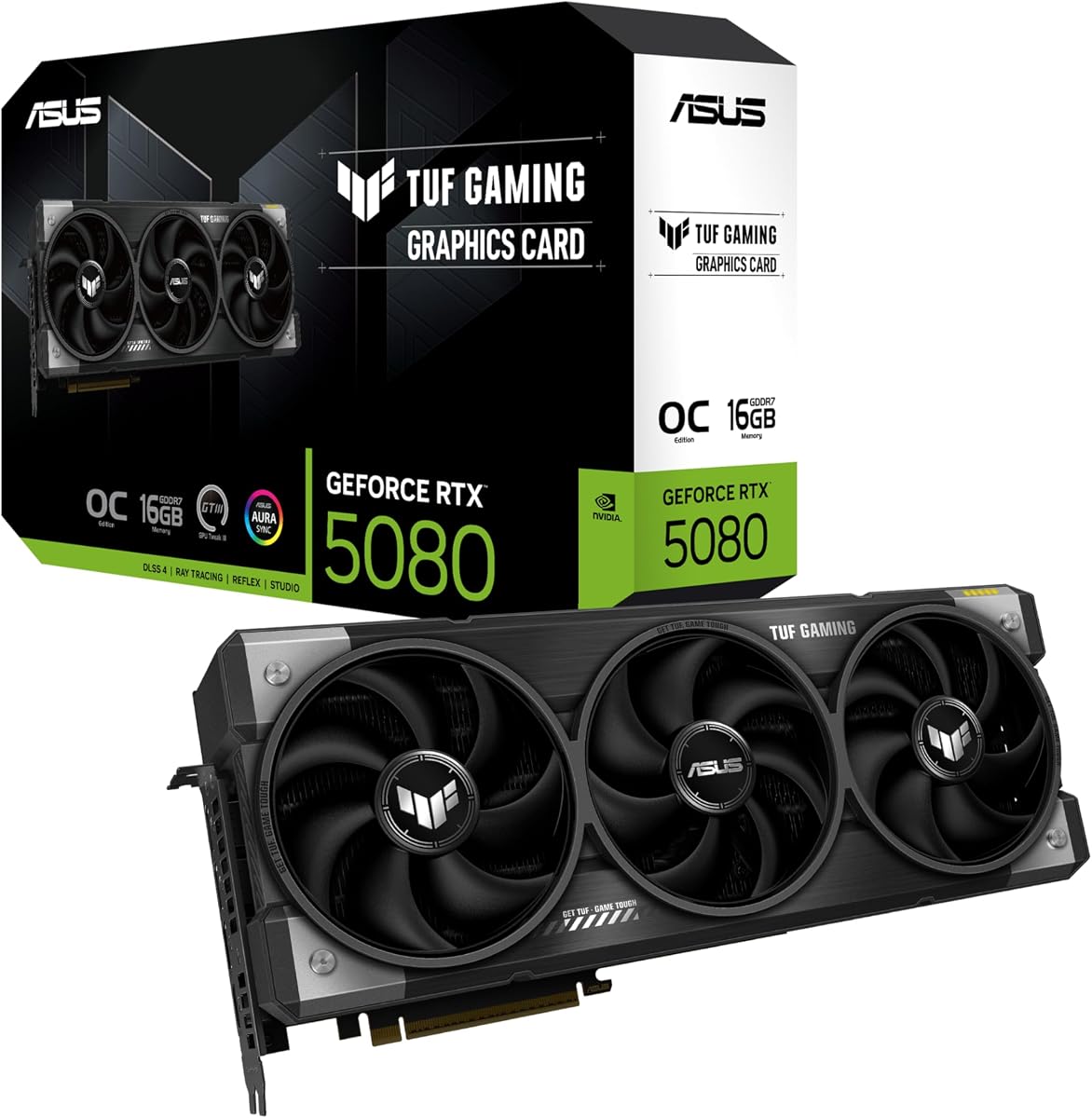
The ASUS TUF Gaming GeForce RTX 5080 16GB GDDR7 OC Edition is the most physically substantial premium recommendation in this guide. It has a 4.6 rating, a 3.6-slot design, three Axial-tech fans, and a massive fin array, all wrapped in a TUF chassis designed for high-end gaming systems.
We may earn a commission when you buy through this link, at no additional cost to you.
Its performance foundation combines NVIDIA's Blackwell architecture, DLSS 4, 16 GB of GDDR7 memory, and an OC boost clock of 2730 MHz. The default boost clock is listed at 2700 MHz. These specifications place the card firmly in the high-end 4K category, where CS2 can benefit from substantial rendering headroom, high refresh rates, and demanding visual configurations.
The trade-offs are immediate and measurable. The supplied length is 348 mm, or 13.7 inches, the card occupies 3.6 slots, and its weight is listed at 4.3 pounds. A minimum 850W PSU with a 16-pin 12V-2×6 connector is required. You must confirm case clearance, slot spacing, PSU capacity, and connector availability before building around it.
For a premium system with a large chassis and robust power supply, the TUF RTX 5080 is the strongest fit in this list. It offers a generous thermal design, protective PCB coating, military-grade components, and a phase-change GPU thermal pad for players who want a high-end card designed for sustained workloads.
The 3.6-slot body and massive fin array give the TUF RTX 5080 room to manage heat across three Axial-tech fans. That scale is useful for sustained gaming, but it also means the card may block several expansion slots and require deliberate case planning.
Military-grade components, protective PCB coating, and Auto-Extreme manufacturing support durability and reliability. These details are particularly relevant for a costly flagship GPU intended to remain in a well-organized enthusiast system.
We may earn a commission when you buy through this link, at no additional cost to you.
The GIGABYTE GeForce RTX 3050 WINDFORCE OC V2 6G is an entry-level graphics card centered on affordability and basic gaming functionality. Its 4.6 rating is respectable for a budget-oriented model, and the listed hardware includes Ampere streaming multiprocessors, second-generation RT cores, third-generation tensor cores, and 6 GB of GDDR6.
We may earn a commission when you buy through this link, at no additional cost to you.
For CS2, the main appeal is moving away from integrated graphics while obtaining a dedicated card with tensor-core support for DLSS. The OC designation also indicates that this is not a completely standard configuration. However, the 96-bit memory interface is narrower than those found on the 256-bit cards in this list, and six GB is the primary capacity limitation.
Two WINDFORCE fans provide the cooling solution, keeping the design straightforward relative to triple-fan premium cards. Exact dimensions, power requirements, and connector details are not included in the supplied information, so those specifications need confirmation for the specific model and any used or modified listing.
This card makes the most sense for a budget CS2 PC at 1080p with a high-refresh monitor, particularly when spending less is more important than maximizing texture quality or 4K readiness. Players who can stretch their budget toward a 16 GB card will gain more memory flexibility, but for basic competitive use this is a straightforward starting point.
Six GB of GDDR6 and dedicated graphics processing make this a functional upgrade over integrated graphics for CS2. It is best suited to 1080p competitive configurations where basic frame-rate headroom and upscaling support are the main priorities.
The two WINDFORCE fans provide a straightforward cooling arrangement that can be easier to accommodate than a large triple-fan flagship. Still, buyers should verify the complete card dimensions before ordering.
We may earn a commission when you buy through this link, at no additional cost to you.
The XFX Swift AMD Radeon RX 9060 XT OC Gaming Edition is one of the most interesting midrange choices here. It carries a 4.8 rating, includes 16 GB of GDDR6, and has a listed boost clock of up to 3320 MHz. That clock figure is higher than the listed OC boost clocks of several more expensive Radeon cards in this guide.
We may earn a commission when you buy through this link, at no additional cost to you.
Its dual-fan SWFT cooling solution offers a more compact-looking alternative to large triple-fan designs, while RDNA 4 provides the underlying Radeon architecture. The card includes HDMI and two DisplayPort outputs, giving a CS2 player flexibility when connecting a high-refresh monitor or arranging a multi-screen desk.
A high factory clock does not guarantee a proportional advantage in every benchmark, and the supplied information does not include exact frame rates or power specifications. The 16 GB memory pool is more significant for long-term flexibility, while the two-fan cooler requires adequate case airflow to manage sustained load. Exact dimensions and recommended PSU should be confirmed before purchase.
This model is worth considering for a 1080p or 1440p CS2 build where 16 GB of memory, high listed clocks, and a straightforward dual-fan design are priorities. It is particularly compelling for buyers who want Radeon hardware without paying for the more extreme RX 9070 XT or RTX 5080 models.
The 3320 MHz listed boost clock makes this card look attractive on paper, while the dual-fan layout can be easier to fit than the massive TUF RTX 5080. Real-world performance still depends on the processor, settings, resolution, cooling, and power configuration.
HDMI and two DisplayPort outputs support a flexible monitor arrangement. A secondary display is useful for chat, stream monitoring, game guides, or system information while CS2 remains the primary task.
We may earn a commission when you buy through this link, at no additional cost to you.
Choosing a GPU for CS2 means balancing resolution, refresh rate, memory capacity, cooling, power requirements, and case clearance. The most important starting point is your display: a capable graphics card cannot deliver a benefit that the monitor or system configuration cannot use.
At 1080p, competitive CS2 is often constrained as much by the processor, frame-rate target, and settings as by the graphics card. A six-gigabyte RTX 3050 can serve as a practical entry-level option, while the 16 GB alternatives provide more headroom for richer visual settings and mixed workloads. At 1440p, the RX 9070-class cards and RTX 5060 Ti become more compelling because pixel count and texture demands rise. If you play at 4K or own a high-refresh 4K monitor, prioritize a modern high-end GPU with sufficient memory bandwidth and cooling rather than choosing on entry-level pricing alone.
Video memory determines how much texture data the GPU can hold and helps prevent stuttering when textures cannot remain resident. Six GB is the least generous capacity in this list and is most appropriate for 1080p competitive play. Sixteen GB is the dominant specification among the higher-ranked cards, providing room for higher settings, high-resolution textures, background applications, and creative workloads. For CS2 specifically, excess memory may not be visible in every match, but it makes the system more versatile as settings, desktop applications, and future games become more demanding.
Memory bus width works with memory speed to determine bandwidth, which influences how quickly the GPU can retrieve textures and frame data. The ASRock RX 9070 Challenger and GIGABYTE RTX 5080 use a 256-bit interface, while the entry-level RTX 3050 models use 96 bits. The ASUS RX 9060 XT, Prime RX 9070 XT, and XFX RX 9060 XT are listed with 16 GB of GDDR6, but their exact bus widths are not included in the supplied specifications. Wider buses generally support greater bandwidth, although processor performance, cache behavior, application demands, and the graphics API also influence real results.
A stronger GPU can expose bottlenecks elsewhere in the system. CS2 benefits from a responsive processor, fast memory, and a capable motherboard, particularly at 1080p or high frame rates. Older CPUs may struggle to feed a flagship graphics card even when the game is graphically demanding. Check whether your power supply has the correct wattage and connectors, whether the case can accept the card's length and thickness, and whether neighboring hardware will block cooling. Balanced components usually produce a more satisfying result than placing the entire budget into the GPU alone.
Cooling affects sustained performance, component longevity, and the acoustic character of your gaming space. The ASUS and ASRock 16 GB cards include 0dB behavior, allowing fan activity to stop under suitable light workloads, while dual-fan and triple-fan designs provide more surface area for heat dissipation. A premium card with a massive fin array may be quieter under load if its fan curve is tuned correctly, although large coolers often require more case airflow. Consider room temperature, fan noise, and whether a side panel is open or closed rather than looking only at the number of fans.
DLSS on the listed NVIDIA cards uses dedicated tensor-core hardware to upscale rendered output, potentially improving frame rates while preserving the look of a higher internal resolution. It can be useful on a high-refresh display or when the GPU cannot quite reach the desired frame rate at native resolution. Upscaling is not a guarantee of perfectly sharp output in every scene, and competitive players often prefer a crisp native image. Test the available graphics modes in CS2 and choose the balance between responsiveness, image clarity, and motion quality that suits your preferences.
A CS2 build often becomes part of a broader gaming PC. A 16 GB card with modern architecture can handle CS2 today while remaining useful for other games, streaming, video editing, and future releases. High-end RTX 5080 models provide exceptional headroom but require a much larger investment, a suitable case, and a robust power supply. Midrange 16 GB options often create the best long-term balance because they reserve more memory and performance than entry-level cards without demanding flagship-sized components. Consider how long the system is expected to remain in use before settling on a tier.
The physical details of a graphics card can matter as much as its specifications. The ASRock RX 9070 Challenger measures 290 by 123 by 51 mm, uses two eight-pin connectors, and recommends a 700W PSU. The ASUS TUF RTX 5080 is 348 mm long, occupies 3.6 slots, weighs 4.3 pounds, and requires a minimum 850W PSU with a 16-pin 12V-2×6 connector. These requirements are very different from compact dual-fan cards. Measure available case space, check slot spacing, confirm the PSU has suitable leads, and review the listing for the exact card you intend to buy.
After installing the graphics card, install the manufacturer-provided driver and use the included monitoring or tuning software to confirm that the GPU is recognized. Update the graphics settings to an appropriate preset, select the correct display output, and verify that CS2 is using the dedicated GPU. A short benchmark or match can reveal unstable clock settings, excessive temperatures, fan noise, or unintended performance limits.
Start with the default fan and power settings before applying manual tuning. The ASUS cards in this list offer Quiet and Performance BIOS profiles, while GPU Tweak III provides performance controls, thermal management, and monitoring. Make only gradual changes, save known-good profiles, and avoid operating settings that cause instability, visual artifacts, or unusually high temperatures. Clean the card with compressed air and keep intake paths unobstructed.
For long-term care, dust the fans and heatsink regularly, use a properly configured operating system, and avoid repeatedly changing drivers or tuning profiles without a clear reason. Keep the chassis closed during normal play, maintain sensible room temperature, and check cables for secure seating. When upgrading, shut down the PC, disconnect power, discharge static electricity, and follow the instructions supplied with the card and chassis.
A dedicated GPU can make a major difference if your system currently relies on integrated graphics, particularly at higher resolutions or settings. It also provides dedicated video memory, more stable frame pacing, and access to features such as DLSS on supported NVIDIA cards. At 1080p, however, the processor and selected settings may remain important performance factors.
Six GB can be adequate for a basic 1080p competitive configuration, while 16 GB offers more flexibility. The extra memory becomes more useful at higher resolutions, with detailed textures, when several demanding applications are open, or when the PC is expected to handle future games. If budget is the main constraint, compare the cost of a six-gigabyte card with the long-term benefits of a 16 GB model.
An RTX 3050 can serve as an affordable entry-level option for 1080p CS2, especially when supported upscaling and a competitive frame-rate target are priorities. Six GB of memory and a narrower memory bus limit its headroom compared with the 16 GB cards listed here. It is more appropriate as a straightforward gaming upgrade than as a 4K or high-end system choice.
Both AMD and NVIDIA options in this guide provide 16 GB configurations suited to modern gaming. NVIDIA models include explicit DLSS support through the listed tensor cores, while AMD options emphasize RDNA architecture, memory capacity, and aggressive factory clocks. The better choice depends on resolution, monitor, system budget, preferred features, and the available components rather than on the brand alone.
A midrange or high-end card with 16 GB of video memory is a strong fit for 1440p CS2, particularly on a high-refresh monitor. The ASUS Dual RX 9060 XT, ASRock RX 9070 Challenger, ASUS Prime RX 9070 XT, ASUS RTX 5060 Ti, and XFX Swift RX 9060 XT all meet that broad hardware description. The processor should also be capable of feeding the GPU at your target frame rate.
You may need to. The ASRock RX 9070 Challenger recommends a 700W PSU and two eight-pin connectors, while the ASUS TUF RTX 5080 requires a minimum 850W PSU with a 16-pin 12V-2×6 connector. Check the exact current listing, your power supply's rating and modular cables, and the recommended wattage for your chosen card before installing it.
It depends on both length and slot thickness. The ASUS TUF RTX 5080 is listed at 348 mm long and 3.6 slots, making it one of the most demanding cards here, while several dual-fan models are easier to accommodate. Measure the distance from the rear expansion slots to the front drive cage, check the power-supply shroud, and allow space for airflow and cables.
DLSS can be useful when native rendering cannot quite reach your desired frame rate or when you prefer a particular image-quality trade-off. The listed NVIDIA cards support the technology through tensor cores. Because competitive players may prioritize clarity and input responsiveness, test different settings in your preferred resolution and choose the visual mode that fits your priorities.
The ASUS Dual RTX 3050 6GB OC is the best budget route into dedicated CS2 gaming, while the ASRock RX 9070 Challenger 16GB OC offers the strongest overall balance in this guide. Its 4.8 rating, 16 GB GDDR6 memory, 256-bit bus, triple-fan cooling, and 0dB behavior make it especially appealing for a balanced 1440p system.
Prioritize the resolution, refresh rate, and frame-rate target you actually want before considering extra power. Players seeking a current NVIDIA feature set should examine the ASUS Dual RTX 5060 Ti or RTX 5080 options, while Radeon buyers have several 16 GB choices across the RX 9060 XT and RX 9070 XT families. Always balance graphics capability with processor performance, PSU capacity, cooling, and physical clearance.
Prices, stock, exact dimensions, connector details, and product listings can change, so verify the current information before ordering. Compare the final cost against your target resolution rather than selecting solely by model name, and make sure the complete PC can power, cool, and physically accommodate the card.