
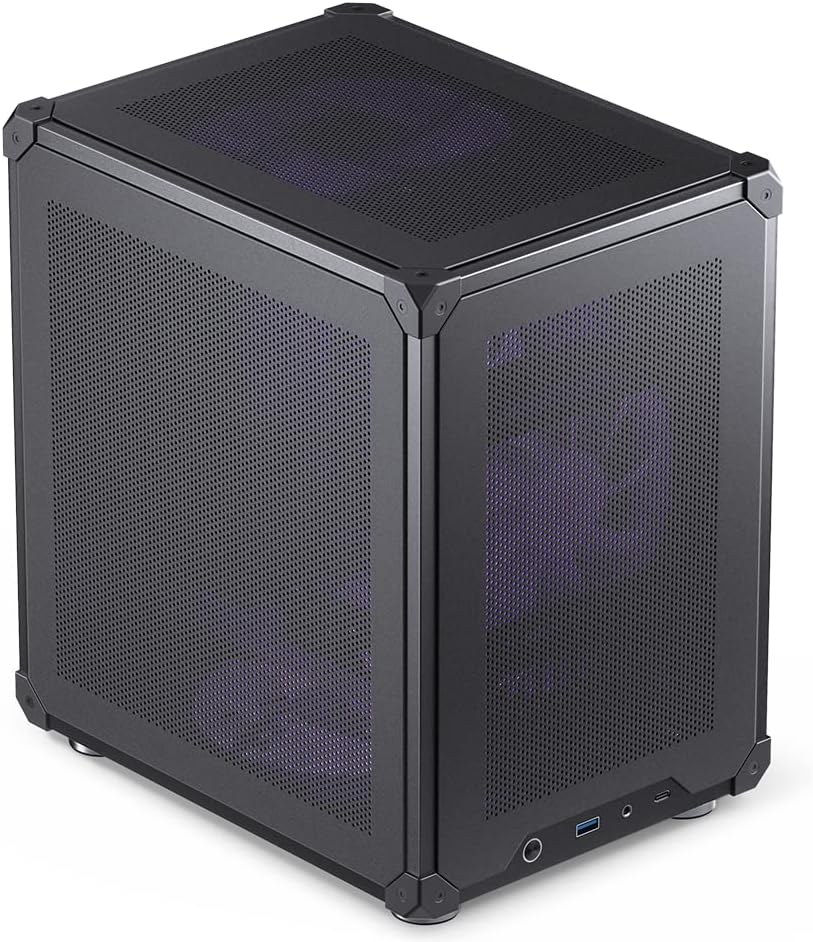
Cooler Master Q300L V3
4.6Editor score
Supports graphics cards up to 366mm
Fits six 120mm or 140mm fans
Accepts ATX power supplies to 200mm
Discover the best Compact E ATX Case options, comparing airflow, motherboard support, dimensions, GPU clearance, cooling, and build convenience.
A compact E-ATX case must balance a surprisingly broad hardware platform with a footprint smaller than a conventional tower. The best examples preserve motherboard flexibility, accommodate demanding graphics cards and power supplies, and still provide sensible airflow, cable routing, and straightforward component access.
We compared the ten cases using their stated motherboard support, maximum GPU and CPU-cooler clearances, radiator options, included fans, structural design, front I/O, and overall ease of use. The list includes truly compact models, Micro-ATX alternatives, dual-layout designs, and portable enclosures built for larger components.
Each selection highlights a different strength: the QUBE 540 prioritizes component clearance, the O11D Mini emphasizes aesthetics, and the Mechanic Master models support unusually ambitious hardware. Product configurations and marketplace availability can change, so check the current listing and compatibility details before ordering.
4.6Editor score

4.7Editor score

3.9Editor score
This side-by-side comparison shows how each enclosure approaches the compact case category, from very small Micro-ATX designs to ATX and E-ATX models with extended power-supply, cooling, and graphics-card support.



The Cooler Master QUBE 540 is an unusual mid-tower built around flexibility, earning a 4.4 rating from buyers. Its most important advantage is not simply compactness but adaptability: the chassis can operate horizontally or vertically, while a reversible I/O panel and movable handles make it easier to reposition the system.
We may earn a commission when you buy through this link, at no additional cost to you.
Motherboard support is unusually broad for a compact enclosure. The case accepts ITX, ATX, and large E-ATX motherboards up to 11 inches wide. Graphics-card clearance reaches 415 millimeters when the front fan is absent, making it suitable for lengthy cards associated with high-end builds. A full front mesh panel and the included SickleFlow 120mm fan reinforce its airflow-focused design.
The principal trade-off is that the generous hardware support requires more deliberate planning than a minimalist Micro-ATX enclosure. Users considering an E-ATX motherboard should verify the board width against the stated limit, and builders seeking a complete air-cooling or liquid-cooling setup may need to add fans and radiators. The reversible panel also means orientation can be chosen during installation rather than fixed permanently.
This is a strong recommendation for a builder who wants E-ATX capability without giving up the visual appeal of a modern tempered-glass case. It also suits anyone who moves their PC between rooms or takes it to an event, since horizontal placement and movable handles add practical flexibility. For those prioritizing motherboard breadth and graphics-card room, the QUBE 540 stands out as the most versatile option in this guide.
Horizontal or vertical operation is more than a cosmetic feature. It lets builders adapt a large ATX-class system to a wider desk, entertainment center, or portable workstation arrangement while retaining the tempered-glass presentation.
Support for E-ATX boards and graphics cards as long as 415 millimeters makes the QUBE 540 unusually useful for powerful compact builds. That flexibility comes with a responsibility to check every clearance before purchasing.
We may earn a commission when you buy through this link, at no additional cost to you.
The Lian Li O11D Mini V2 combines a compact ATX mid-tower format with polished presentation, and its 4.7 rating reflects strong buyer satisfaction. The defining visual feature is the pair of pillar-less tempered-glass panels, which provide a broad, nearly uninterrupted view of the internal components.
We may earn a commission when you buy through this link, at no additional cost to you.
Its angled bottom design is more than a styling exercise. The 10-degree slant directs cool air toward the intake area and can improve GPU cooling, while the protruding mesh side panel allows the enclosure to retain a compact footprint while accommodating a full-size ATX power supply. Standard ATX, M-ATX, and Mini-ITX motherboards are supported, with particular optimization for ATX back-connect boards.
The main disadvantage is that this is not an E-ATX case, despite its ability to accept standard ATX boards. It also arrives without fans, which means airflow planning and cooling hardware costs must be considered separately. For builders who expect a clean display build, though, the horizontal and vertical GPU anti-sag brackets and dedicated 24-pin cable brackets help manage the two areas that most often look messy.
Choose the O11D Mini V2 when appearance, full-size ATX power supply support, and large display components matter more than maximum motherboard width. It is particularly well suited to showcase systems where the glass panels are a central part of the build. For anyone assembling a compact workstation or gaming PC around a standard ATX board, it combines thoughtful engineering with a highly desirable aesthetic.
The pillar-less front and side glass creates a cleaner view than conventional framed panels. This makes the case especially effective for systems with coordinated components, visible liquid-cooling hardware, or color-matched cable accents.
Heavy graphics cards and power cables can undermine an otherwise tidy build. Horizontal and vertical GPU supports plus a dedicated 24-pin bracket address both issues without sacrificing the case's open presentation.
We may earn a commission when you buy through this link, at no additional cost to you.
The Mechanic Master C34Pro is a compact portable enclosure designed to accept serious ATX and E-ATX hardware. Its 3.9 rating is the lowest among the ten products, but the specification sheet reveals a case aimed at builders who want an unusually complete set of compatibility options in a relatively small 30.6-liter body.
We may earn a commission when you buy through this link, at no additional cost to you.
Graphics cards up to 420 millimeters, 360-millimeter radiators, tower coolers up to 165 millimeters, and ATX power supplies up to 220 millimeters provide substantial headroom. Multi-zone fan mounts across the top, bottom, and front allow cooling to be tailored to the chosen components. The 2-millimeter aluminum shell and steel frame also indicate a construction approach more substantial than that of many ultra-compact cases.
Its lowest buyer rating deserves attention. Large clearances do not guarantee that every motherboard, cooler, graphics card, and power supply will fit simultaneously, so the final combination must be checked carefully. There is also less room for arbitrary improvisation than in a conventional tower. On the positive side, the 18-millimeter cable-management area, included magnetic screwdriver kit, and multiple power-supply mounting positions are intended to simplify the build process.
The C34Pro is best for a builder who treats portability and E-ATX support as non-negotiable and is willing to plan the component layout. The integrated carry handle makes it useful for LAN events, mobile workstations, and relocations. It may not be the first choice for a first-time builder, but for a carefully planned high-performance system, it offers a compelling combination of compactness, flexibility, and travel-ready construction.
The 420-millimeter graphics-card allowance, extended ATX power supply support, and 360-millimeter radiator capability allow the C34Pro to serve demanding builds. Compactness remains meaningful because the stated capacity is only 30.6 liters.
An integrated carry handle and flexible power-supply placement distinguish the C34Pro from a static desktop enclosure. That portability makes it relevant for events, shared workstations, and users who frequently rearrange their equipment.
We may earn a commission when you buy through this link, at no additional cost to you.
The Cooler Master Q300L V1 is a compact Micro-ATX enclosure with a 4.5 rating and a clear emphasis on ventilation. Its perforated panels on all sides support airflow and heat dissipation, making it a practical choice for builders who want a small case without restricting fan placement.
We may earn a commission when you buy through this link, at no additional cost to you.
The case supports Micro-ATX and Mini-ITX motherboards, graphics cards up to 360 millimeters, CPU coolers up to 159 millimeters, and power supplies up to 160 millimeters. Cooling can be configured with a 240-millimeter liquid cooler and as many as five fans. A magnetic dust filter helps reduce the amount of debris entering the chassis, while the transparent side panel keeps the build visible.
The adjustable I/O panel can be positioned at the front, top, or bottom on either side, which is a useful feature in a compact layout. The trade-off is that the case is limited to smaller motherboard formats and its traditional front connectivity does not include the modern USB Type-C option found on several newer alternatives. It also cannot serve as a true E-ATX enclosure.
Buyers seeking a straightforward, breathable small-form-factor system will find the Q300L V1 easy to understand and flexible to cool. It works particularly well for a Micro-ATX gaming PC with a moderately long graphics card, a modest air cooler, or a 240-millimeter liquid-cooling loop. It remains a solid compact choice, although the newer Q300L V3 offers more fan flexibility and updated power-supply accommodation.
Perforated surfaces on all sides reduce the chance of a compact chassis becoming a heat trap. Combined with support for five fans and a 240-millimeter radiator, that openness gives builders several thermal paths.
The movable I/O panel can follow the orientation and location of the system. That flexibility is particularly helpful under a desk or in a tight entertainment setup where the most accessible panel position may differ from the default.
We may earn a commission when you buy through this link, at no additional cost to you.
The Mechanic Master C34 Ultra-Compact pairs a standard ATX motherboard platform with a portability-focused design, earning a 4.6 rating. Unlike many cases advertised as compact, it supports a full standard ATX board as well as full-size ATX power supplies and graphics cards up to 335 millimeters.
We may earn a commission when you buy through this link, at no additional cost to you.
Its integrated carry handle makes the enclosure easy to transport between rooms, workstations, or LAN events. The internal layout is designed to simplify installation, and the metal front I/O panel includes USB 3.0 and USB Type-C connectivity. Cooling support includes 240-millimeter radiators for liquid-cooling users and air coolers as tall as 162 millimeters.
The most important caveat is that the case does not support E-ATX motherboards. In addition, Mechanic Master recommends an SFX-L power supply for the cleanest cable management and easiest installation. Although full-size ATX power supplies are listed as compatible, using one may introduce additional cable-routing constraints in the ultra-compact layout.
The C34 Ultra is a good match for someone who wants the portability of a small case without giving up a standard ATX motherboard. It is especially useful for a mobile gaming rig or compact workstation that may be moved frequently. Buyers should measure their power supply and cooling choices carefully, but those who value the handle and clean modern I/O will find a distinctive and practical design.
Supporting standard ATX boards in an ultra-compact enclosure gives builders access to a broad motherboard ecosystem. It can be especially valuable when a system needs to be serviced or upgraded without changing to a smaller board format.
The carry handle provides a practical reason to choose this enclosure over a larger desktop case. Users can move a complete system while retaining full-size ATX expansion and compatibility.
We may earn a commission when you buy through this link, at no additional cost to you.
The ASUS Prime AP201 is a compact Micro-ATX case built around spatial efficiency, and its 4.7 rating makes it one of the strongest-rated products in the comparison. The stated 33-liter footprint is efficiently organized rather than aggressively minimized, leaving room for full-size ATX power supplies and long graphics cards.
We may earn a commission when you buy through this link, at no additional cost to you.
Cooling is a major strength. The AP201 supports 280- and 360-millimeter radiators and up to six fans. Its quasi-filter mesh panels contain more than 57,000 precision-machined 1.5-millimeter holes, combining airflow with a clear view of the components. Graphics cards up to 338 millimeters and ATX power supplies up to 180 millimeters are also accommodated.
The practical drawback is motherboard format: the AP201 is a Micro-ATX case and does not meet the needs of a builder committed to an E-ATX board. Radiator and fan combinations also need to be checked carefully because a large radiator can consume several mounting positions. Even so, the extensive fan support means it can be configured for either air or liquid cooling without relying on a single airflow path.
Tool-free side panels make routine access and maintenance more convenient, while the extended motherboard tray, strategic cutouts, and 32-millimeter cable gap help keep wiring out of sight. The AP201 is a strong recommendation for a compact, well-cooled system where Micro-ATX is acceptable and tidy cable management is a priority. It combines thoughtful spatial planning with a highly efficient presentation.
The AP201's 33 liters accommodate a full-size ATX power supply, a long graphics card, and large cooling hardware. Builders get useful capacity without moving into a much larger conventional mid-tower.
Tool-free side panels simplify access, while the extended tray and 32-millimeter gap make cable routing more manageable. These details are valuable in a small chassis where every millimeter influences the finished build.
We may earn a commission when you buy through this link, at no additional cost to you.
The Cooler Master Q300L V3 updates the compact high-airflow formula with a 4.6 rating and extensive component support. It accepts Micro-ATX motherboards, graphics cards up to 366 millimeters, ATX power supplies up to 200 millimeters, and CPU air coolers up to 178 millimeters.
We may earn a commission when you buy through this link, at no additional cost to you.
Cooling flexibility is its standout feature. The case can hold up to six 120- or 140-millimeter fans and support a 240-millimeter AIO radiator. This makes it possible to create a well-ventilated Micro-ATX system without moving to a large chassis. Tempered glass, magnetic dust filters, a movable I/O panel, and cable-management provisions support a polished and practical build.
Its limitation is that the case cannot accept a standard ATX or E-ATX motherboard, despite its ability to hold full-size ATX power supplies. The broad fan and radiator support also describes physical capability rather than a guaranteed thermal result; radiator orientation, intake direction, and the selected components all affect performance. The recommendation to pair the case with specific Cooler Master components is optional rather than a requirement.
The Q300L V3 is well suited to a Micro-ATX gaming PC with a long graphics card, a sizable tower cooler, or a 240-millimeter liquid-cooling loop. It gives builders a broad selection of cooling options while maintaining a compact footprint. Compared with the earlier V1, it offers longer graphics-card clearance, greater power-supply length allowance, and more fan flexibility.
Supporting six fans and a 240-millimeter radiator gives a Micro-ATX builder more thermal options than many similarly small cases. It is a compelling platform for tuned airflow configurations.
The 366-millimeter graphics-card allowance and 200-millimeter power-supply accommodation reduce the risk of choosing a compact case for a full-size component. Clearance checks are still essential, but the usable envelope is generous.
We may earn a commission when you buy through this link, at no additional cost to you.
The Zalman CUBIX M-ATX delivers one of the smallest footprints in this guide, with a total volume of 17.1 liters and a 4.5 buyer rating. It is designed as a simple compact desktop enclosure rather than a showcase chassis, which makes it relevant for space-conscious office, home, and media builds.
We may earn a commission when you buy through this link, at no additional cost to you.
Despite its small dimensions, it accepts standard ATX power supplies, graphics cards up to 260 millimeters, and CPU coolers up to 137 millimeters. A perforated front panel works with the included 80-millimeter fan to encourage airflow. The 0.8-millimeter steel structure provides a more substantial shell than the dimensions might initially imply, while the restrained front I/O includes USB 3.0, USB 2.0, and a 3.5-millimeter stereo connector.
The trade-offs are clear: 260 millimeters of GPU clearance is much less than the 335- to 420-millimeter allowances found among the larger compact cases, and the 137-millimeter CPU-cooler ceiling rules out many tall air coolers. There is also no USB Type-C port. These restrictions mean the case is best matched to carefully selected, dimension-conscious components rather than flagship hardware.
Choose the CUBIX M-ATX when minimizing desk space is the primary goal and the system uses a reasonably short graphics card, a standard ATX power supply, and a modest cooler. It offers a straightforward way to build a functional Micro-ATX PC without taking over the available space. Builders chasing maximum expandability or the latest front-panel standards should consider a roomier alternative.
At 17.1 liters, the CUBIX M-ATX can reclaim a meaningful amount of desk or shelf space. That makes it practical for basic workstation setups and compact entertainment systems where every saved centimeter matters.
USB 3.0, USB 2.0, and a stereo audio connection cover common peripheral needs. The absence of USB Type-C reflects a more conventional feature set rather than a premium-oriented design.
We may earn a commission when you buy through this link, at no additional cost to you.
The JONSBO C6 Black is a compact mesh chassis with a 4.6 rating and an emphasis on straightforward access. Its upper cover and side panel open without tools, reducing the effort required when installing components or reaching internal connections.
We may earn a commission when you buy through this link, at no additional cost to you.
All sides use mesh, and the chassis provides front, upper, and lower fan positions. The upper position can hold a 120- or 140-millimeter fan, while the bottom position supports another 120- or 140-millimeter option; the listed front position can accommodate a 120-millimeter fan or hard drive. Front connectivity includes USB Type-C, one USB 3.0 port, and audio connections.
The strongest limitation is its component envelope. CPU coolers are restricted to 75 millimeters, making low-profile cooling essential, while graphics cards must fall between 200 and 255 millimeters. Standard ATX power supplies up to 185 millimeters are supported, but cable management may be tighter than in larger cases. Motherboard support covers ITX and Micro-ATX rather than full ATX.
The C6 is best suited to a deliberately compact build using a short graphics card and a low-profile CPU cooler. Its tool-free panels and mesh construction make it convenient to assemble and ventilate. Buyers should resist choosing it based only on the compact appearance and verify their cooler, graphics card, and power-supply dimensions first.
Tool-free top and side panels reduce friction during the build process. They also make it easier to inspect connections, adjust wiring, or add components after the system is assembled.
Mesh across the chassis provides multiple paths for air movement, and the three identified mounting zones support a basic cooling layout. Component clearance remains the more important consideration for thermal planning.
We may earn a commission when you buy through this link, at no additional cost to you.
The NZXT H5 Flow is a compact ATX mid-tower with a 4.6 rating and a polished approach to airflow and appearance. It includes two 120-millimeter Quiet Airflow fans, one at the front and one at the rear, giving buyers a functioning starting configuration rather than an empty chassis.
We may earn a commission when you buy through this link, at no additional cost to you.
Cooling capacity is more ambitious than the modest fan bundle suggests. The front supports a radiator up to 360 millimeters, while the top accepts a radiator up to 240 millimeters. Ultra-fine mesh on the top, front, and side panels supports airflow and dust filtering, and the perforated sides and bottom of the power-supply shroud allow two 120-millimeter fans to draw air into the lower section.
Because the supplied data does not state a maximum graphics-card length, power-supply length, or CPU-cooler height, those dimensions should be verified against the manufacturer's current specifications. Those missing numbers make it impossible to assess every clearance from the listing alone. Its ATX designation also means motherboard support should be confirmed for the exact board and any back-connect layout.
The H5 Flow is a good choice for builders who value a clean, modern enclosure, straightforward cable routing, and substantial liquid-cooling options. Wide channels, hooks, and straps make the interior easier to tidy, while the included fans cover the basic intake and exhaust positions. It ranks below cases with fully published clearance data, but its feature set makes it worth considering for a compact, well-presented build.
Front 360-millimeter and top 240-millimeter radiator support create a strong foundation for liquid cooling. The enclosure also includes two 120-millimeter fans to support the initial airflow path.
The perforated power-supply shroud lets additional fans pull cool air toward the lower internals. This can improve circulation around the graphics card and power area in a tightly packed system.
We may earn a commission when you buy through this link, at no additional cost to you.
Choosing a compact enclosure is an exercise in balancing motherboard format, component dimensions, cooling, and build access. The right case fits the equipment you already own or plan to buy without turning every upgrade into a spatial compromise.
True E-ATX support is the most important distinction for buyers searching this category. The Cooler Master QUBE 540 and Mechanic Master C34Pro explicitly support E-ATX boards, while the C34Pro also supports standard ATX. Other cases in the guide accept standard ATX, Micro-ATX, Mini-ITX, or ITX boards, so their inclusion depends on how broadly the keyword is being interpreted. Check the exact board width as well as the supported form factor, because a product labeled for ATX may not have enough clearance for an extended E-ATX layout.
Choose an explicitly E-ATX-compatible model when the motherboard is non-negotiable. A standard ATX case is more appropriate for builders who value the enclosure's cooling, appearance, or dimensions more than maximum motherboard width.
Graphics cards vary dramatically in length, and the case manufacturer may measure clearance differently depending on the position of the front fans, drive cage, or radiator. The C34Pro supports cards up to 420 millimeters, the QUBE 540 reaches 415 millimeters without a front fan, the Q300L V3 supports 366 millimeters, and the JONSBO C6 is limited to 200-255 millimeters. Always compare the exact card model rather than relying on the graphics-card chipset name.
For a high-end build, prioritize a case with at least 350 millimeters of clearance. A shorter case can work, but it may require a compact model, a power riser, or a different layout that can complicate assembly and cable routing.
Compact cases often force a choice between a full-size ATX power supply and a smaller SFX-class unit. The Lian Li O11D Mini V2 specifically accommodates full-size ATX power supplies, while the C34 Ultra accepts them but recommends an SFX-L supply for the cleanest build. Other limits include 200 millimeters for the Q300L V3, 185 millimeters for the JONSBO C6, and 180 millimeters for the ASUS Prime AP201.
Check the power supply model and its total length, including any modular cable bend. If the case supports ATX and SFX supplies, an SFX-L unit can be easier to route even though a full-size model may fit physically.
CPU cooler clearance can determine whether a build uses a low-profile cooler, a standard tower, or a liquid-cooling pump and radiator. The JONSBO C6 is the most restrictive at 75 millimeters, followed by the Zalman CUBIX M-ATX at 137 millimeters. The Q300L V3 reaches 178 millimeters, the Mechanic Master C34 Ultra reaches 162 millimeters, and the C34Pro supports 165-millimeter tower coolers.
Measure the cooler's height including its fan and heat pipe structure. If a large air cooler is important, select a compact case with at least 155 millimeters of clearance rather than assuming all compact cases accept mid- or full-tower coolers.
Radiator support is a more useful indicator of cooling potential than the number of preinstalled fans. The C34Pro accepts a 360-millimeter radiator, the NZXT H5 Flow supports 360 millimeters at the front and 240 millimeters at the top, and the ASUS Prime AP201 supports 280- and 360-millimeter options. Smaller cases can still work well with air cooling, but fan and radiator positions become increasingly important as the internal volume shrinks.
Map the desired radiator position to the listed clearance and check whether additional fans can be installed without blocking the graphics card. A case with no included fans may offer more choice, but the total build also becomes more involved.
Compact systems need deliberate airflow because tightly packed hardware can recirculate hot air. The QUBE 540 uses a full front mesh panel, the NZXT H5 Flow combines fine mesh with a perforated power-supply shroud, the Q300L V1 has perforated sides, and the JONSBO C6 uses mesh throughout. These approaches differ in restriction, dust control, and acoustic behavior, so the actual cooling path matters more than the word mesh alone.
Prefer a case with clear intake, exhaust, and positive-pressure options. Confirm that any front or top filter can be cleaned and that the selected radiator or fans will not block important vents.
A case may fit every component yet remain frustrating to assemble. The JONSBO C6 and ASUS Prime AP201 offer tool-free side-panel removal, the Q300L V1 and Q300L V3 use movable I/O panels, and the Mechanic Master C34 series includes carry handles. These features can save time during installation and make routine access more convenient.
If the system will move between rooms or travel to events, prioritize a handle and durable shell. If it will remain stationary, a more open interior, wider cable channels, and removable panels may matter more than portability.
Front I/O should match the devices used every day. The QUBE 540, C34 Ultra, and JONSBO C6 include USB Type-C, while the NZXT H5 Flow focuses on cable-management channels, hooks, and straps. The C34Pro provides 18 millimeters of cable-management space, and the ASUS Prime AP201 combines an extended tray with a 32-millimeter gap. These details determine whether the finished system looks orderly.
List the required ports before buying, including USB Type-C, audio, and the number of USB connections. Then inspect the cable-management layout to ensure the power and data cables can be hidden without forcing them to pass through cooling hardware.
Before installing components, lay out the case, compare each part with the published clearance figures, and identify where the motherboard, power supply, graphics card, fans, and radiator will sit. Install the power supply and hard drives or solid-state drives first, then route their cables behind the tray before obstructing access with the motherboard and graphics card.
After assembly, follow the case's airflow direction. Place intake fans where they draw cool room air and exhaust fans where they release rising heat. Confirm that every fan spins freely, that cables do not touch blades, and that dust filters sit flush. Use software monitoring to check operating temperatures and investigate unusually warm areas, airflow noise, or unstable performance.
Every few months, power down and disconnect the system before opening the case. Clean removable dust filters according to the manufacturer's instructions, inspect fan grilles, and gently remove accumulated dust from exposed surfaces. Keep screws and hardware in an organized container, and avoid restricting vents with objects, carpet, or poorly positioned cables.
An E-ATX case supports an extended ATX motherboard that is larger than a standard ATX board. A case may support only standard ATX, only Micro-ATX, or both, while an explicitly E-ATX-compatible model adds room for the wider board. Confirm the maximum supported width rather than assuming every ATX case can accept E-ATX.
They can be, because dense component placement may limit airflow. Cases with front and rear mesh, multiple fan positions, and large radiator support provide more options. Choosing a case with a perforated power-supply shroud or multiple intake paths can also reduce recirculation. A well-planned compact build can run effectively, but cooling hardware and component clearances require careful matching.
Yes, especially for models with small cases or long graphics cards. Compare the exact card length with the maximum stated clearance, and check whether that measurement assumes the removal of a front fan or radiator. Thickness, power connectors, and support brackets can also affect practical fit even when overall length appears compatible.
Some can, including the Lian Li O11D Mini V2 and Mechanic Master C34 Ultra, while other models impose shorter limits. Always check the specified maximum power-supply length and allow space for a modular cable bend. An SFX or SFX-L power supply may provide easier routing in a tightly packed chassis.
A carry handle makes a completed system easier to move between rooms, workstations, or LAN events. It is particularly useful in larger portable cases that otherwise require awkward two-handed handling. The handle does not make every component safe for transport, so users should disconnect power and secure the internal parts before moving the system.
A case with included fans can be ready for basic use more quickly and may offer better immediate airflow. A no-fan model can provide greater freedom over fan sizes, positions, and colors, but it makes cooling planning more involved. Consider the number and placement of supported fans, the radiator options, and whether the included fans match your components.
It can, depending on the rest of the chassis design. A solid panel may restrict airflow, while a vented or mesh design can provide a suitable path for air. Cases such as the QUBE 540 and O11D Mini V2 combine visible panels with substantial mesh surfaces, allowing the internal hardware to remain visible without abandoning airflow.
Check both the form factor and the physical dimensions. The case should list the supported standards, and the motherboard's width, socket position, rear-panel openings, and expansion-slot arrangement must be compatible. Back-connect motherboard designs may also require a compatible case or specific positioning, so review the case instructions before starting the build.
The Cooler Master QUBE 540 is the most flexible choice for a genuine compact E-ATX build, offering large motherboard and graphics-card support with horizontal or vertical placement. The Mechanic Master C34Pro takes portability even further with an integrated handle, 420-millimeter GPU allowance, and 360-millimeter radiator support, while the Lian Li O11D Mini V2 leads in polished presentation and standard ATX power-supply accommodation.
Your priority should determine the winner. Choose an explicitly E-ATX-compatible enclosure for the broadest motherboard platform, a roomy Micro-ATX model for flexible cooling and tidy organization, or the very compact CUBIX M-ATX when saving space matters most. Before purchasing, verify the exact motherboard width, graphics-card length, CPU-cooler height, power-supply dimensions, and radiator position as one complete hardware set.
Marketplace listings, product revisions, and component availability can change, and current prices should be checked before ordering. Reviewing the latest dimensions and included accessories will help ensure that the selected compact case works with your build rather than requiring expensive hardware substitutions later.