
PRV AUDIO DSP 2.4X
4.7Editor score
Four independent crossover outputs
Fifteen-band graphic equalization
Real-time LCD control
Sequencer remote trigger support
Our Digital Signal Processor Dsp for Car Audio guide compares 10 leading models for crossover control, tuning flexibility, connectivity, and system fit options.
A digital signal processor gives a car audio system the control needed to shape sound accurately after installation. The right DSP can provide time alignment, precise crossovers, multi-channel EQ, phase correction, gain control, and protection for amplifiers, making system design far more exact than a conventional head unit alone.
This guide compares ten DSPs based on the supplied specifications, including channel capacity, input options, crossover flexibility, equalization, app or display control, signal processing, remote triggering, and intended system complexity. It covers compact four-channel units, expandable eight-channel processors, and professional models designed for more elaborate installations.
Each review explains the strongest reasons to consider a particular processor, along with important trade-offs involving control style, channel count, or installation complexity. The top selections are intended to serve different priorities, including value, overall versatility, and premium processing capability; current prices and availability can change.
4.7Editor score
4.6Editor score

4.6Editor score
The table below highlights the principal differences among these ten DSPs, focusing on processor resolution, channel count, control methods, crossover flexibility, and input compatibility.





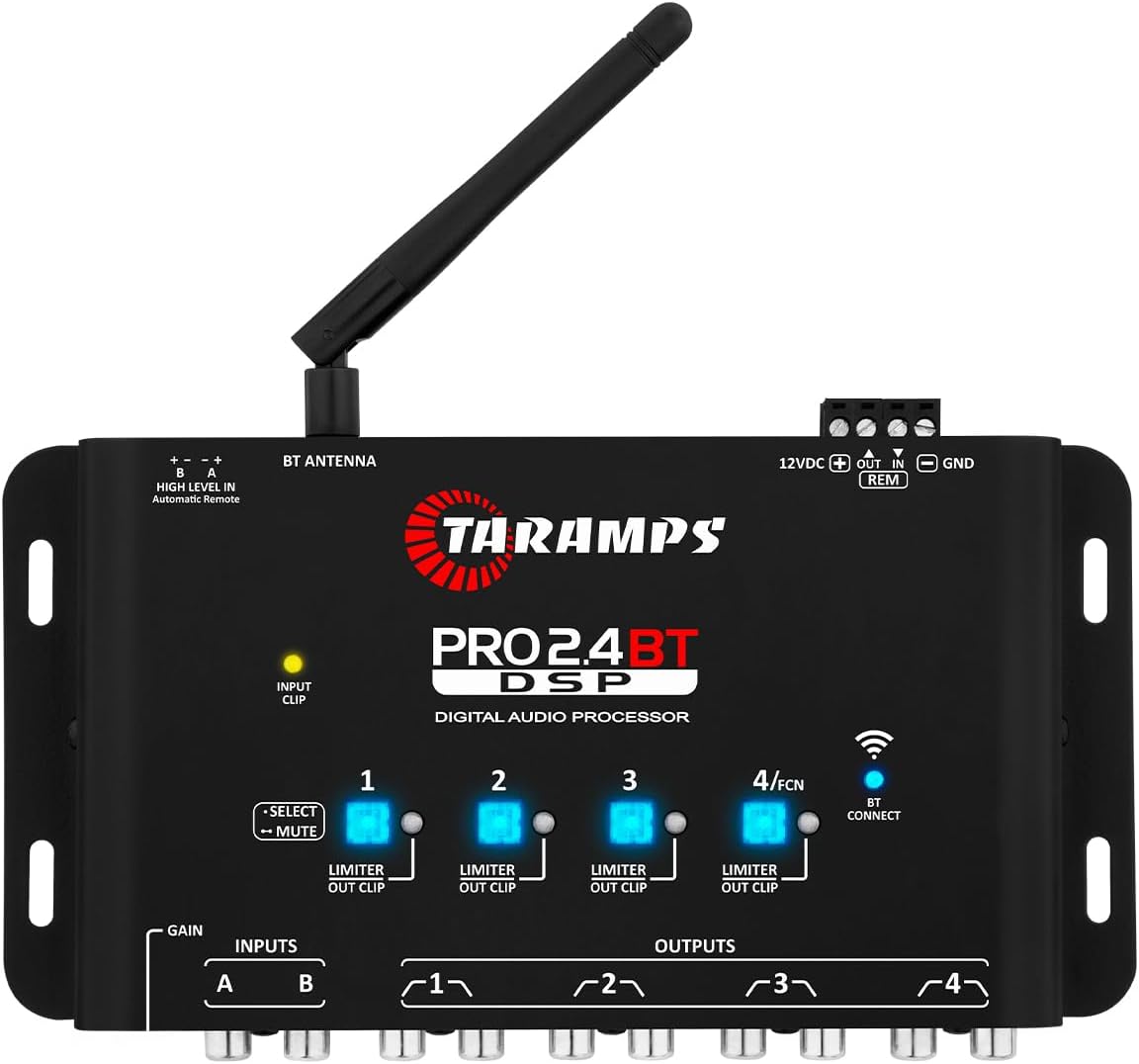
The Taramps PRO 2.4 BT combines a four-channel DSP with wireless app control, 24-bit/48kHz processing, and a broad collection of tuning tools. Its 4.6 rating reflects a well-rounded feature set for installers and serious enthusiasts who want precise control without relying on a physical front-panel menu. Bluetooth 5.4 BLE and an external antenna distinguish it from processors that expose only basic local controls.
We may earn a commission when you buy through this link, at no additional cost to you.
The processor supports a 15-band graphic EQ, parametric EQs, high-pass and low-pass crossover filters extending to -48dB per octave, per-channel delay, phase inversion, and an adjustable limiter. Its two input paths accommodate high-level signals for an OEM head unit and RCA inputs for aftermarket equipment. An auto turn-on function and Anti-Puff System support clean integration, while preset encryption and sharing through WhatsApp, email, or AirDrop are unusually practical features.
The principal limitation is its four-output architecture. It is well suited to front tweeters, front door woofers, rear speakers, and a subwoofer, but a larger multi-amplifier build may require additional processing channels. Controlling the unit through an app also adds a dependency on compatible software and a properly configured phone or tablet. Nevertheless, its combination of input flexibility, crossover depth, routing tools, and remote preset transfer makes it one of the most complete four-channel options here.
This is a strong recommendation for a daily-driven car with an upgraded factory system, a compact four-channel active setup, or an enthusiast who values remote tuning. It can also manage up to four processors from the same app, which adds practical value for multi-vehicle installations. Choose it when Bluetooth control, OEM integration, and detailed per-channel tuning matter more than having eight independent outputs.
Bluetooth 5.4 configuration puts EQ curves, crossover filters, gain, delay, phase, limiter settings, and routing within reach of the Taramps PRO app. The external antenna is intended to improve connection range and stability, while password protection and encrypted presets help keep configurations private when they are shared.
High-level input with auto turn-on makes the processor especially practical when replacing a factory head unit is undesirable. RCA inputs remain available for conventional aftermarket head units, and the Anti-Puff System targets unwanted noise during startup and shutdown.
We may earn a commission when you buy through this link, at no additional cost to you.
The PRV AUDIO DSP 2.4X is a four-channel digital crossover and equalizer that combines independent output control with an approachable 16×2-character LCD interface. It carries a 4.7 rating, the highest among the listed products, and is well suited to users who want meaningful DSP authority without relying entirely on a mobile application.
We may earn a commission when you buy through this link, at no additional cost to you.
Two inputs, designated A and B, can be assigned independently to each output as A, B, or A+B. That routing flexibility is useful when a system mixes a factory source with a separate audio signal. The built-in equalization system includes a 15-band graphic EQ, manual tuning, and 12 presets covering Flat, Loudness, Bass Boost, Mid Bass, Treble Boost, Powerful, Electronic, Rock, Hip Hop, Pop, Vocal, and Pancadão. Parametric EQ provides additional control over gain, frequency, and bandwidth.
The sequencer feature is another differentiator. Through the remote trigger connection, the processor can sequentially activate other connected products, reducing the need for separate automatic startup devices. On the other hand, the supplied product information does not identify Bluetooth or high-level input support, so buyers with a factory radio or a preference for app-based tuning should verify compatibility before finalizing their installation plan.
The DSP 2.4X is an attractive pick for a conventional four-channel system requiring active crossovers, flexible source routing, and convenient equalization. It is especially appealing to installers who prefer physical control feedback over a phone interface. It is not the strongest recommendation for a high-level OEM upgrade, but for compatible systems it delivers a remarkably useful feature set and holds the highest rating in this roundup.
Choosing A, B, or A+B separately for each output gives installers useful flexibility when a vehicle has more than one source. This is particularly helpful in systems where different speaker groups require different source combinations.
The LCD and local interface allow real-time changes without pairing a phone. For quick track-side adjustment, that can be simpler and faster than navigating through a mobile control platform.
We may earn a commission when you buy through this link, at no additional cost to you.
The PRV AUDIO DSP 2.8X extends the DSP 2.4X concept to eight independent outputs, making it a natural choice for multi-amplifier and multi-speaker installations. Its 4.6 rating reflects a capable processor with familiar equalization and crossover tools, while the larger channel count provides more room for active three-way front systems, rear channels, and dedicated subwoofer control.
We may earn a commission when you buy through this link, at no additional cost to you.
The processor has two audio inputs, A and B, with independent source selection for every output. A 15-band graphic equalizer, manual control, and 12 tonal presets cover routine sound shaping, while the parametric EQ adds gain, frequency, and bandwidth adjustments for more exact correction. An LCD display provides local feedback and real-time control, and the sequencer remote trigger can initiate other products in a defined order.
Eight channels are only as useful as the system design behind them. An installer who intends to run front tweeters, front midrange speakers, rear speakers, and a subwoofer will have more assignment freedom than with a four-channel model. Conversely, a simple two-amplifier installation may not need every output, and unused channels should be configured carefully to avoid unnecessary gain or processing complications.
The DSP 2.8X is recommended for installers who want PRV's familiar control approach but need more routing capacity than a four-channel processor. It is less convenient than a Bluetooth-equipped alternative for remote phone tuning, yet the physical interface may be preferable in permanent installations. For a complex but controller-focused build, it offers an effective balance of channel count, equalization, and sequencing.
Eight independent outputs support a broader vehicle audio topology than a standard four-channel model. This capacity is useful for active front systems, separate rear amplification, and dedicated low-frequency channels in the same processor.
The same broad set of graphic and parametric controls used on the four-channel PRV model makes the eight-channel version approachable for installers already familiar with the platform. Presets can provide a starting point, followed by more precise manual refinement.
We may earn a commission when you buy through this link, at no additional cost to you.
The PRV AUDIO DSP 2.4X BT is designed around four independent output channels, Bluetooth app configuration, and direct use with a factory infotainment system. Its 3.7 rating is the lowest in the list, but the supplied specifications identify practical features that can make it relevant to OEM upgrades where replacing the head unit is undesirable.
We may earn a commission when you buy through this link, at no additional cost to you.
Each output offers independent gain, crossover, and parametric EQ settings, along with 21 digital crossover filter choices spanning Butterworth, Linkwitz-Riley, and Bessel configurations for HPF and LPF functions. Phase, delay, and limiter controls are also provided per channel. The built-in speaker-wire converter and high-level input streamline integration with a factory radio, while presets for PRV speakers and drivers can reduce the initial crossover setup burden.
The lower rating should be interpreted in context. It is a customer rating rather than a laboratory measurement, and it may reflect the product's overall customer experience rather than a lack of processing features. Still, buyers should consider it carefully, particularly if the accompanying app, documentation, or installation workflow is a priority. The model also does not offer the eight-channel capacity of the DSP 2.8X.
This processor is best suited to a four-channel OEM upgrade requiring high-level input, flexible crossover slopes, and app-based remote changes. The PRV-specific crossover presets are a useful bonus for builders using compatible PRV speakers, while the other models support more brands. For those who prioritize wireless adjustment and clean factory integration, the feature set is compelling, but the lower rating warrants careful expectation-setting.
The integrated speaker-wire converter allows the DSP to accept a high-level signal from factory audio, supporting a modern processing upgrade while retaining the original infotainment unit. That can simplify wiring and preserve familiar dashboard controls.
With 21 HPF and LPF options across Butterworth, Linkwitz-Riley, and Bessel styles, the processor gives installers a varied toolkit for matching amplifier behavior and speaker requirements. The exact slope and response choice should reflect the rest of the system design.
We may earn a commission when you buy through this link, at no additional cost to you.
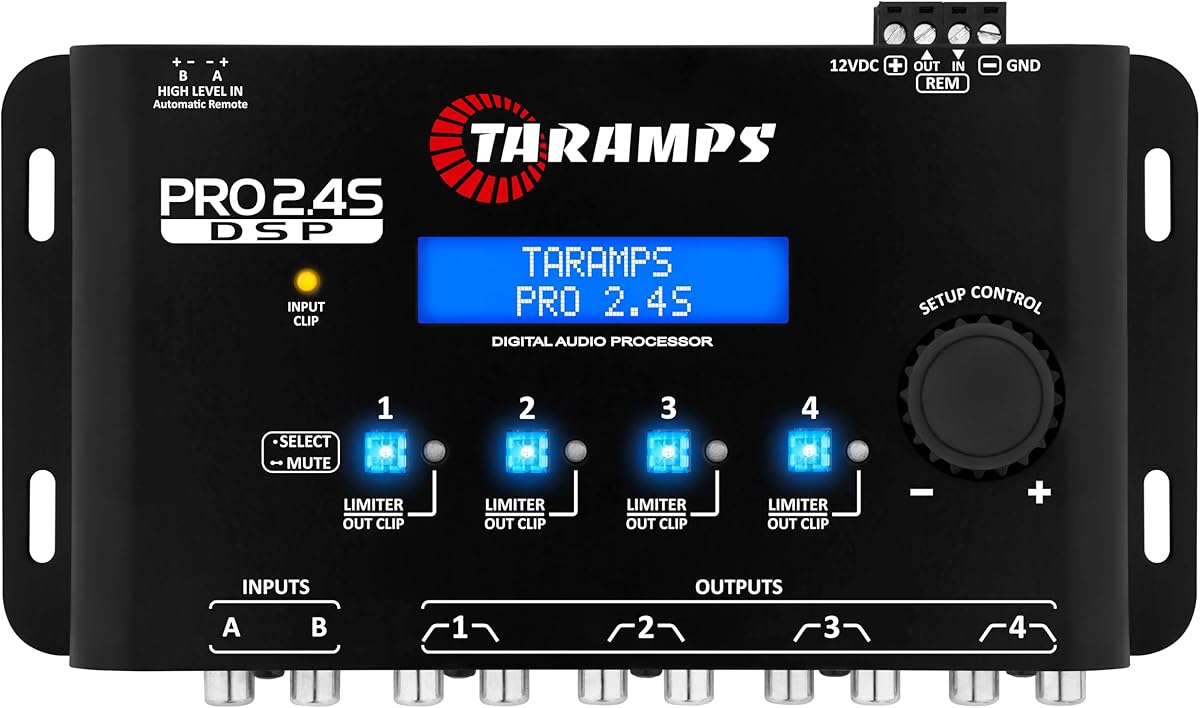
The Taramps PRO 2.4S is a four-channel digital crossover and equalizer centered on 15-band graphic EQ, parametric EQ, active crossover controls, delay alignment, and a limiter. Its 4.6 rating places it among the stronger general-purpose options in the comparison, and its integration features make it a credible choice for both OEM upgrades and custom active systems.
We may earn a commission when you buy through this link, at no additional cost to you.
RCA and high-level inputs allow the processor to work with aftermarket head units or factory stereos. Multiple crossover slopes and routing options help distribute frequencies among tweeters, door speakers, rear speakers, and subwoofers. The included Anti-Pop System targets unwanted turn-on and turn-off noise, while clip indicators and limiting functions provide useful safeguards when setting amplifier gain and managing signal levels.
The supplied information does not identify wireless control, so those who expect Bluetooth app adjustment should verify that feature before buying. The four-channel limit also means that a highly active front stage with separate tweeter, midrange, and midbass channels can consume the available outputs quickly. As with any crossover, correct speaker impedance compatibility, amplifier design, and filter settings remain essential.
The PRO 2.4S is a solid recommendation for a four-channel installation that values equalization and crossover depth over phone-based remote management. It fits daily drivers particularly well because high-level input and anti-pop behavior simplify factory integration. For a larger competition-style system, the eight-channel Taramps or PRV alternatives offer more flexible routing.
Clip indicators help identify signal overload, while the limiter provides an additional layer of control. These features are especially valuable during initial gain matching, when incorrect input or amplifier settings can otherwise produce abrupt distortion.
Graphic EQ, parametric EQ, delay, crossover filters, and routing are all housed in one compact processor. That makes the unit suitable for either a conventional upgraded speaker system or a fully active four-channel arrangement.
We may earn a commission when you buy through this link, at no additional cost to you.
The Banda Audiopart X8AiR is the most specification-dense model in this guide, combining 32-bit/96kHz processing, four inputs, eight outputs, 79 EQ bands per channel, Bluetooth, app control, and an advanced crossover. Its 4.6 rating makes it a credible premium selection for installers building a sophisticated multi-amplifier system.
We may earn a commission when you buy through this link, at no additional cost to you.
The processor supports per-channel EQ curves, adjustable crossover points, time alignment, phase control, channel gain, and peak limiting. Its eight outputs can serve component speakers, rear channels, and subwoofers across multiple amplifiers. The specified processing resolution and fine EQ granularity make it attractive for users who want detailed control over imaging, frequency distribution, and speaker integration rather than only basic tone adjustment.
That precision also creates responsibility. A 79-band interface and numerous controls can overwhelm a beginner, and a technically sophisticated DSP cannot correct fundamentally poor speaker placement, inadequate wiring, or mismatched amplifier channels. The system must be designed coherently, with crossover points, delay, gain, and power allocation treated as parts of one installation plan. The supplied information also does not mention high-level input, so OEM compatibility should be confirmed before purchase.
The X8AiR is best for advanced enthusiasts and professional installers handling component systems or complex multi-amplifier layouts. Bluetooth app control makes repeated adjustments convenient, while the processing depth provides room to refine a properly designed installation. Buyers with a simple factory-speaker setup may find more than they need, but for a high-end build, this processor offers one of the most capable feature sets in the comparison.
Seventy-nine bands per channel allow very narrow corrective work in addition to broader tonal shaping. Combined with independent gain, crossover, alignment, and phase controls, this supports highly differentiated speaker roles within one vehicle.
Four inputs and eight outputs provide a practical framework for powered component fronts, separate rear channels, and dedicated subwoofer amplification. This is where the processor's channel count can translate directly into a cleaner, more purposeful system design.
We may earn a commission when you buy through this link, at no additional cost to you.
The Taramps PRO 2.8S Black brings eight-channel processing to the Taramps PRO range, making it a logical option for multi-amplifier installations and active speaker configurations. Its 4.4 rating remains solid, and the combination of dynamic limiters, detailed equalization, high-precision crossover filters, alignment tools, and flexible inputs gives it broad appeal.
We may earn a commission when you buy through this link, at no additional cost to you.
The processor includes a 15-band graphic EQ, parametric adjustment, and 12 presets for faster setup. Crossover filters can be tuned from 10Hz to 22kHz on each output, supporting active three-way designs, conventional front and rear groups, and dedicated subwoofer channels. Precise delay and phase controls help align speakers for more coherent imaging, while adjustable RMS and peak limiters offer two different approaches to protecting high-performance systems.
RCA and high-level inputs with auto turn-on make the unit relevant to factory and aftermarket installations. However, the supplied data does not identify Bluetooth or app control, so remote phone-based tuning should not be assumed. The broad tuning range also requires accurate measurement and careful gain staging. Excessive delay, narrow EQ corrections, or inappropriate limiting can reduce realism rather than improve it.
This model is well matched to an eight-channel active build where separate tweeter, midrange, midbass, rear, and subwoofer amplification are desired. It also works for a less complex system if only the necessary channels are enabled. Choose it when flexible high-level integration and per-output protection are priorities, but confirm the exact control method if you prefer wireless adjustment.
Separate RMS and peak limiters allow the installer to match processing behavior to the amplifier and speaker combination. This is more nuanced than relying on a single limiter setting and can be valuable in high-output systems.
Per-channel delay and phase controls support a more consistent soundstage when speakers are mounted at different distances from the listening position. Accurate measurements and a stable reference track are important for applying these tools effectively.
We may earn a commission when you buy through this link, at no additional cost to you.
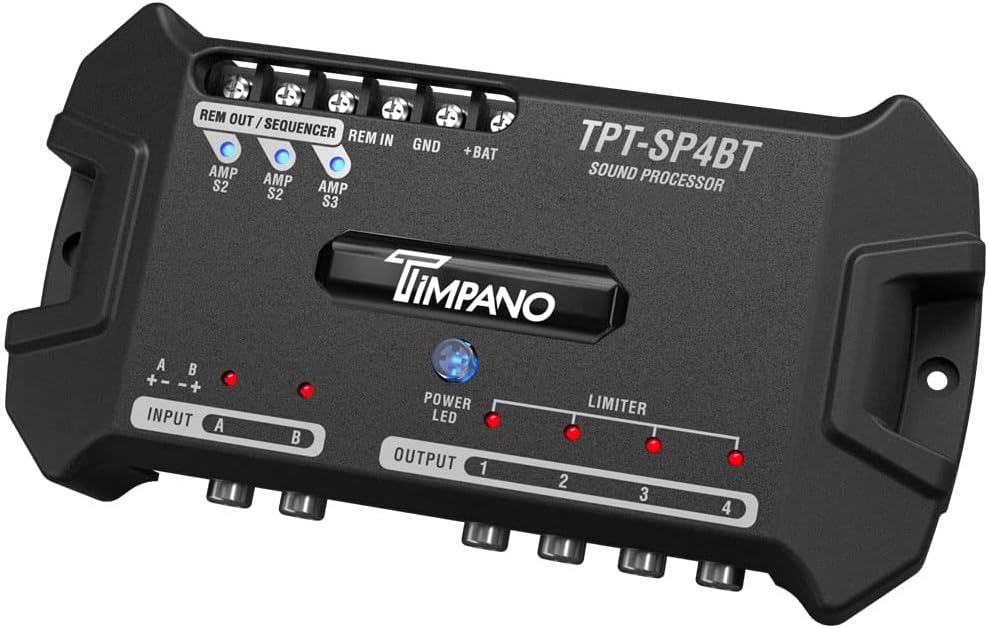
The Timpano TPT-SP4BT combines four-channel digital processing with Bluetooth control from Android or iOS devices. Its 4.5 rating and broad set of real-time adjustment tools make it a strong option for compact custom systems that benefit from diagnostic features not commonly highlighted in DSP product descriptions.
We may earn a commission when you buy through this link, at no additional cost to you.
The app can modify equalization, crossover filters, alignment, gain, phase inversion, limiter settings, and input/output routing in real time. Diagnostic tools include a battery voltmeter, frequency generator, frequency sweep, and pink noise. These functions help identify unwanted resonances, verify frequency response, and assess system noise, while the battery display provides a convenient view of the vehicle's electrical state.
The sequencer can manage the programmed startup and shutdown of up to three products through S1, S2, and S3 remote connections. That is useful for coordinating amplifiers, accessories, and the DSP itself. The unit works with aftermarket units and factory radios, though the supplied data does not list a specific high-level input, so vehicle compatibility should be verified. Four outputs are also a constraint for highly active multi-way systems.
The TPT-SP4BT is recommended for installers who value testing tools and phone-based control in a compact four-channel package. It may be especially useful during setup because the generator, sweep, and pink-noise functions can help validate filter and equalizer decisions. For more extensive architecture, choose an eight-channel model rather than sacrificing system layout for convenience.
The frequency generator, sweep, and pink-noise options turn the processor into a useful installation aid. They can help reveal rattles, filter problems, noise, and response irregularities that ordinary music listening may not make obvious.
Three programmable remote outputs can bring connected products online in a controlled order and shut them down in sequence. This can simplify wiring and create a more repeatable startup behavior across the installation.
We may earn a commission when you buy through this link, at no additional cost to you.
The Dayton Audio DSP-408 is a four-input, eight-output processor with fully adjustable 10-band parametric EQ on every output, built-in crossover functions, time alignment, and input/output mixing. Its 4.0 rating is lower than most of the lineup, but the specification set remains relevant for installers who need broad routing flexibility across car or home audio projects.
We may earn a commission when you buy through this link, at no additional cost to you.
Real-time signal processing, application-specific customization, and a graphical user interface support a methodical setup process. All eight outputs can be equalized independently, and mixing allows signals to be distributed with more control than a simple fixed input-to-output arrangement. The processor can serve both home and car installations, making it a potentially useful option for builders working across multiple project types.
Bluetooth is not built in according to the supplied information; an optional dongle is available for streaming and app control. A wired remote is also listed as optional. That distinction matters because buyers expecting a standard Bluetooth-equipped model may find the experience less immediate. The 4.0 rating and lack of detailed specifications for processing resolution or filter slopes make careful feature verification especially advisable.
The DSP-408 is most appropriate for a custom eight-channel project that needs independent parametric EQ, flexible mixing, and time alignment. It may also appeal to a home audio builder looking for the same processor architecture. For a typical car installation that assumes built-in wireless control, a dedicated Bluetooth model could be easier. Its broad channel capability, however, provides a useful foundation for carefully planned systems.
A dedicated 10-band parametric EQ on each of the eight outputs supports precise correction for different speaker roles. It provides more targeted control than a single global tone curve, which matters in systems with separate tweeters, midbass drivers, and subwoofers.
Input and output mixing expands the processor beyond a conventional one-source crossover. This can simplify integration when multiple source paths or specialized speaker feeds need to be combined, provided the installer understands the routing implications.
We may earn a commission when you buy through this link, at no additional cost to you.
The Stetsom STX2448 FLOATING PRO is a professional-oriented DSP/crossover with a 15-band graphic equalizer, RCA and high-level inputs, a remote sequencer, subharmonic bass, and peak and RMS limiting. Its 4.4 rating reflects a feature-rich approach, while the Floating mode provides a processing architecture that differs from conventional fixed-resource DSP designs.
We may earn a commission when you buy through this link, at no additional cost to you.
Floating mode allows the processor to be loaded with different audio streams and resources, expanding the ways it can be configured for different systems. The unit operates in Standard and Pro modes and uses an encoder button with rotation and click actions to move through configuration options. RCA and high signal inputs share input A and B, while input-level adjustment and separate CLIP indicators help installers establish a clean starting point.
The main challenge is the learning curve associated with a professional, multi-mode interface. A vehicle installation can still involve substantial tuning time, and the exact output count is not provided in the supplied information, so buyers should confirm that the architecture fits their intended amplifier and speaker layout. High-level input is a clear advantage for factory systems, but the processing still needs appropriate speaker measurements and careful filter design.
The STX2448 FLOATING PRO is a compelling recommendation for advanced builders who want a professional processor with flexible modes, high-level integration, sequencing, and comprehensive limiting. It may be especially useful for complex builds where a conventional four- or eight-channel processor does not offer the desired configuration freedom. Buyers should review the manual and current manual before ordering to ensure that its operating model matches their experience.
Floating mode is the defining feature of this updated processor, allowing different streams and resources to shape its behavior. Standard and Pro modes give the installer two operating approaches, with the final choice depending on system goals and familiarity with the interface.
Adjustable input levels and CLIP indicators for channels A and B help establish a consistent signal foundation before equalization and crossover work begins. Correct input calibration is essential because downstream amplifier gain cannot reliably compensate for an overloaded or inconsistent source.
We may earn a commission when you buy through this link, at no additional cost to you.
The right DSP should match the architecture of your speakers and amplifiers while offering the tuning controls needed to integrate them. Channel count, source compatibility, crossover flexibility, and control method are the most important starting points.
Start by counting the independently processed speaker channels in the intended installation, not merely the number of amplifiers. A four-channel DSP may handle front tweeters, front midbass speakers, rear speakers, and a subwoofer, while a fully active three-way front stage plus rear and subwoofer channels can require more outputs. Allow room for growth if future speakers or amplifiers may be added, but do not purchase extra channels simply to fill them. Each unused output should still be configured thoughtfully, and every active channel needs its own crossover, gain, alignment, and protection settings.
A DSP is only useful if it can receive the vehicle's audio signal cleanly. High-level input is important when retaining a factory head unit or infotainment system, while RCA inputs suit most aftermarket head units. Check whether the processor has a speaker-wire converter, auto turn-on behavior, and suitable input clipping indicators. A head unit with its own processing may also complicate the design, so decide which unit will control tone, crossover points, and level. Signal conversion requirements should be confirmed before purchasing rather than after wiring is underway.
A useful car DSP should offer high-pass and low-pass filters with a range of slopes or response styles. HPF filters remove unwanted low frequencies from small speakers, while LPF filters keep subwoofers from reproducing midrange content. Butterworth, Linkwitz-Riley, Bessel, and other named responses can produce different phase and transition characteristics. Check the available frequency range and whether settings are independently adjustable per output. Correct crossover design also depends on amplifier behavior and speaker loading, so the DSP should be treated as one part of a matched system rather than a substitute for it.
Graphic EQ provides broad tone control, while parametric EQ allows more targeted adjustments at selected frequencies and bandwidths. Models with more bands can make precise correction easier, but the number alone does not determine quality. Consider whether the graphic and parametric tools can be assigned per output and whether presets are available for a quick starting point. Excessive EQ can amplify noise, reduce headroom, or create a harsh result, so a processor with accurate level controls and protection is often more useful than one with a long list of superficial controls.
Local controls, an LCD, a remote, a phone app, and Bluetooth all serve different installation styles. A local interface can be faster for immediate adjustments, while Bluetooth is convenient when the processor is mounted out of reach. Confirm whether the listed Bluetooth function is for control only or also supports audio streaming, and whether the required app is available for the buyer's device. App control should not be assumed from a generic Bluetooth icon, and remote control may be an optional accessory. Choose the interface that matches the user's comfort and the amount of tuning expected.
Delay and phase controls can improve imaging when speakers are mounted at different distances, but they require accurate measurement. Limiter settings help control peaks, while RMS limiters may suit some high-output amplifier configurations differently from peak limiters. Look for per-channel delay, phase inversion, gain controls, and clip indicators. These features help protect equipment and improve system consistency, but they are not substitutes for appropriate amplifier settings, adequate power, correct wiring, and responsible listening. A processor can reveal poor system design; it cannot always repair it.
A DSP may also coordinate the startup of amplifiers, signal processors, and other accessories. Remote sequencer outputs can reduce the need for separate relay modules and create a predictable order of operations. Consider how many products need control, whether the processor offers enough remote outputs, and whether a hardwired remote is included or optional. Also account for enclosure space, mounting stability, heat management, and cable routing. In a vehicle, a processor that is logically powerful but difficult to mount, service, or cool may be less practical than a simpler model.
Processor resolution and sampling rate can indicate the sophistication of the internal signal path, although they should not be treated as the only measure of audible quality. The supplied models range from products with stated 24-bit/48kHz processing to one specifying 32-bit/96kHz. Compare these figures, but also consider filter implementation, control precision, supported outputs, and whether required features are present. A higher resolution processor with fewer useful routing options may be less appropriate than a simpler model that directly matches the vehicle's design.
Begin with safe, methodical signal flow. Identify the source, processor outputs, amplifiers, and speakers before making permanent connections. Check wiring polarity, ensure adequate power and ground, and use the manufacturer's recommendations for input and output connections. If the DSP has a high-level input, allow enough time for the source to stabilize after startup and use auto turn-on or an appropriate remote connection. Confirm the processor reaches operating status before adjusting EQ, crossover, and gain settings.
Tune the system in stages rather than changing many controls at once. Begin with input level, set output gain, establish the intended high-pass or low-pass filters, and then work on time alignment and phase. Use a repeatable reference track, measurements where appropriate, and the processor's test signals to identify noise or response problems. Save a baseline configuration before making major changes. This makes it easier to reverse a setting that does not improve the result and to maintain a known-good setup across different listening positions.
For long-term reliability, mount the processor securely away from moisture, direct heat, and moving components. Keep ventilation paths clear, avoid placing heavy objects on the enclosure, and check connectors periodically for looseness or corrosion. Protect wiring from sharp edges and moving pedals. Update only through the manufacturer's supported software process, keep a separate copy of important presets, and use the processor's password or encryption features when sharing configurations. Clean the enclosure with a dry or lightly damp cloth rather than spraying liquid directly into it.
An amplifier supplies power, while a DSP handles system correction and signal distribution. A DSP can provide crossovers, EQ, delay, phase adjustment, routing, and limiting even when the amplifiers are excellent. It is particularly useful in active or multi-amplifier installations, although a simple factory system with conventional speakers may not need every feature offered by a professional processor.
RCA inputs are designed for low-level audio signals from aftermarket head units or dedicated audio sources. High-level inputs are intended to accept speaker-level signals from a factory radio or amplifier, often through a built-in speaker-wire converter. The correct choice depends on the source unit and its available connections, so confirm compatibility before installation.
The required number depends on how many speaker groups need independent processing. A typical upgraded four-speaker system may use a four-channel DSP, while a fully active front stage with rear speakers and a subwoofer can require six or eight channels. Count independently controlled outputs rather than speakers alone, because a multi-way component set may need separate tweeter and midbass channels.
No. Bluetooth control usually means a phone or tablet can connect to the DSP to change settings, while Bluetooth streaming means audio is sent wirelessly to the processor or vehicle system. The supplied product information primarily describes Bluetooth configuration and app control for the listed models, so buyers who want streaming should verify that function separately.
A DSP can improve several problems, including poor frequency distribution, timing differences, phase issues, and unsuitable EQ, but it cannot overcome every installation fault. Incorrect polarity, damaged wiring, inadequate power, speaker incompatibility, and severe cabin noise require physical corrections. The best results come from combining sound treatment, clean signal flow, accurate tuning, and a properly designed DSP.
Crossover filters divide the frequency spectrum so each speaker receives the range it can reproduce efficiently. High-pass filters protect smaller speakers from bass, while low-pass filters keep a subwoofer focused on low frequencies. Using the wrong filter can cause poor tonal balance, reduced output, phase problems, or damage to speakers and amplifiers.
Tune under the conditions in which the system will usually be listened to, because the car's cabin strongly affects reflections and perceived response. If the design changes significantly between open-window and closed-window driving, check both. Keep measurements and reference tracks consistent so every adjustment is based on a meaningful comparison.
The supplied models include controls ranging from local menus to detailed app-based tuning, so installation difficulty varies. A basic four-channel setup may be approachable for an experienced DIY installer, while complex high-level integration, eight-channel active systems, and time alignment benefit from careful planning and measurement. Incorrect power, grounding, or signal wiring can cause reduced performance or equipment damage.
The PRV AUDIO DSP 2.4X stands out for value, its 4.7 rating, independent four-channel routing, useful presets, and local adjustment. The Taramps PRO 2.4 BT is the strongest all-around recommendation for buyers who prioritize wireless app control, high-level OEM integration, and detailed crossover and delay tools. The Banda Audiopart X8AiR represents the premium choice with 32-bit/96kHz processing, eight outputs, and extensive per-channel equalization.
Choose the processor by mapping its outputs and inputs to the actual vehicle, not by feature count alone. A four-channel model may be perfect for front components, rear speakers, and a subwoofer, while an eight-channel model offers more freedom for active front systems and multiple amplifiers. Bluetooth or local control, high-level connectivity, filter options, and protection should be weighed according to the installation and the installer's preferred workflow.
Finally, check current prices, availability, app compatibility, and the latest product documentation before ordering, since all three can change over time. The included links provide access to the listed products, and the rankings summarize the supplied specifications rather than the results of personal testing. With the correct model and a methodical setup process, a DSP can provide the control needed for a more balanced, coherent, and repeatable car audio system.